Wallenberg Neuroscience Center, Department of Experimental Medical Sciences, Brain Disease Biomarker Unit, Lund University, Lund, Sweden.
Institute of Neuroscience and Physiology, Department of Psychiatry and Neurochemistry, The Sahlgrenska Academy at University of Gothenburg, Mölndal, Sweden.
Sci Rep. 2017 Oct 26;7(1):14114. doi: 10.1038/s41598-017-14179-1.
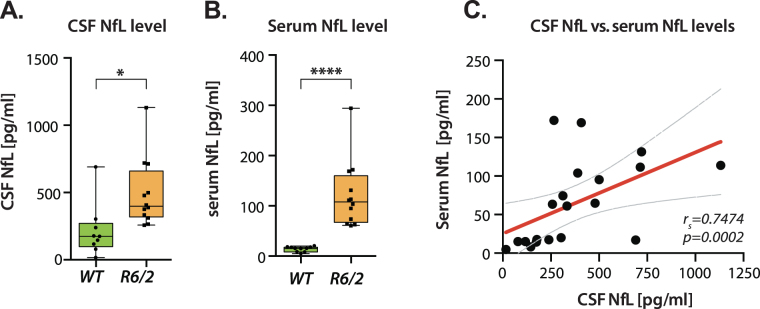
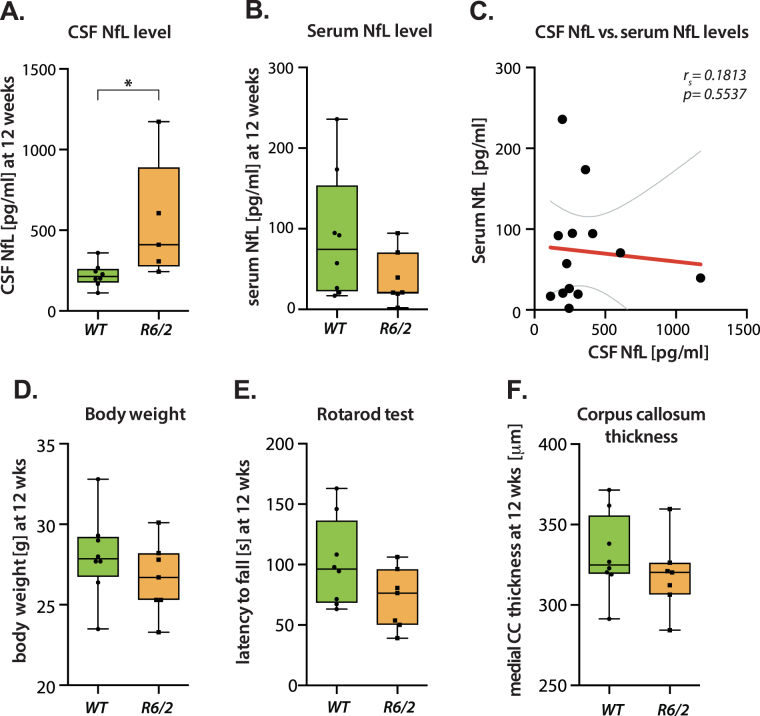
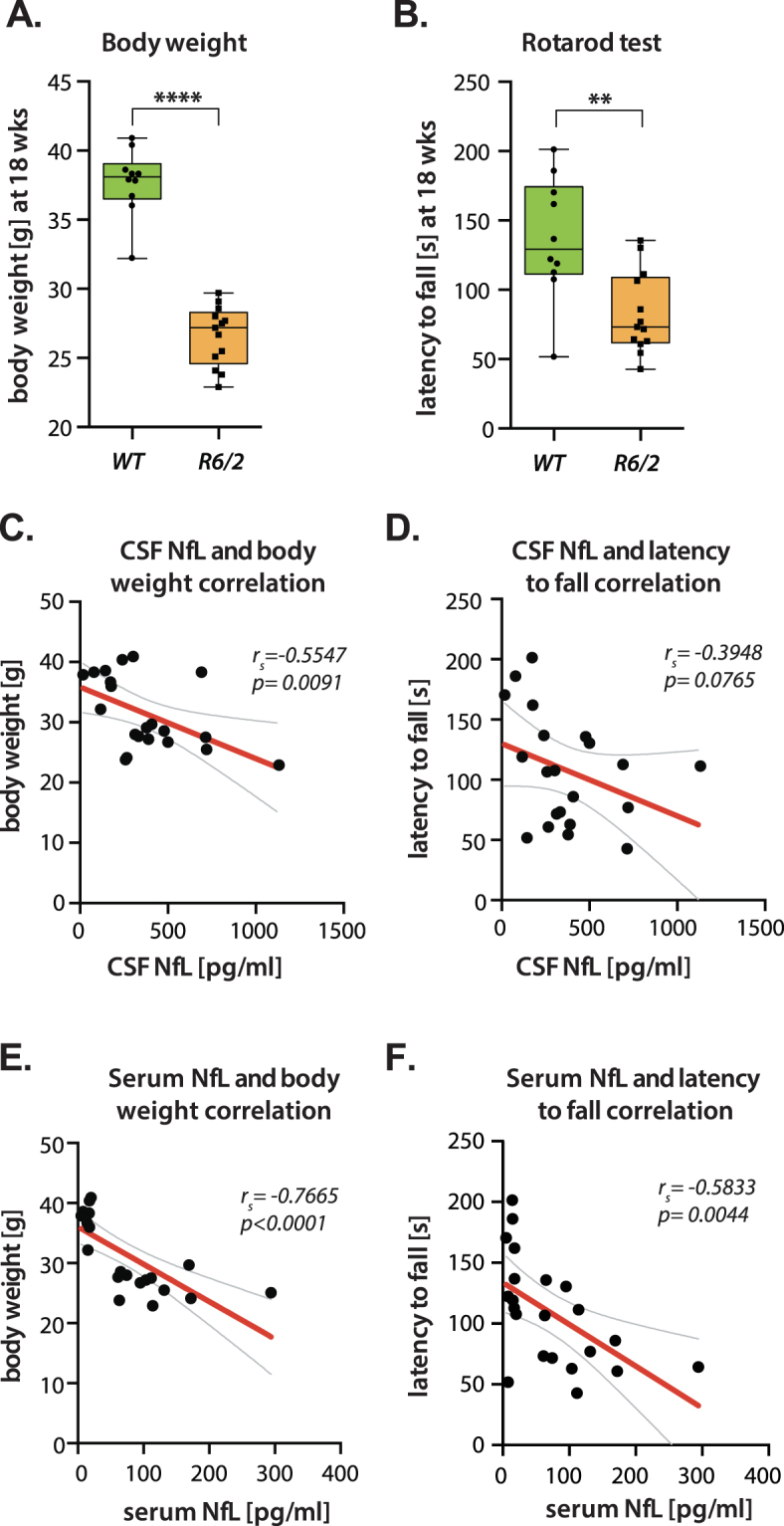
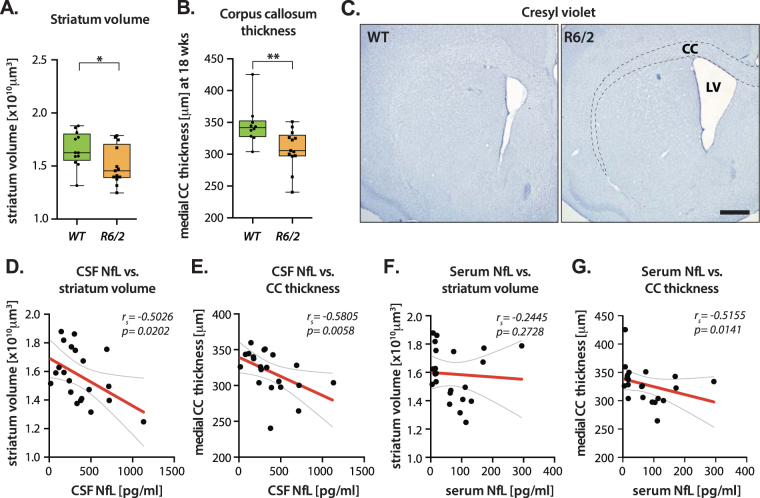
There is an unmet need to reliably and non-invasively monitor disease progression in preclinical Huntington's disease (HD) models. As a marker of axonal damage, neurofilament light chain (NfL) has been suggested a marker for neurodegeneration. NfL concentrations in blood and CSF were recently shown to have prognostic value for clinical HD progression and brain atrophy. We therefore hypothesized that CSF and blood NfL concentrations could be useful preclinical HD markers, reflecting underlying pathology. To test our hypothesis we utilized the R6/2 mouse model of HD and measured NfL concentrations in CSF and serum using the ultrasensitive Single molecule array (Simoa) platform. In addition, we assessed HD mouse disease characteristics. We found robust increases of NfL in CSF and serum in R6/2 mice compared to wild-type littermates. CSF and serum concentrations of NfL were significantly correlated, suggesting similar marker potential of serum NfL. CSF and serum concentrations of NfL correlated with disease severity, as assessed by striatal volume and body weight loss. We here provide evidence that CSF and blood NfL concentrations can be used as accessible and reliable pre-clinical HD markers. This will be of potential use for monitoring HD mouse model disease progression and evaluating preclinical disease-modifying treatment response.
目前需要可靠且非侵入性地监测临床前亨廷顿病 (HD) 模型中的疾病进展,但尚未实现这一目标。神经丝轻链 (NfL) 作为轴突损伤的标志物,已被认为是神经退行性变的标志物。最近的研究表明,血液和脑脊液中的 NfL 浓度对临床 HD 进展和脑萎缩具有预后价值。因此,我们假设脑脊液和血液 NfL 浓度可以作为有用的临床前 HD 标志物,反映潜在的病理变化。为了验证我们的假设,我们利用 R6/2 亨廷顿病小鼠模型,使用超灵敏单分子阵列 (Simoa) 平台测量了脑脊液和血清中的 NfL 浓度。此外,我们评估了 HD 小鼠的疾病特征。与野生型同窝仔相比,R6/2 小鼠的脑脊液和血清 NfL 浓度均显著升高。脑脊液和血清 NfL 浓度呈显著相关性,提示血清 NfL 具有相似的标志物潜力。脑脊液和血清 NfL 浓度与疾病严重程度相关,如纹状体体积和体重减轻。我们的研究结果表明,脑脊液和血液 NfL 浓度可作为可及且可靠的临床前 HD 标志物。这对于监测 HD 小鼠模型的疾病进展和评估临床前疾病修饰治疗反应可能具有潜在的应用价值。