You Peijun, Yuan Ran, Chen Chuanyu
Department of Anesthesiology, Shandong Jining No 1 People's Hospital, Shandong, People's Republic of China.
Department of Anesthesiology, Affiliated Hospital of Jining Medical College, Jining, Shandong, People's Republic of China.
Drug Des Devel Ther. 2017 Sep 18;11:2743-2752. doi: 10.2147/DDDT.S141031. eCollection 2017.
Topical anesthesia analgesic therapy has diverse applicability in solving the barrier properties of skin and unfavorable physicochemical properties of drugs. Lidocaine (LID) combined with prilocaine (PRI) has been used as a topical preparation for dermal anesthesia for treatment of conditions such as paresthesia.
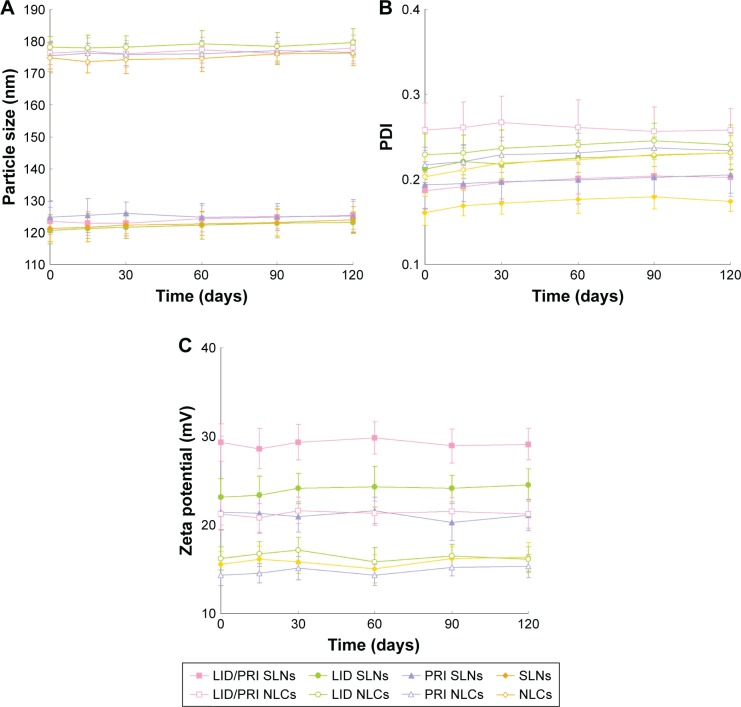
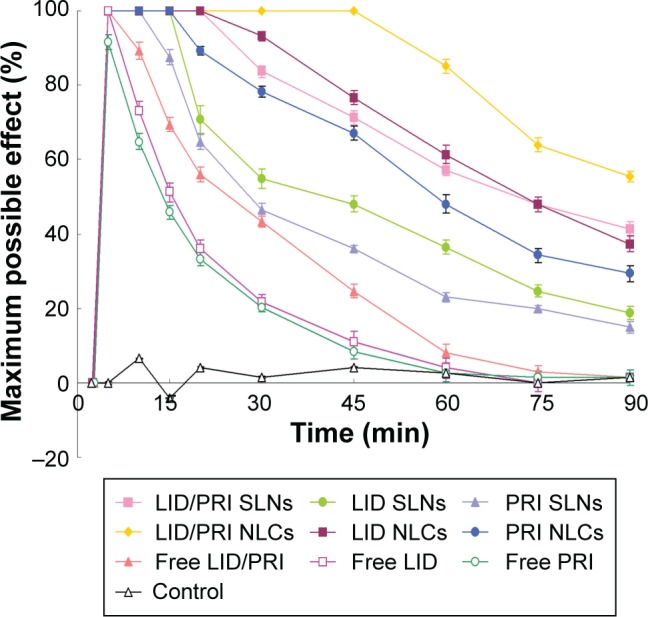
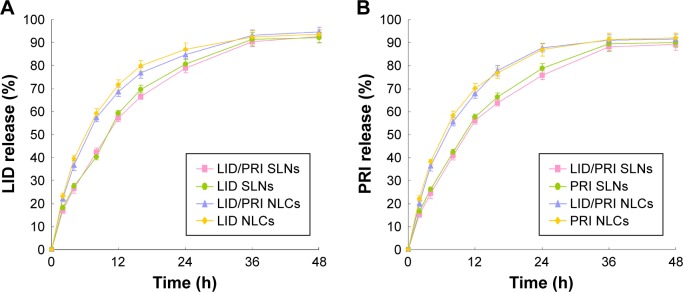
In this study, for combination anesthesia and overcoming the drawbacks of LID and PRI, respectively, LID- and PRI-loaded solid lipid nanoparticles (SLNs) and nanostructured lipid carriers (NLCs) were prepared and characterized by determination of their particle size, drug loading capacity, stability, in vitro drug release behavior and in vitro cellular viability. Ex vivo skin permeation and in vivo anesthesia analgesic efficiency of these two systems were also evaluated and compared.
Results revealed that combination delivery of the dual drugs exhibited more remarkable efficiency than signal drug-loaded systems. SLN systems have better ex vivo skin permeation ability than NLCs. NLC systems revealed a stronger in vivo anesthesia analgesic effect than SLN systems.
It can be concluded that SLNs and NLCs have different advantages, and that both carriers are promising dual drug delivery systems for topical anesthetic analgesic therapy.
局部麻醉镇痛疗法在解决皮肤屏障特性和药物不良理化性质方面具有多种适用性。利多卡因(LID)与丙胺卡因(PRI)联合使用已被用作皮肤麻醉的局部制剂,用于治疗感觉异常等病症。
在本研究中,为了分别实现联合麻醉并克服利多卡因和丙胺卡因的缺点,制备了负载利多卡因和丙胺卡因的固体脂质纳米粒(SLN)和纳米结构脂质载体(NLC),并通过测定其粒径、载药量、稳定性、体外药物释放行为和体外细胞活力对其进行表征。还评估并比较了这两种体系的离体皮肤渗透和体内麻醉镇痛效果。
结果表明,两种药物的联合递送比单药负载体系表现出更显著的效果。SLN体系比NLC体系具有更好的离体皮肤渗透能力。NLC体系比SLN体系表现出更强的体内麻醉镇痛作用。
可以得出结论,SLN和NLC具有不同的优势,并且这两种载体都是用于局部麻醉镇痛治疗的有前景的双药递送体系。