Dörsam Stefan, Fesseler Jana, Gorte Olga, Hahn Thomas, Zibek Susanne, Syldatk Christoph, Ochsenreither Katrin
Technical Biology, Institute of Process Engineering in Life Sciences, Karlsruhe Institute of Technology (KIT), Engler-Bunte-Ring 3, Karlsruhe, 76131 Germany.
Industrial Biotechnology, Department of Molecular Biotechnology, Fraunhofer Institute for Interfacial Engineering and Biotechnology (IGB), Stuttgart, Germany.
Biotechnol Biofuels. 2017 Oct 23;10:242. doi: 10.1186/s13068-017-0930-x. eCollection 2017.
The organic acid producer and are able to convert several alternative carbon sources to malic and fumaric acid. Thus, carbohydrate hydrolysates from lignocellulose separation are likely suitable as substrate for organic acid production with these fungi.
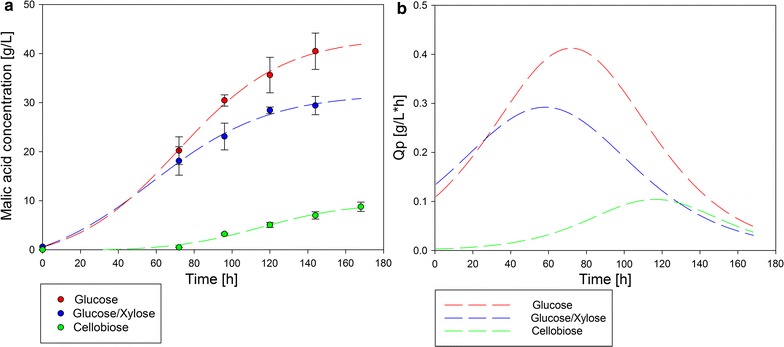
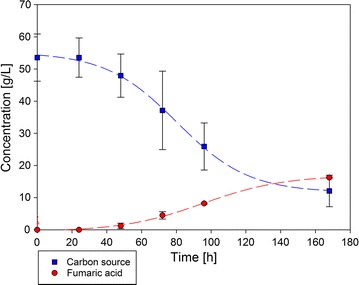
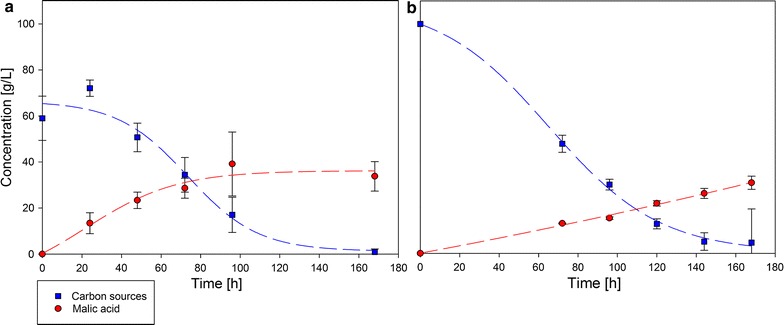
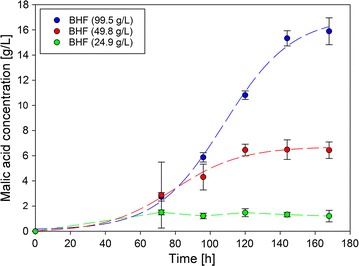
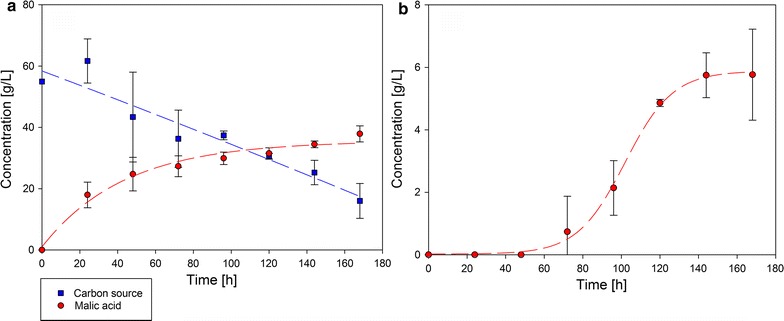
Before lignocellulose hydrolysate fractions were tested as substrates, experiments with several mono- and disaccharides, possibly present in pretreated biomass, were conducted for their suitability for malic acid production with This includes levoglucosan, glucose, galactose, mannose, arabinose, xylose, ribose, and cellobiose as well as cheap and easy available sugars, e.g., fructose and maltose. is able to convert every sugar investigated to malate, albeit with different yields. Based on the promising results from the pure sugar conversion experiments, fractions of the organosolv process from beechwood () and were further analyzed as carbon source for cultivation and fermentation with for malic acid and for fumaric acid production. The highest malic acid concentration of 37.9 ± 2.6 g/L could be reached using beechwood cellulose fraction as carbon source in bioreactor fermentation with and 16.2 ± 0.2 g/L fumaric acid with .
We showed in this study that the range of convertible sugars for is even higher than known before. We approved the suitability of fiber/cellulose hydrolysate obtained from the organosolv process as carbon source for in shake flasks as well as in a small-scale bioreactor. The more challenging hemicellulose fraction of was also positively evaluated for malic acid production with .
有机酸生产者能够将多种替代碳源转化为苹果酸和富马酸。因此,木质纤维素分离得到的碳水化合物水解产物可能适合作为这些真菌生产有机酸的底物。
在测试木质纤维素水解产物馏分作为底物之前,对预处理生物质中可能存在的几种单糖和双糖进行了实验,以确定它们是否适合用于生产苹果酸。这包括左旋葡聚糖、葡萄糖、半乳糖、甘露糖、阿拉伯糖、木糖、核糖和纤维二糖,以及廉价易得的糖,如果糖和麦芽糖。能够将所研究的每种糖转化为苹果酸盐,尽管产率不同。基于纯糖转化实验的良好结果,进一步分析了来自山毛榉木()和的有机溶剂法馏分作为培养和发酵的碳源,用于生产苹果酸和富马酸。在生物反应器发酵中,使用山毛榉木纤维素馏分作为碳源,最高苹果酸浓度可达37.9±2.6 g/L,使用时富马酸浓度为16.2±0.2 g/L。
我们在本研究中表明,可转化糖的范围比以前已知的更高。我们证实了从有机溶剂法获得的纤维/纤维素水解产物作为碳源在摇瓶和小型生物反应器中适合用于。对于生产苹果酸,山毛榉木更具挑战性的半纤维素馏分也得到了积极评价。