Kessler Ronald C, Aguilar-Gaxiola Sergio, Alonso Jordi, Benjet Corina, Bromet Evelyn J, Cardoso Graça, Degenhardt Louisa, de Girolamo Giovanni, Dinolova Rumyana V, Ferry Finola, Florescu Silvia, Gureje Oye, Haro Josep Maria, Huang Yueqin, Karam Elie G, Kawakami Norito, Lee Sing, Lepine Jean-Pierre, Levinson Daphna, Navarro-Mateu Fernando, Pennell Beth-Ellen, Piazza Marina, Posada-Villa José, Scott Kate M, Stein Dan J, Ten Have Margreet, Torres Yolanda, Viana Maria Carmen, Petukhova Maria V, Sampson Nancy A, Zaslavsky Alan M, Koenen Karestan C
Department of Health Care Policy, Harvard Medical School, Boston, MA, USA.
Center for Reducing Health Disparities, UC Davis Health System, Sacramento, CA, USA.
Eur J Psychotraumatol. 2017 Oct 27;8(sup5):1353383. doi: 10.1080/20008198.2017.1353383. eCollection 2017.
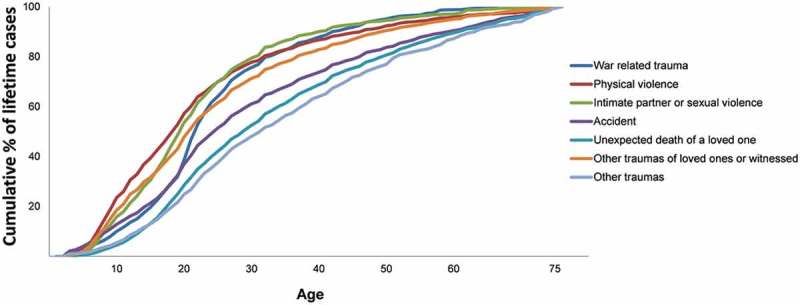
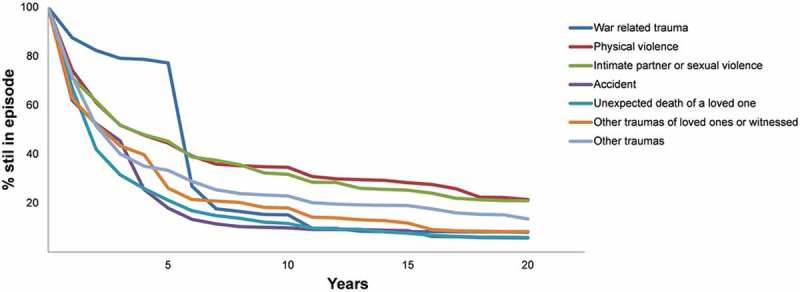
: Although post-traumatic stress disorder (PTSD) onset-persistence is thought to vary significantly by trauma type, most epidemiological surveys are incapable of assessing this because they evaluate lifetime PTSD only for traumas nominated by respondents as their 'worst.' : To review research on associations of trauma type with PTSD in the WHO World Mental Health (WMH) surveys, a series of epidemiological surveys that obtained representative data on trauma-specific PTSD. : WMH Surveys in 24 countries (n = 68,894) assessed 29 lifetime traumas and evaluated PTSD twice for each respondent: once for the 'worst' lifetime trauma and separately for a randomly-selected trauma with weighting to adjust for individual differences in trauma exposures. PTSD onset-persistence was evaluated with the WHO Composite International Diagnostic Interview. : In total, 70.4% of respondents experienced lifetime traumas, with exposure averaging 3.2 traumas per capita. Substantial between-trauma differences were found in PTSD onset but less in persistence. Traumas involving interpersonal violence had highest risk. Burden of PTSD, determined by multiplying trauma prevalence by trauma-specific PTSD risk and persistence, was 77.7 person-years/100 respondents. The trauma types with highest proportions of this burden were rape (13.1%), other sexual assault (15.1%), being stalked (9.8%), and unexpected death of a loved one (11.6%). The first three of these four represent relatively uncommon traumas with high PTSD risk and the last a very common trauma with low PTSD risk. The broad category of intimate partner sexual violence accounted for nearly 42.7% of all person-years with PTSD. Prior trauma history predicted both future trauma exposure and future PTSD risk. : Trauma exposure is common throughout the world, unequally distributed, and differential across trauma types with respect to PTSD risk. Although a substantial minority of PTSD cases remits within months after onset, mean symptom duration is considerably longer than previously recognized.
虽然创伤后应激障碍(PTSD)的起病-持续情况被认为因创伤类型而异,但大多数流行病学调查无法对此进行评估,因为它们仅针对被调查者提名的“最严重”创伤评估终生PTSD。:为回顾世界卫生组织世界心理健康(WMH)调查中创伤类型与PTSD关联的研究,这是一系列获得创伤特异性PTSD代表性数据的流行病学调查。:对24个国家(n = 68,894)的WMH调查评估了29种终生创伤,并对每位被调查者进行了两次PTSD评估:一次针对“最严重”的终生创伤,另一次针对随机选择的创伤,并进行加权以调整个体创伤暴露差异。使用世界卫生组织综合国际诊断访谈评估PTSD的起病-持续情况。:总体而言,70.4%的被调查者经历过终生创伤,人均暴露创伤数平均为3.2次。在PTSD起病方面发现创伤之间存在显著差异,但在持续情况方面差异较小。涉及人际暴力的创伤风险最高。通过将创伤患病率乘以创伤特异性PTSD风险和持续情况来确定的PTSD负担为77.7人年/100名被调查者。该负担比例最高的创伤类型为强奸(13.1%)、其他性侵犯(15.1%)、被跟踪(9.8%)和亲人意外死亡(11.6%)。这四种中的前三种代表相对罕见但PTSD风险高的创伤,最后一种代表非常常见但PTSD风险低的创伤。亲密伴侣性暴力这一广泛类别占所有PTSD人年数的近42.7%。既往创伤史可预测未来的创伤暴露和未来的PTSD风险。:创伤暴露在全世界都很常见,分布不均,且在PTSD风险方面因创伤类型而异。虽然相当一部分PTSD病例在起病后数月内缓解,但平均症状持续时间比先前认识的要长得多。