La Pierre Kimberly J, Simms Ellen L, Tariq Mohsin, Zafar Marriam, Porter Stephanie S
Department of Integrative Biology University of California Berkeley CA USA.
Present address: Smithsonian Environmental Research Center Edgewater MD USA.
Ecol Evol. 2017 Sep 17;7(20):8599-8611. doi: 10.1002/ece3.3310. eCollection 2017 Oct.
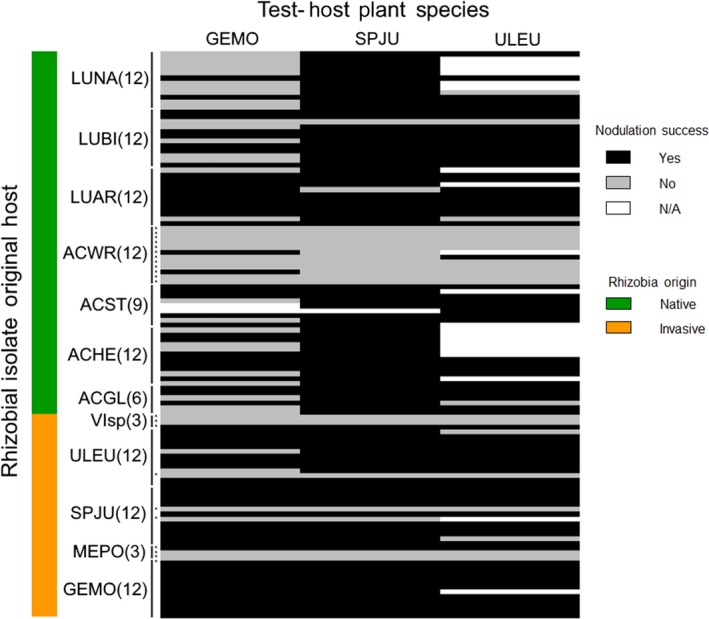
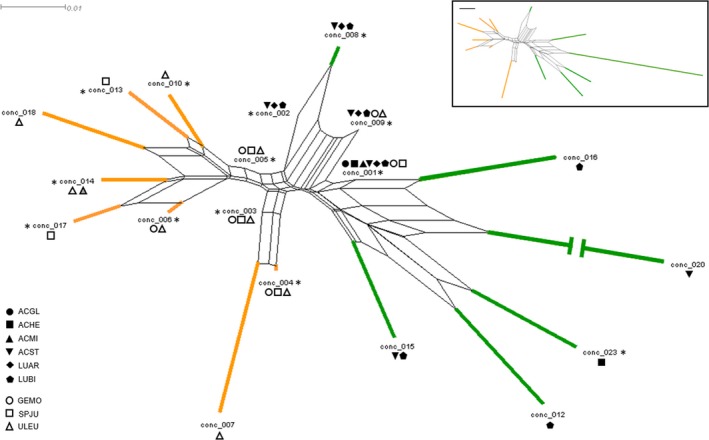
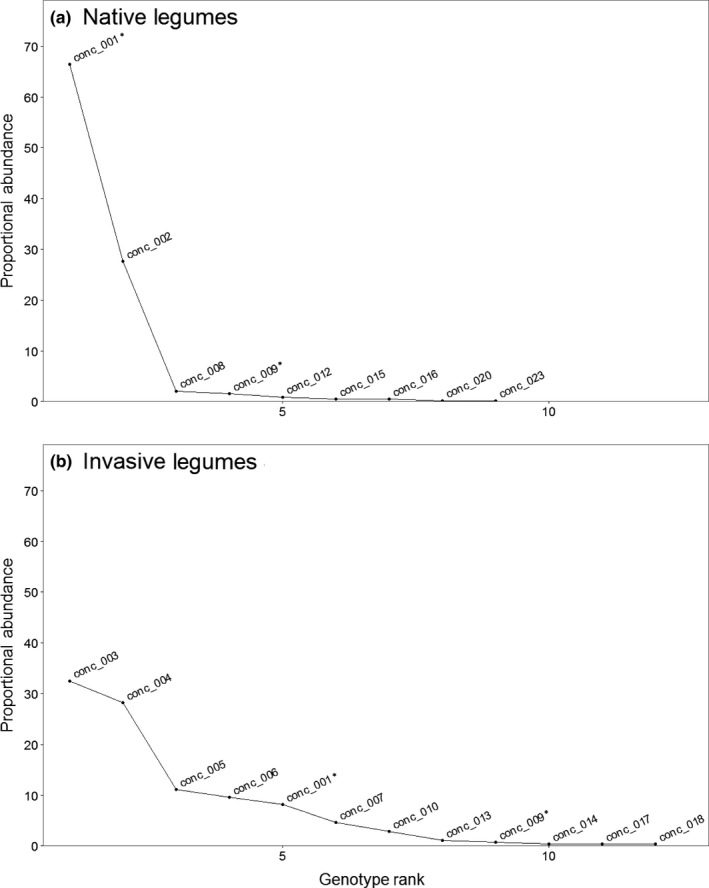
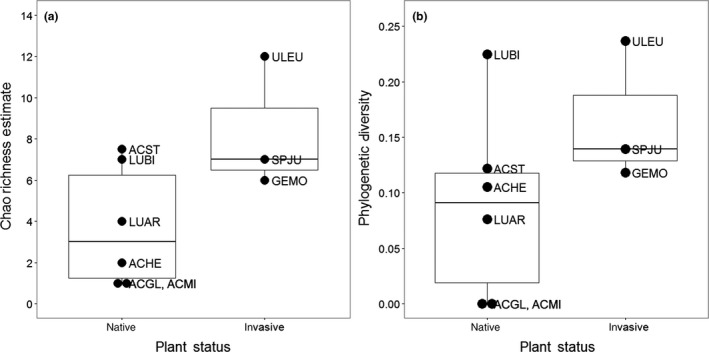
Mutualistic interactions can strongly influence species invasions, as the inability to form successful mutualisms in an exotic range could hamper a host's invasion success. This barrier to invasion may be overcome if an invader either forms novel mutualistic associations or finds and associates with familiar mutualists in the exotic range. Here, we ask (1) does the community of rhizobial mutualists associated with invasive legumes in their exotic range overlap with that of local native legumes and (2) can any differences be explained by fundamental incompatibilities with particular rhizobial genotypes? To address these questions, we first characterized the rhizobial communities naturally associating with three invasive and six native legumes growing in the San Francisco Bay Area. We then conducted a greenhouse experiment to test whether the invasive legume could nodulate with any of a broad array of rhizobia found in their exotic range. There was little overlap between the communities associated with wild-grown invasive and native legumes, yet the invasive legumes could nodulate with a broad range of rhizobial strains under greenhouse conditions. These observations suggest that under field conditions in their exotic range, these invasive legumes are not currently associating with the mutualists of local native legumes, despite their potential to form such associations. However, the promiscuity with which these invading legumes can form mutualistic associations could be an important factor early in the invasion process if mutualist scarcity limits range expansion. Overall, the observation that invasive legumes have a community of rhizobia distinct from that of native legumes, despite their ability to associate with many rhizobial strains, challenges existing assumptions about how invading species obtain their mutualists. These results can therefore inform current and future efforts to prevent and remove invasive species.
互利共生相互作用能够强烈影响物种入侵,因为在异域无法形成成功的互利共生关系可能会阻碍宿主的入侵成功。如果入侵者要么形成新的互利共生关联,要么在异域找到并与熟悉的互利共生伙伴建立联系,那么这种入侵障碍可能会被克服。在此,我们提出两个问题:(1)与入侵豆科植物在异域共生的根瘤菌互利共生体群落是否与当地本土豆科植物的群落重叠?(2)能否用与特定根瘤菌基因型的根本不兼容性来解释任何差异?为了解决这些问题,我们首先对自然生长在旧金山湾区的三种入侵豆科植物和六种本土豆科植物所共生的根瘤菌群落进行了特征描述。然后,我们进行了一项温室实验,以测试入侵豆科植物是否能够与在其异域发现的多种根瘤菌形成根瘤。野生入侵豆科植物和本土豆科植物所共生的群落之间几乎没有重叠,但在温室条件下,入侵豆科植物能够与多种根瘤菌菌株形成根瘤。这些观察结果表明,在其异域的野外条件下,尽管这些入侵豆科植物有形成此类关联的潜力,但目前它们并未与当地本土豆科植物的互利共生伙伴建立联系。然而,如果互利共生伙伴稀缺限制了范围扩张,那么这些入侵豆科植物形成互利共生关联的宽泛性可能是入侵过程早期的一个重要因素。总体而言,入侵豆科植物拥有与本土豆科植物不同的根瘤菌群落这一观察结果,尽管它们能够与多种根瘤菌菌株建立联系,但这对关于入侵物种如何获得其互利共生伙伴的现有假设提出了挑战。因此,这些结果可为当前及未来预防和清除入侵物种的工作提供参考。