Ewa-Choy Y W, Pingguan-Murphy B, Abdul-Ghani N A, Jahendran J, Chua K H
Department of Physiology, Faculty of Medicine, Universiti Kebangsaan Malaysia, Kuala Lumpur, Malaysia.
Department of Biomedical Engineering, Faculty of Engineering, University of Malaya, Kuala Lumpur, Malaysia.
Biomater Res. 2017 Oct 17;21:19. doi: 10.1186/s40824-017-0105-7. eCollection 2017.
The three-dimensional (3D) system is one of the important factors to engineer a biocompatible and functional scaffold for the applications of cell-based therapies for cartilage repair. The 3D alginate hydrogels system has previously been shown to potentially promote chondrogenesis. The chondrocytic differentiation of co-cultured adipose-derived stem cells (ADSCs) and nasal chondrocytes (NCs) within alginate constructs are hypothesized to be influenced by concentration of alginate hydrogel. In this study, we evaluated the effects of alginate concentration on chondrogenic differentiation of ADSCs and NCs co-cultured in a biological approach.
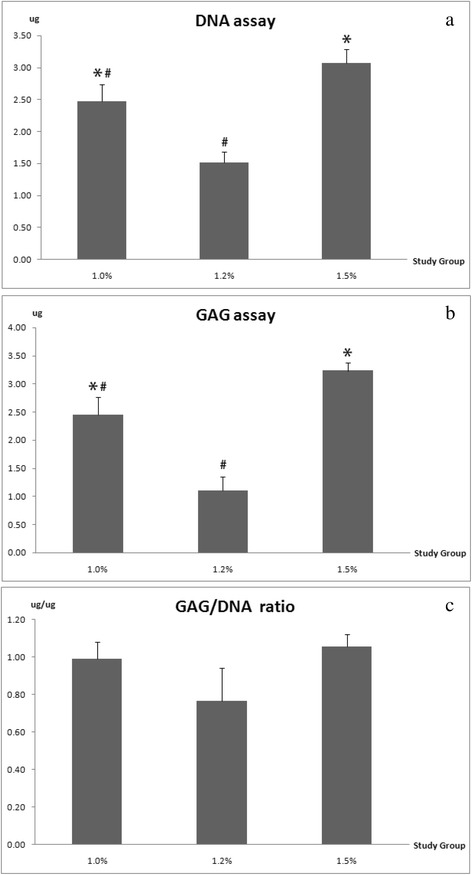
The co-cultured cells of 2:1 ADSCs-to-NCs ratio were encapsulated in alginate constructs in one of three concentrations (1.0%, 1.2% and 1.5%) and cultured under serum free conditions for 7 days. Cell viability, cell proliferation, immunohistochemical, gycosaminogylycans (GAG) synthesis, and gene expression were examined.
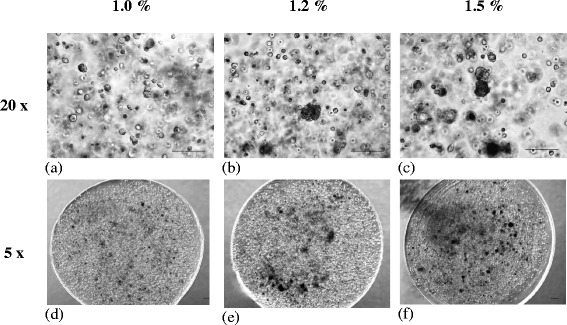
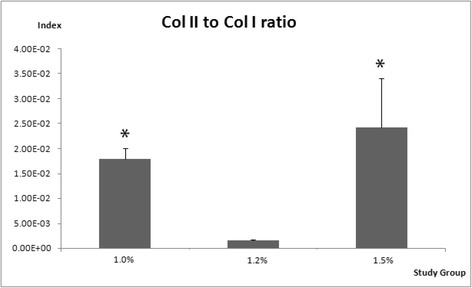
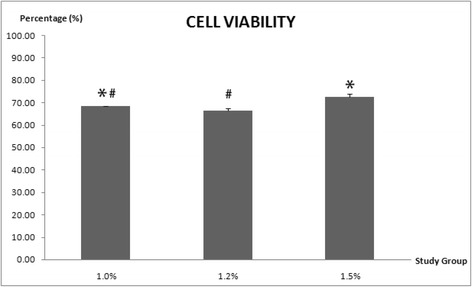
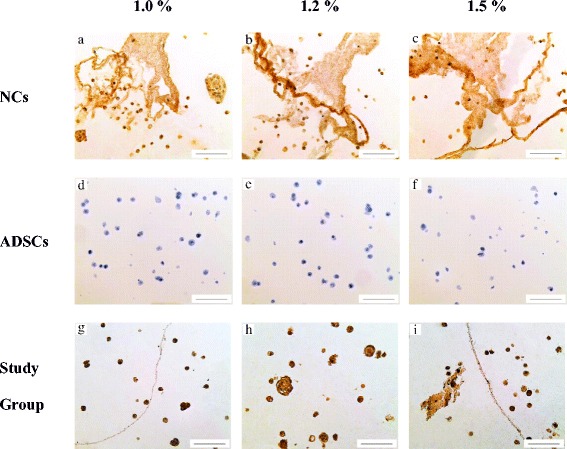
Overall, the 1.2% alginate concentration group was relatively effective in chondrocytic differentiation in comparable to other groups. The cell morphology, cell viability, and cell proliferation revealed initial chondrogenic differentiation by the formation of cell clusters as well as the high permeability for exchange of solutes. The formation of newly synthesis cartilage-specific extracellular matrix in 1.2% group was demonstrated by positive immunohistochemical staining of collagen type II. The co-cultured cells in 1.2% group highly expressed COL II, ACP and SOX-9, compared to 1.0% and 1.5% groups, denote the retention of cartilaginous-specific phenotype by suppressing the undifferentiation stem cell markers of SOX-2 and OCT-4. The study showed 1.2% group was less likely to differentiate towards osteogenesis by downregulating hyperthrophy chondrocytic gene of COL X and osseous marker genes of OSC and OSP.
This study suggests that variations in the alginate concentration of co-cultured ADSCs and NCs influenced the chondrogenesis. The remarkable biological performance on chondrogenic differentiation in regulating the concentration of alginate 3D culture provides new insights into the cell cross-talk and demonstrates the effectiveness in regenerative therapies of cartilage defects in tissue engineering.
三维(3D)系统是构建用于软骨修复的细胞疗法应用的生物相容性和功能性支架的重要因素之一。三维海藻酸盐水凝胶系统此前已显示出潜在的促进软骨形成作用。据推测,海藻酸盐构建体内共培养的脂肪来源干细胞(ADSCs)和鼻软骨细胞(NCs)的软骨细胞分化受海藻酸盐水凝胶浓度的影响。在本研究中,我们采用生物学方法评估了海藻酸盐浓度对共培养的ADSCs和NCs软骨形成分化的影响。
将按2:1比例共培养的ADSCs和NCs细胞封装在三种浓度(1.0%、1.2%和1.5%)之一的海藻酸盐构建体中,并在无血清条件下培养7天。检测细胞活力、细胞增殖、免疫组织化学、糖胺聚糖(GAG)合成及基因表达。
总体而言,与其他组相比,1.2%海藻酸盐浓度组在软骨细胞分化方面相对更有效。细胞形态、细胞活力和细胞增殖显示,通过形成细胞簇以及溶质交换的高渗透性,出现了初始软骨形成分化。1.2%组中通过II型胶原的阳性免疫组织化学染色证明了新合成的软骨特异性细胞外基质的形成。与1.0%和1.5%组相比,1.2%组中的共培养细胞高表达COL II、ACP和SOX-9,这表明通过抑制未分化干细胞标志物SOX-2和OCT-4,保留了软骨特异性表型。该研究表明,1.2%组通过下调COL X的肥大软骨细胞基因以及OSC和OSP的骨标志物基因,向成骨分化的可能性较小。
本研究表明,共培养的ADSCs和NCs的海藻酸盐浓度变化影响软骨形成。在调节海藻酸盐3D培养浓度方面,软骨形成分化具有显著的生物学性能,为细胞间相互作用提供了新见解,并证明了其在组织工程软骨缺损再生治疗中的有效性。