Kim Seoyoung, Kim Junhyung, Choi Jaehoon, Jeong Woonhyeok, Kwon Sunyoung
Department of Plastic and Reconstructive Surgery, Keimyung University Dongsan Medical Center, Keimyung University School of Medicine, Daegu, Korea.
Department of Pathology, Keimyung University Dongsan Medical Center, Keimyung University School of Medicine, Daegu, Korea.
Arch Plast Surg. 2017 Nov;44(6):482-489. doi: 10.5999/aps.2017.00801. Epub 2017 Oct 26.
Polydeoxyribonucleotide (PDRN) is known to have anti-inflammatory and angiogenic effects and to accelerate wound healing. The aim of this study was to investigate whether PDRN could improve peripheral tissue oxygenation and angiogenesis in diabetic foot ulcers.
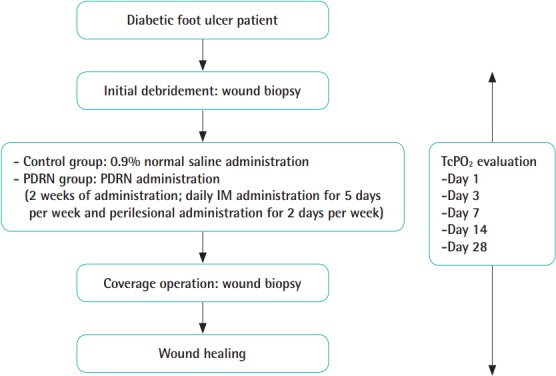
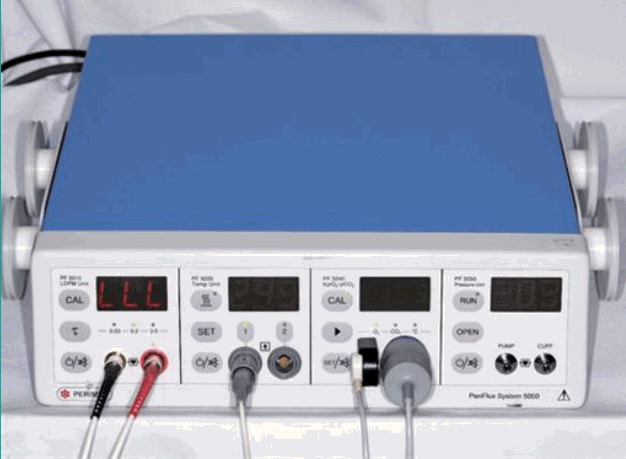
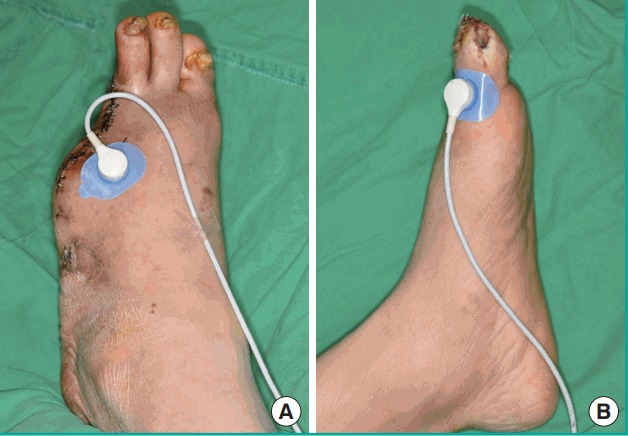
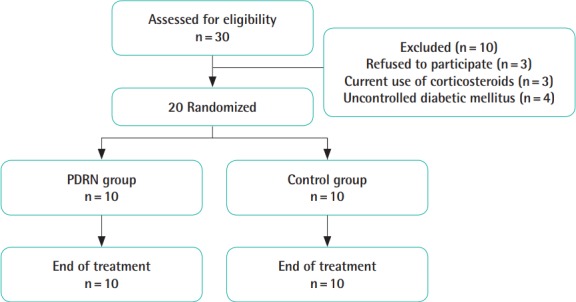
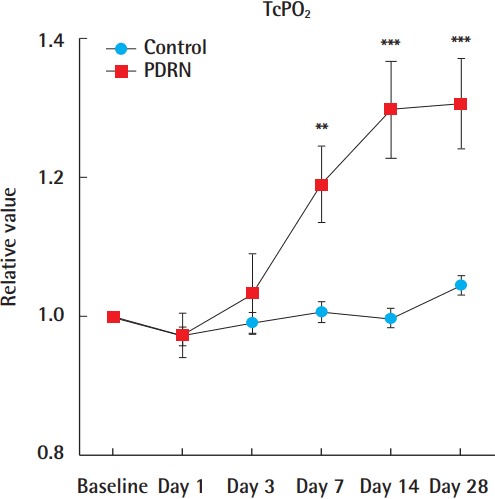
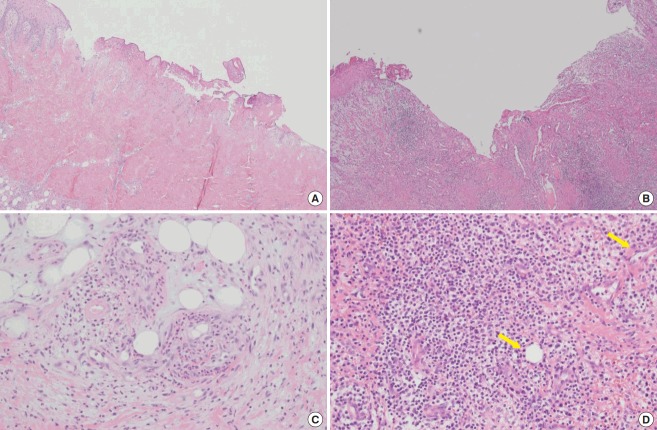
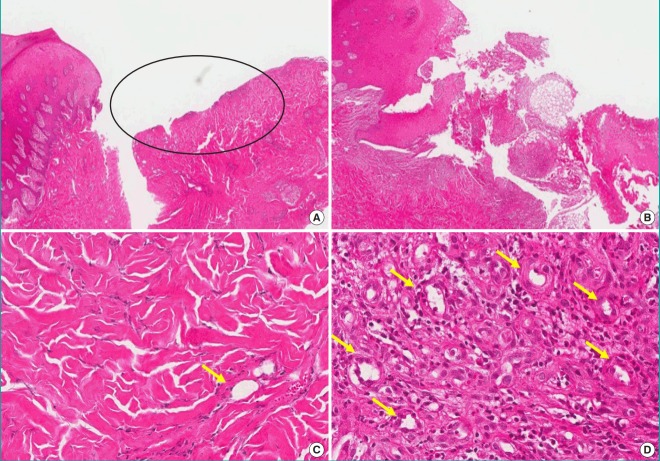
This was a prospective randomized controlled clinical trial. Twenty patients with a non-healing diabetic foot ulcer were randomly distributed into a control group (n=10) and a PDRN group (n=10). Initial surgical debridement and secondary surgical procedures such as a split-thickness skin graft, primary closure, or local flap were performed. Between the initial surgical debridement and secondary surgical procedures, 0.9% normal saline (3 mL) or PDRN was injected for 2 weeks by the intramuscular (1 ampule, 3 mL, 5.625 mg, 5 days per week) and perilesional routes (1 ampule, 3 mL, 5.625 mg, 2 days per week). Transcutaneous oxygen tension (TcPO) was evaluated using the Periflux System 5000 with TcPO/CO unit 5040 before the injections and on days 1, 3, 7, 14, and 28 after the start of the injections. A pathologic review (hematoxylin and eosin stain) of the debrided specimens was conducted by a pathologist, and vessel density (average number of vessels per visual field) was calculated.
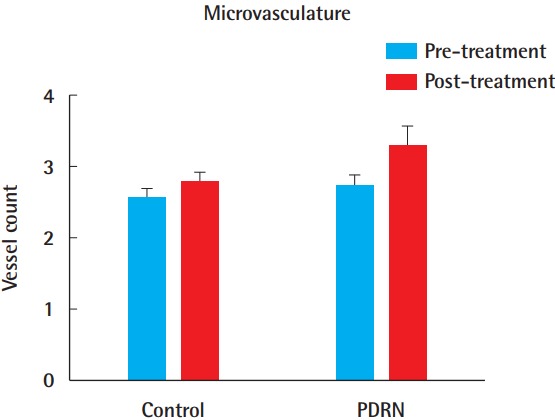
Compared with the control group, the PDRN-treated group showed improvements in peripheral tissue oxygenation on day 7 (P<0.01), day 14 (P<0.001), and day 28 (P<0.001). The pathologic review of the specimens from the PDRN group showed increased angiogenesis and improved inflammation compared with the control group. No statistically significant difference was found between the control group and the PDRN group in terms of vessel density (P=0.094). Complete healing was achieved in every patient.
In this study, PDRN improved peripheral tissue oxygenation. Moreover, PDRN is thought to be effective in improving inflammation and angiogenesis in diabetic foot ulcers.
聚脱氧核糖核苷酸(PDRN)已知具有抗炎和促血管生成作用,并能加速伤口愈合。本研究的目的是调查PDRN是否能改善糖尿病足溃疡的外周组织氧合和血管生成。
这是一项前瞻性随机对照临床试验。20例糖尿病足溃疡不愈合患者被随机分为对照组(n = 10)和PDRN组(n = 10)。进行了初始手术清创以及诸如分层皮片移植、一期缝合或局部皮瓣等二次手术。在初始手术清创和二次手术之间, 通过肌肉注射(1安瓿,3 mL,5.625 mg,每周5天)和病灶周围注射(1安瓿,3 mL,5.625 mg,每周2天)的方式注射0.9%生理盐水(3 mL)或PDRN,持续2周。在注射前以及注射开始后的第1、3、7、14和28天,使用配有TcPO/CO单元5040的Periflux System 5000评估经皮氧分压(TcPO)。由病理学家对清创标本进行病理检查(苏木精和伊红染色),并计算血管密度(每个视野的平均血管数)。
与对照组相比,PDRN治疗组在第7天(P<0.01)、第14天(P<0.001)和第28天(P<0.001)外周组织氧合得到改善。与对照组相比,PDRN组标本的病理检查显示血管生成增加,炎症改善。对照组和PDRN组在血管密度方面未发现统计学上的显著差异(P = 0.094)。所有患者均实现完全愈合。
在本研究中,PDRN改善了外周组织氧合。此外,PDRN被认为对改善糖尿病足溃疡的炎症和血管生成有效。