a Department of Molecular and Cell Biology, Li Ka Shing Center for Biomedical and Health Sciences, CIRM Center of Excellence , University of California , Berkeley , CA , USA.
b Howard Hughes Medical Institute , Berkeley , CA , USA.
Nucleus. 2018 Jan 1;9(1):20-32. doi: 10.1080/19491034.2017.1389365. Epub 2017 Dec 14.
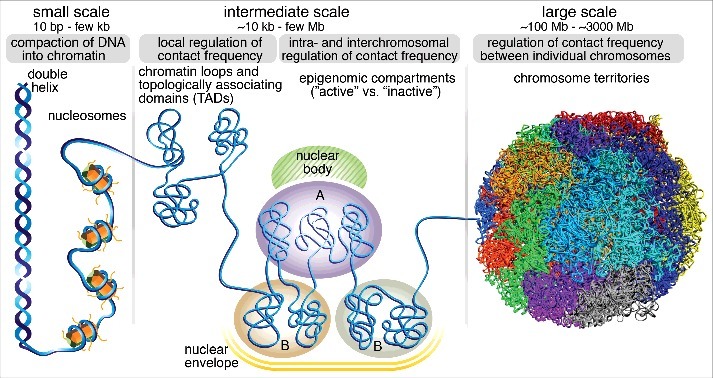
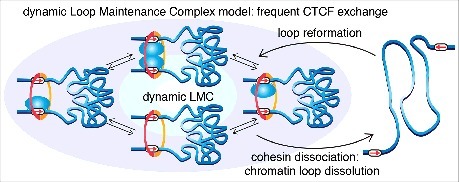
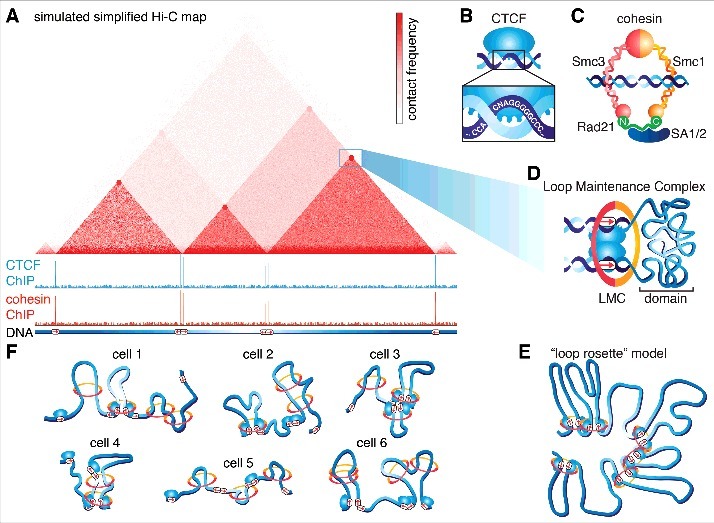
Mammalian genomes are folded into spatial domains, which regulate gene expression by modulating enhancer-promoter contacts. Here, we review recent studies on the structure and function of Topologically Associating Domains (TADs) and chromatin loops. We discuss how loop extrusion models can explain TAD formation and evidence that TADs are formed by the ring-shaped protein complex, cohesin, and that TAD boundaries are established by the DNA-binding protein, CTCF. We discuss our recent genomic, biochemical and single-molecule imaging studies on CTCF and cohesin, which suggest that TADs and chromatin loops are dynamic structures. We highlight complementary polymer simulation studies and Hi-C studies employing acute depletion of CTCF and cohesin, which also support such a dynamic model. We discuss the limitations of each approach and conclude that in aggregate the available evidence argues against stable loops and supports a model where TADs are dynamic structures that continually form and break throughout the cell cycle.
哺乳动物基因组折叠成空间域,通过调节增强子-启动子接触来调节基因表达。在这里,我们回顾了关于拓扑关联域(TAD)和染色质环的结构和功能的最新研究。我们讨论了环挤出模型如何解释 TAD 的形成,以及 TAD 是由环形蛋白复合物黏连蛋白形成的证据,并且 TAD 边界是由 DNA 结合蛋白 CTCF 建立的。我们讨论了我们最近关于 CTCF 和黏连蛋白的基因组、生化和单分子成像研究,这些研究表明 TAD 和染色质环是动态结构。我们强调了互补的聚合物模拟研究和采用 CTCF 和黏连蛋白急性耗竭的 Hi-C 研究,这些研究也支持这种动态模型。我们讨论了每种方法的局限性,并得出结论,总的来说,现有证据反对稳定的环,并支持 TAD 是动态结构的模型,这些结构在整个细胞周期中不断形成和断裂。