Chronaki Georgia, Soltesz Fruzsina, Benikos Nicholas, Sonuga-Barke Edmund J S
Developmental Cognitive Neuroscience (DCN) Laboratory, School of Psychology, University of Central Lancashire, UK; Developmental Brain-Behaviour Laboratory, Psychology, University of Southampton, UK; Division of Neuroscience & Experimental Psychology, University of Manchester, UK.
Developmental Brain-Behaviour Laboratory, Psychology, University of Southampton, UK.
Dev Cogn Neurosci. 2017 Dec;28:12-20. doi: 10.1016/j.dcn.2017.10.003. Epub 2017 Oct 18.
Neural hypo-sensitivity to cues predicting positive reinforcement has been observed in ADHD using the Monetary Incentive Delay (MID) task. Here we report the first study using an electrophysiological analogue of this task to distinguish between (i) cue related anticipation of reinforcement and downstream effects on (ii) target engagement and (iii) performance in a clinical sample of adolescents with ADHD and controls.
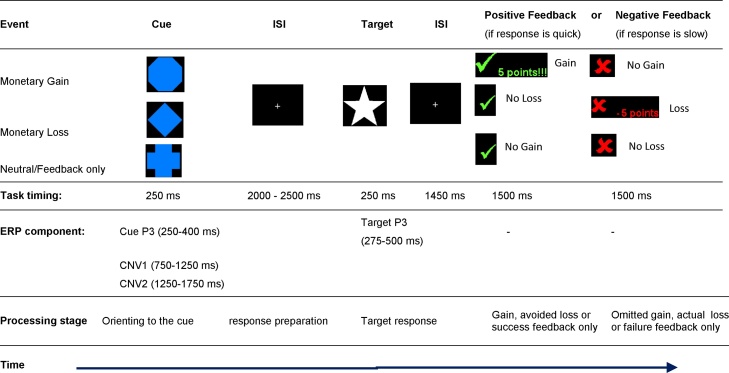
Thirty-one controls and 32 adolescents with ADHD aged 10-16 years performed the electrophysiological (e)-MID task - in which preparatory cues signal whether a response to an upcoming target will be reinforced or not - under three conditions; positive reinforcement, negative reinforcement (response cost) and no consequence (neutral). We extracted values for both cue-related potentials known to be, both, associated with response preparation and modulated by reinforcement (Cue P3 and Cue CNV) and target-related potentials (target P3) and compared these between ADHD and controls.
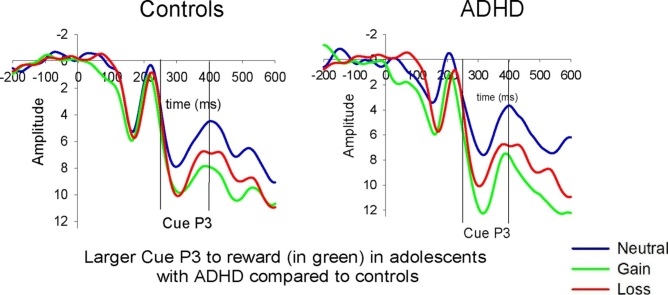
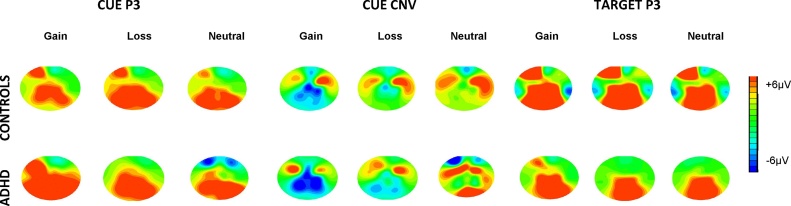
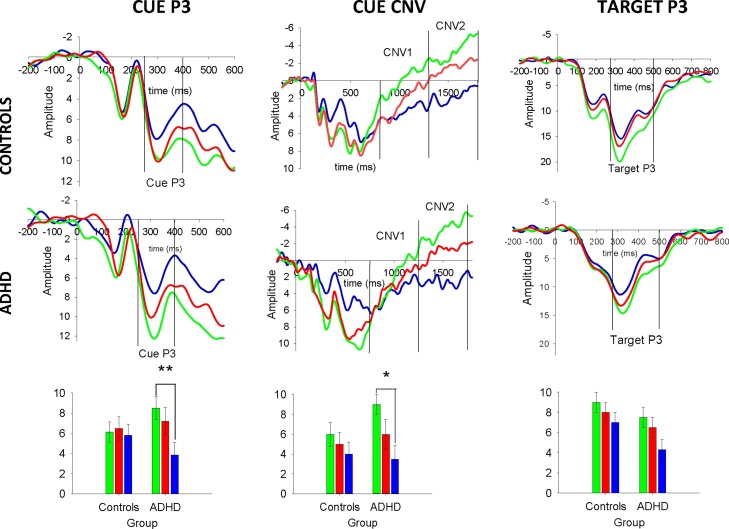
ADHD and controls did not differ on cue-related components on neutral trials. Against expectation, adolescents with ADHD displayed Cue P3 and Cue CNV reinforcement-related enhancement (versus neutral trials) compared to controls. ADHD individuals displayed smaller target P3 amplitudes and slower and more variable performance - but effects were not modulated by reinforcement contingencies. When age, IQ and conduct problems were controlled effects were marginally significant but the pattern of results did not change.
ADHD was associated with hypersensitivity to positive (and marginally negative) reinforcement reflected on components often thought to be associated with response preparation - however these did not translate into improved attention to targets. In the case of ADHD, upregulated CNV may be a specific marker of hyper-arousal rather than an enhancement of anticipatory attention to upcoming targets. Future studies should examine the effects of age, IQ and conduct problems on reinforcement sensitivity in ADHD.
使用金钱激励延迟(MID)任务,已观察到注意力缺陷多动障碍(ADHD)患者对预测积极强化的线索存在神经低敏现象。在此,我们报告了第一项研究,该研究使用此任务的电生理模拟方法,以区分(i)与线索相关的强化预期以及对(ii)目标参与和(iii)ADHD青少年临床样本及对照组表现的下游影响。
31名对照组和32名10 - 16岁的ADHD青少年进行了电生理(e)-MID任务,即在三种条件下,预备线索表明对即将到来的目标的反应是否会得到强化;积极强化、消极强化(反应代价)和无后果(中性)。我们提取了已知与反应准备相关且受强化调节的线索相关电位(线索P3和线索CNV)以及目标相关电位(目标P3)的值,并在ADHD组和对照组之间进行比较。
在中性试验中,ADHD组和对照组在线索相关成分上没有差异。与预期相反,与对照组相比,ADHD青少年在积极强化试验中显示出线索P