Meule Adrian
Department of Psychology, University of Salzburg, Hellbrunner Straße 34, 5020, Salzburg, Austria.
Center for Cognitive Neuroscience, University of Salzburg, Salzburg, Austria.
Eat Weight Disord. 2018 Feb;23(1):39-43. doi: 10.1007/s40519-017-0452-3. Epub 2017 Oct 28.
The Food Cravings Questionnaires are among the most often used measures for assessing the frequency and intensity of food craving experiences. However, there is a lack of studies that have examined specific cut-off scores that may indicate pathologically elevated levels of food cravings.
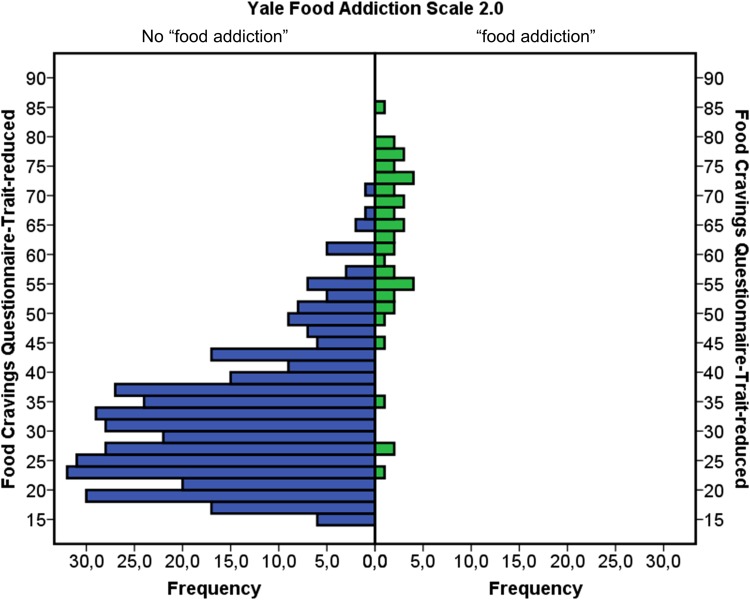
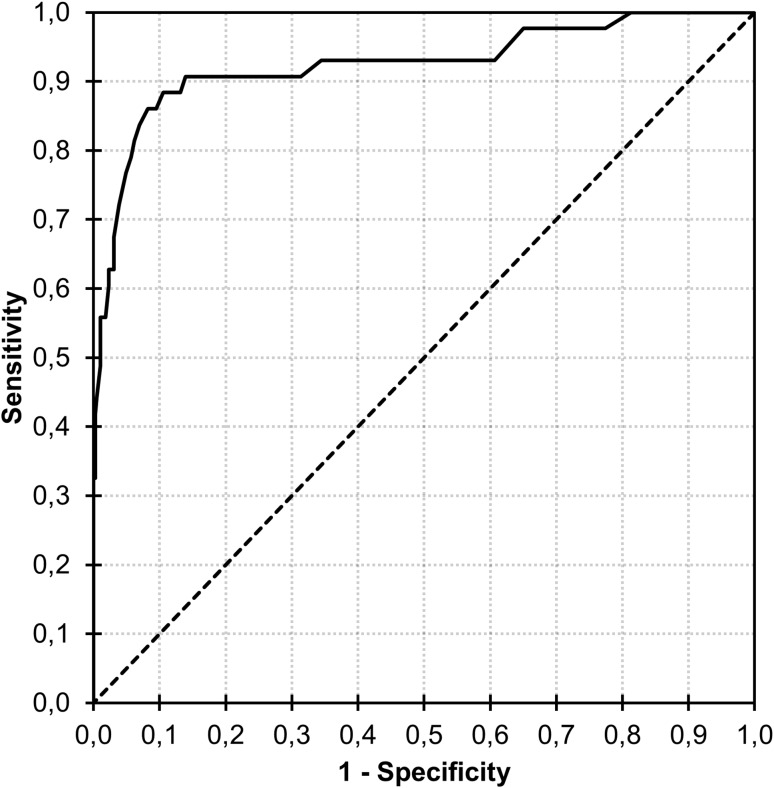
Receiver-Operating-Characteristic analysis was used to determine sensitivity and specificity of scores on the Food Cravings Questionnaire-Trait-reduced (FCQ-T-r) for discriminating between individuals with (n = 43) and without (n = 389) "food addiction" as assessed with the Yale Food Addiction Scale 2.0.
A cut-off score of 50 on the FCQ-T-r discriminated between individuals with and without "food addiction" with high sensitivity (85%) and specificity (93%).
FCQ-T-r scores of 50 and higher may indicate clinically relevant levels of trait food craving.
Level V, descriptive study.
食物渴望问卷是评估食物渴望经历的频率和强度时最常用的测量工具之一。然而,缺乏研究来检验可能表明食物渴望水平病理性升高的特定临界值。
采用受试者工作特征分析来确定简化版食物渴望问卷特质量表(FCQ-T-r)得分在区分使用耶鲁食物成瘾量表2.0评估为有(n = 43)和无(n = 389)“食物成瘾”个体时的敏感性和特异性。
FCQ-T-r得分50可区分有和无“食物成瘾”的个体,敏感性高(85%),特异性高(93%)。
FCQ-T-r得分50及以上可能表明特质性食物渴望达到临床相关水平。
V级,描述性研究。