Department of Psychiatry, Yale School of Medicine, New Haven, Connecticut, USA.
Social and Behavioral Sciences Division, Department of Chronic Disease Epidemiology, Yale School of Public Health, New Haven, Connecticut, USA.
Obesity (Silver Spring). 2016 Oct;24(10):2064-9. doi: 10.1002/oby.21607. Epub 2016 Aug 25.
To compare four subgroups of adults with overweight/obesity: those with binge-eating disorder (BED) only, food addiction (FA) only, both BED + FA, and neither.
For this study, 502 individuals with overweight/obesity (body mass index >25 kg/m(2) ) completed a Web-based survey with established measures of eating and health-related behaviors. Most were female (n = 415; 83.2%) and White (n = 404; 80.8%); mean age and body mass index were 38.0 (SD = 13.1) years and 33.6 (SD = 6.9) kg/m(2) , respectively.
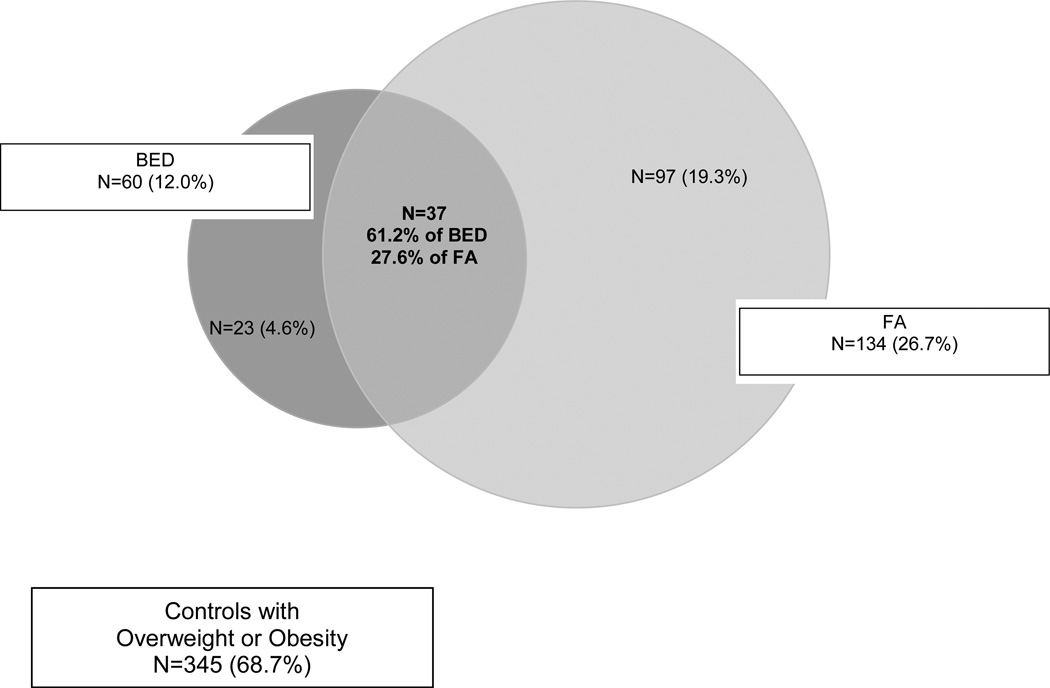
Among 502 participants with overweight/obesity, 43 (8.5%) met BED criteria, 84 (16.6%) met FA criteria, 51 (10.1%) met both BED + FA criteria, and 328 (64.8%) met neither (control). The three groups with eating pathology (BED, FA, and BED + FA) had significantly greater disturbances on most measures (eating disorder psychopathology, impulsivity, and self-control) than the control group, while the FA and BED + FA groups reported significantly higher depression scores relative to the control group. The three eating groups did not differ significantly from each other.
In this online survey, of those with overweight/obesity, nearly one third met criteria for BED, FA, or BED + FA, and these forms of disordered eating were associated with greater pathology relative to individuals with overweight/obesity without BED and FA. Future research should examine whether the presence of BED, FA, or co-occurring BED + FA requires tailored interventions in individuals with overweight or obesity.
比较超重/肥胖的四个亚组成年人:仅暴食障碍(BED)、仅食物成瘾(FA)、BED+FA 均有和均无。
本研究中,502 名超重/肥胖个体(体重指数>25 kg/m²)完成了一项基于网络的调查,该调查采用了已确立的饮食和健康相关行为的测量方法。大多数为女性(n=415;83.2%)和白人(n=404;80.8%);平均年龄和体重指数分别为 38.0(SD=13.1)岁和 33.6(SD=6.9)kg/m²。
在 502 名超重/肥胖的参与者中,43 人(8.5%)符合 BED 标准,84 人(16.6%)符合 FA 标准,51 人(10.1%)符合 BED+FA 标准,328 人(64.8%)均不符合(对照组)。有饮食病理学(BED、FA 和 BED+FA)的三组在大多数指标(饮食障碍心理病理学、冲动性和自我控制)上的紊乱明显比对照组更严重,而 FA 和 BED+FA 组与对照组相比,抑郁评分明显更高。这三组饮食障碍组彼此之间没有显著差异。
在这项在线调查中,超重/肥胖的个体中,近三分之一符合 BED、FA 或 BED+FA 的标准,与没有 BED 和 FA 的超重/肥胖个体相比,这些形式的饮食障碍与更大的病理有关。未来的研究应该检查 BED、FA 或同时存在的 BED+FA 是否需要针对超重或肥胖个体进行定制干预。