Luarte Alejandro, Cisternas Pablo, Caviedes Ariel, Batiz Luis Federico, Lafourcade Carlos, Wyneken Ursula, Henzi Roberto
Centro de Investigaciones Biomédicas, Facultad de Medicina, Universidad de los Andes, Santiago, Chile.
Biomedical Neuroscience Institute, Universidad de Chile, Santiago, Chile.
Stem Cells Int. 2017;2017:1719050. doi: 10.1155/2017/1719050. Epub 2017 Sep 7.
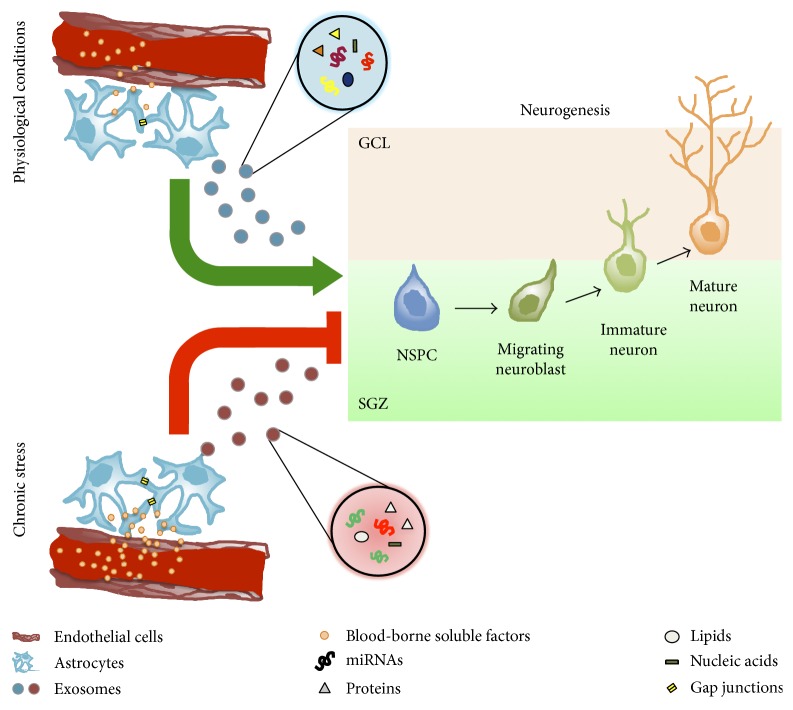
Repetitive stress negatively affects several brain functions and neuronal networks. Moreover, adult neurogenesis is consistently impaired in chronic stress models and in associated human diseases such as unipolar depression and bipolar disorder, while it is restored by effective antidepressant treatments. The adult neurogenic niche contains neural progenitor cells in addition to amplifying progenitors, neuroblasts, immature and mature neurons, pericytes, astrocytes, and microglial cells. Because of their particular and crucial position, with their end feet enwrapping endothelial cells and their close communication with the cells of the niche, astrocytes might constitute a nodal point to bridge or transduce systemic stress signals from peripheral blood, such as glucocorticoids, to the cells involved in the neurogenic process. It has been proposed that communication between astrocytes and niche cells depends on direct cell-cell contacts and soluble mediators. In addition, new evidence suggests that this communication might be mediated by extracellular vesicles such as exosomes, and in particular, by their miRNA cargo. Here, we address some of the latest findings regarding the impact of stress in the biology of the neurogenic niche, and postulate how astrocytic exosomes (and miRNAs) may play a fundamental role in such phenomenon.
重复性应激会对多种脑功能和神经网络产生负面影响。此外,在慢性应激模型以及诸如单相抑郁症和双相情感障碍等相关人类疾病中,成体神经发生持续受损,而有效的抗抑郁治疗可使其恢复。成体神经发生微环境除了包含扩增祖细胞、神经母细胞、未成熟和成熟神经元外,还含有神经祖细胞、周细胞、星形胶质细胞和小胶质细胞。由于星形胶质细胞具有特殊且关键的位置,其终足包裹着内皮细胞,并与微环境中的细胞密切沟通,因此星形胶质细胞可能构成一个节点,将外周血中的全身应激信号(如糖皮质激素)传递或转导至参与神经发生过程的细胞。有人提出,星形胶质细胞与微环境细胞之间的通讯依赖于直接的细胞间接触和可溶性介质。此外,新证据表明这种通讯可能由细胞外囊泡(如外泌体)介导,尤其是通过其携带的微小RNA(miRNA)。在此,我们探讨了有关应激对神经发生微环境生物学影响的一些最新发现,并推测星形胶质细胞外泌体(和miRNA)可能在此现象中发挥重要作用。