Costa Janaína Calu, da Silva Inacio Crochemore Mohnsam, Victora Cesar Gomes
International Center for Equity in Health, Postgraduate Program in Epidemiology, Federal University of Pelotas, Pelotas, RS, Brazil.
BMJ Glob Health. 2017 Jul 28;2(2):e000350. doi: 10.1136/bmjgh-2017-000350. eCollection 2017.
Due to biological reasons, boys are more likely to die than girls. The detection of gender bias requires knowing the expected relation between male and female mortality rates at different levels of overall mortality, in the absence of discrimination. Our objective was to compare two approaches aimed at assessing excess female under-five mortality rate (U5MR) in low/middle-income countries.
We compared the two approaches using data from 60 Demographic and Health Surveys (2005-2014). The prescriptive approach compares observed mortality rates with historical patterns in Western societies where gender discrimination was assumed to be low or absent. The descriptive approach is derived from global estimates of all countries with available data, including those affected by gender bias.
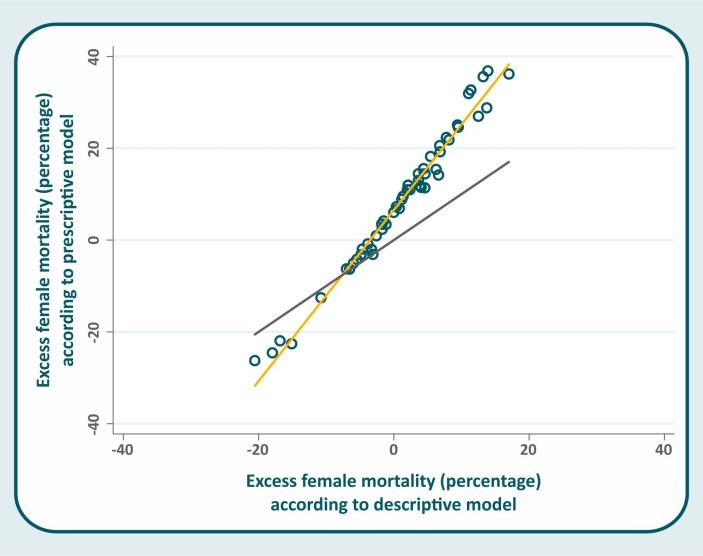
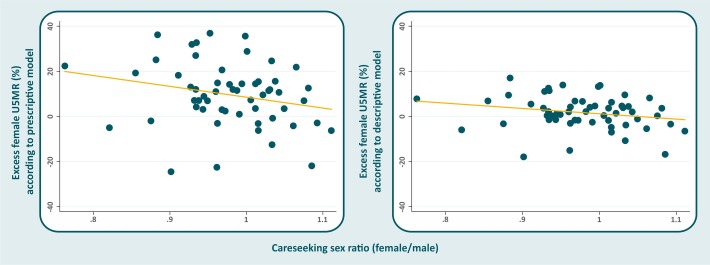
The prescriptive approach showed significant excess female U5MR in 20 countries, compared with only one country according to the descriptive approach. Nevertheless, both models showed similar country rankings. The 13 countries with the highest and the 10 countries with the lowest rankings were the same according to both approaches. Differences in excess female mortality among world regions were significant, but not among country income groups.
Both methods are useful for monitoring time trends, detecting gender-based inequalities and identifying and addressing its causes. The prescriptive approach seems to be more sensitive in the identification of gender bias, but needs to be updated using data from populations with current-day structures of causes of death.
由于生物学原因,男孩比女孩更容易死亡。在不存在歧视的情况下,检测性别偏见需要了解不同总体死亡率水平下男女死亡率之间的预期关系。我们的目标是比较两种旨在评估低收入/中等收入国家五岁以下女童超额死亡率(U5MR)的方法。
我们使用来自60项人口与健康调查(2005 - 2014年)的数据比较这两种方法。规范性方法将观察到的死亡率与西方社会的历史模式进行比较,在西方社会中,性别歧视被认为较低或不存在。描述性方法源自对所有有可用数据的国家的全球估计,包括那些受到性别偏见影响的国家。
规范性方法显示有20个国家存在显著的五岁以下女童超额死亡率,而描述性方法仅显示一个国家存在这种情况。然而,两种模型显示的国家排名相似。根据两种方法,排名最高的13个国家和排名最低的10个国家是相同的。世界各地区之间五岁以下女童超额死亡率的差异显著,但国家收入组之间的差异不显著。
两种方法都有助于监测时间趋势、检测基于性别的不平等以及识别和解决其原因。规范性方法在识别性别偏见方面似乎更敏感,但需要使用具有当今死亡原因结构的人群数据进行更新。