Key Laboratory of Industrial Fermentation Microbiology, Ministry of Education, College of Biotechnology, Tianjin University of Science & Technology, Tianjin, 300457, People's Republic of China.
Microb Cell Fact. 2017 Oct 30;16(1):182. doi: 10.1186/s12934-017-0796-4.
Cofactor engineering is involved in the modification of enzymes related to nicotinamide adenine dinucleotides (NADH and NAD) metabolism, which results in a significantly altered spectrum of metabolic products. Cofactor engineering plays an important role in metabolic engineering but is rarely reported in the sterols biotransformation process owing to its use of multi-catabolic enzymes, which promote multiple consecutive reactions. Androst-4-ene-3, 17-dione (AD) and androst-1, 4-diene-3, 17-dione (ADD) are important steroid medicine intermediates that are obtained via the nucleus oxidation and the side chain degradation of phytosterols by Mycobacterium. Given that the biotransformation from phytosterols to AD (D) is supposed to be a NAD-dependent process, this work utilized cofactor engineering in Mycobacterium neoaurum and investigated the effect on cofactor and phytosterols metabolism.
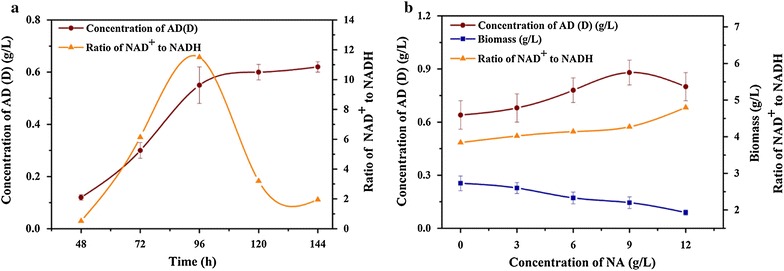
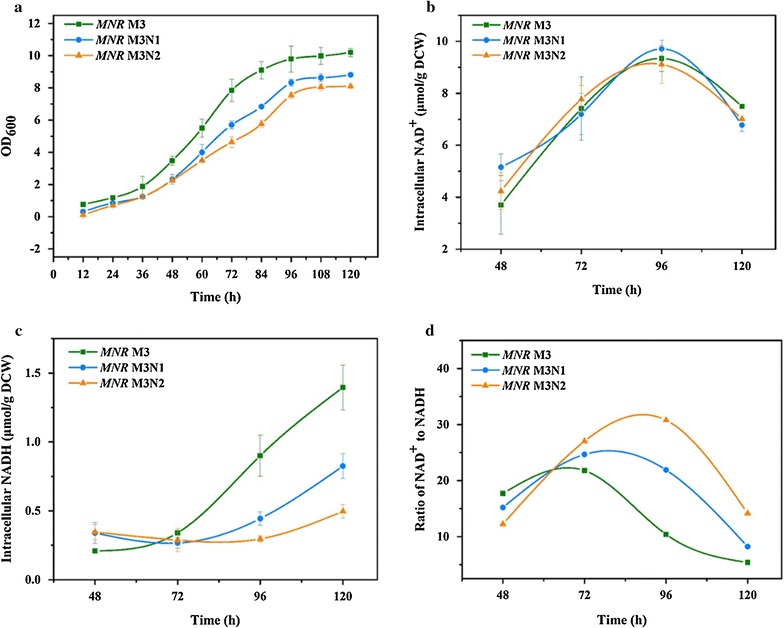
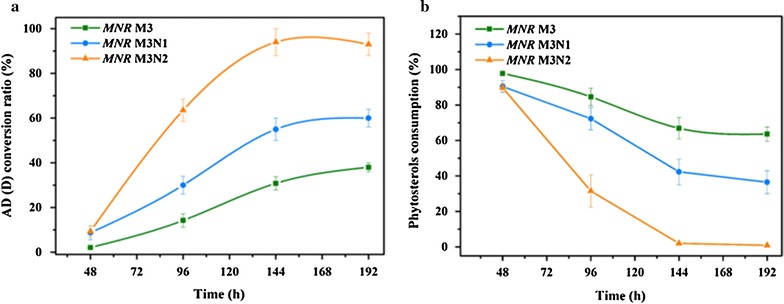
Through the addition of the coenzyme precursor of nicotinic acid in the phytosterols fermentation system, the intracellular NAD/NADH ratio and the AD (D) production of M. neoaurum TCCC 11978 (MNR M3) were higher than in the control. Moreover, the NADH: flavin oxidoreductase was identified and was supposed to exert a positive effect on cofactor regulation and phytosterols metabolism pathways via comparative proteomic profiling of MNR cultured with and without phytosterols. In addition, the NADH: flavin oxidoreductase and a water-forming NADH oxidase from Lactobacillus brevis, were successfully overexpressed and heterologously expressed in MNR M3 to improve the intracellular ratio of NAD/NADH. After 96 h of cultivation, the expression of these two enzymes in MNR M3 resulted in the decrease in intracellular NADH level (by 51 and 67%, respectively) and the increase in NAD/NADH ratio (by 113 and 192%, respectively). Phytosterols bioconversion revealed that the conversion ratio of engineered stains was ultimately improved by 58 and 147%, respectively. The highest AD (D) conversion ratio by MNR M3N2 was 94% in the conversion system with soybean oil as reaction media to promote the solubility of phytosterols.
The ratio of NAD/NADH is an important factor for the transformation of phytosterols. Expression of NADH: flavin oxidoreductase and water-forming NADH oxidase in MNR improved AD (D) production. Besides the manipulation of key enzyme activities, which included in phytosterols degradation pathways, maintenance the balance of redox also played an important role in promoting steroid biotransformation. The recombinant MNR strain may be useful in industrial production.
辅因子工程涉及到与烟酰胺腺嘌呤二核苷酸(NADH 和 NAD)代谢相关的酶的修饰,这导致代谢产物的谱发生显著改变。辅因子工程在代谢工程中起着重要作用,但由于其使用多代谢酶来促进多个连续反应,因此在甾醇生物转化过程中很少有报道。雄甾-4-烯-3,17-二酮(AD)和雄甾-1,4-二烯-3,17-二酮(ADD)是重要的甾体药物中间体,可通过分枝杆菌对植物甾醇的核氧化和侧链降解获得。鉴于植物甾醇转化为 AD(D)应该是一个依赖 NAD 的过程,本工作利用分枝杆菌中新霉素的辅因子工程,并研究了其对辅因子和植物甾醇代谢的影响。
通过在植物甾醇发酵系统中添加烟碱酸辅酶前体,分枝杆菌 TCCC 11978(MNR M3)的细胞内 NAD/NADH 比值和 AD(D)的产量均高于对照组。此外,通过比较有和没有植物甾醇培养的 MNR 的蛋白质组学分析,鉴定出 NADH:黄素氧化还原酶,并认为其通过调节辅因子和植物甾醇代谢途径发挥积极作用。此外,成功地在 MNR M3 中过表达和异源表达了来自短乳杆菌的 NADH:黄素氧化还原酶和形成水的 NADH 氧化酶,以提高细胞内 NAD/NADH 比值。培养 96 小时后,MNR M3 中这两种酶的表达导致细胞内 NADH 水平降低(分别降低 51%和 67%),NAD/NADH 比值增加(分别增加 113%和 192%)。甾醇生物转化表明,工程菌的转化率最终分别提高了 58%和 147%。在以大豆油为反应介质的转化系统中,MNR M3N2 的 AD(D)转化率最高,达到 94%,以促进植物甾醇的溶解度。
NAD/NADH 比值是植物甾醇转化的重要因素。MNR 中 NADH:黄素氧化还原酶和形成水的 NADH 氧化酶的表达提高了 AD(D)的产量。除了操纵包括在植物甾醇降解途径中的关键酶活性外,维持氧化还原平衡在促进甾体生物转化中也起着重要作用。重组 MNR 菌株可能在工业生产中有用。