Avasthi Ajit, Basu Debasish, Subodh B N, Gupta Pramod K, Malhotra Nidhi, Rani Poonam, Sharma Sunil
Department of Psychiatry, Postgraduate Institute of Medical Education and Research, Chandigarh, India.
Department of Biostatistics, Postgraduate Institute of Medical Education and Research, Chandigarh, India.
Indian J Psychiatry. 2017 Jul-Sep;59(3):275-283. doi: 10.4103/psychiatry.IndianJPsychiatry_326_16.
Substance misuse is a global health and social problem with major adverse consequences. A number of regional studies on prevalence of substance use and dependence have been carried out in India; but methodologically robust data from Chandigarh are sparse.
A house-to-house survey was carried out to estimate the prevalence of substance use and dependence in an adequate multistage-stratified random sample in the Union Territory (UT) of Chandigarh, using standardized instruments and predefined measures. Two thousand individuals (1000 each from urban and rural sites) from 743 households were interviewed.
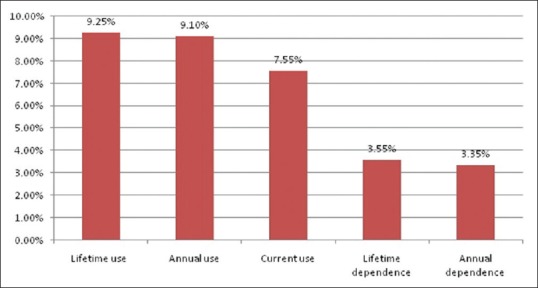
Lifetime use of any substance was reported in 21.26% households (8.01% of all respondents; 13.6% males and 1.01% females). Current use was reported in 6.55% of respondents. Prevalence rates of both lifetime and annual/current substance dependence were 2.96% (4.74% for males and 0.72% for females). Alcohol (6.72%) was the most common substance to be ever used by respondents, followed by tobacco (3.34%), opioids (0.17%), and hypnotics (0.04%). Lifetime dependence rates were found to be 1.76%, 2.28%, 0.04% and 0.17% for alcohol, tobacco, hypnotics, and opioids, respectively. None reported the use of cannabinoids, inhalants, or stimulants. Substance users were more likely to be married, employed, and in higher income group as compared to those who never used substance. Only 3.78% substance users had ever sought treatment for the same.
Substance use is prevalent in the UT of Chandigarh, with a higher prevalence in males. Substance users hardly ever seek treatment for substance use. This highlights the need of awareness and community-level services for the treatment of substance use disorders.
药物滥用是一个具有重大不良后果的全球健康和社会问题。印度已开展了多项关于药物使用和依赖患病率的区域研究;但来自昌迪加尔的方法学上可靠的数据却很稀少。
采用标准化工具和预定义措施,在昌迪加尔联合属地的一个适当的多阶段分层随机样本中进行挨家挨户的调查,以估计药物使用和依赖的患病率。对来自743户家庭的2000人(城市和农村地区各1000人)进行了访谈。
21.26%的家庭报告有过任何药物使用经历(占所有受访者的8.01%;男性为13.6%,女性为1.01%)。6.55%的受访者报告目前正在使用药物。终生和年度/当前药物依赖的患病率均为2.96%(男性为4.74%,女性为0.72%)。酒精(6.72%)是受访者使用过的最常见药物,其次是烟草(3.34%)、阿片类药物(0.17%)和催眠药(0.04%)。酒精、烟草、催眠药和阿片类药物的终生依赖率分别为1.76%、2.28%、0.04%和0.17%。没有人报告使用过大麻、吸入剂或兴奋剂。与从未使用过药物的人相比,药物使用者更有可能已婚、就业且属于高收入群体。只有3.78%的药物使用者曾因药物使用问题寻求过治疗。
药物使用在昌迪加尔联合属地很普遍,男性患病率更高。药物使用者几乎从不因药物使用问题寻求治疗。这凸显了提高认识和提供社区层面药物使用障碍治疗服务的必要性。