Blanco Wilfredo, Bertram Richard, Tabak Joël
Department of Computer Science, State University of Rio Grande do Norte, Natal, Brazil.
Laboratory of Memory, Sleep and Dreams, Brain Institute, Federal University of Rio Grande do Norte, Natal, Brazil.
Front Comput Neurosci. 2017 Sep 29;11:88. doi: 10.3389/fncom.2017.00088. eCollection 2017.
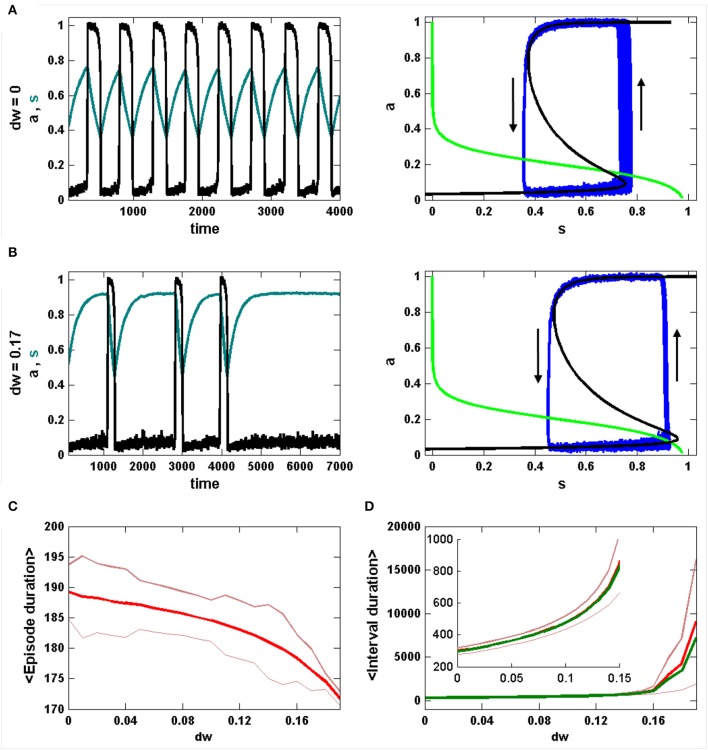
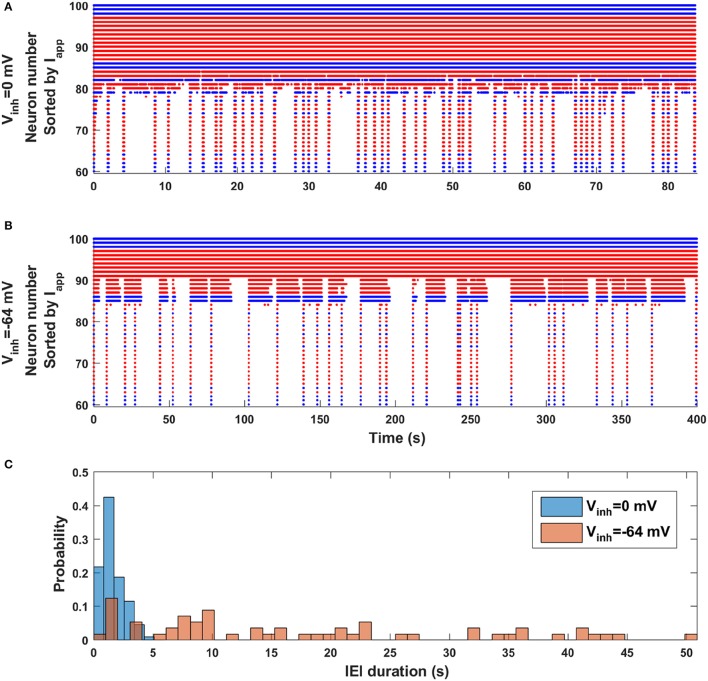
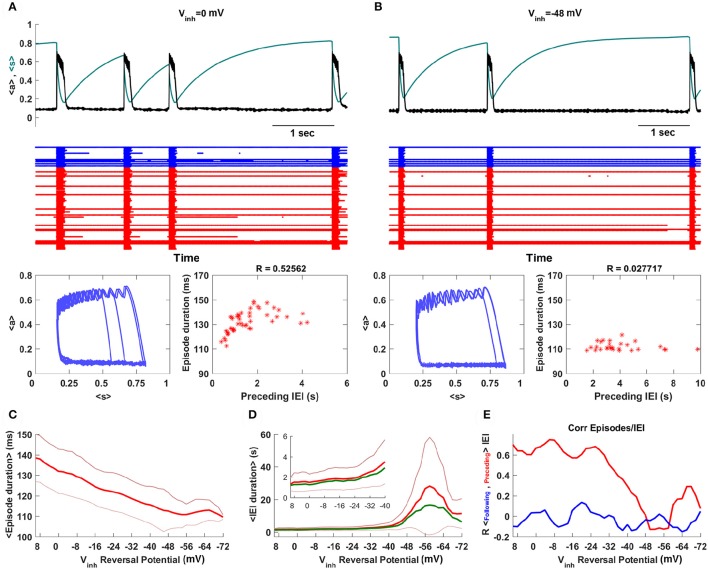
Early in development, neural systems have primarily excitatory coupling, where even GABAergic synapses are excitatory. Many of these systems exhibit spontaneous episodes of activity that have been characterized through both experimental and computational studies. As development progress the neural system goes through many changes, including synaptic remodeling, intrinsic plasticity in the ion channel expression, and a transformation of GABAergic synapses from excitatory to inhibitory. What effect each of these, and other, changes have on the network behavior is hard to know from experimental studies since they all happen in parallel. One advantage of a computational approach is that one has the ability to study developmental changes in isolation. Here, we examine the effects of GABAergic synapse polarity change on the spontaneous activity of both a mean field and a neural network model that has both glutamatergic and GABAergic coupling, representative of a developing neural network. We find some intuitive behavioral changes as the GABAergic neurons go from excitatory to inhibitory, shared by both models, such as a decrease in the duration of episodes. We also find some paradoxical changes in the activity that are only present in the neural network model. In particular, we find that during early development the inter-episode durations become longer on average, while later in development they become shorter. In addressing this unexpected finding, we uncover a priming effect that is particularly important for a small subset of neurons, called the "intermediate neurons." We characterize these neurons and demonstrate why they are crucial to episode initiation, and why the paradoxical behavioral change result from priming of these neurons. The study illustrates how even arguably the simplest of developmental changes that occurs in neural systems can present non-intuitive behaviors. It also makes predictions about neural network behavioral changes that occur during development that may be observable even in actual neural systems where these changes are convoluted with changes in synaptic connectivity and intrinsic neural plasticity.
在发育早期,神经系统主要具有兴奋性耦合,即使是GABA能突触也是兴奋性的。这些系统中的许多都表现出自发性活动发作,这已通过实验和计算研究进行了表征。随着发育的进行,神经系统会经历许多变化,包括突触重塑、离子通道表达的内在可塑性以及GABA能突触从兴奋性向抑制性的转变。由于这些变化以及其他变化都是同时发生的,因此从实验研究中很难了解它们各自对网络行为有什么影响。计算方法的一个优点是能够单独研究发育变化。在这里,我们研究了GABA能突触极性变化对平均场模型和同时具有谷氨酸能和GABA能耦合的神经网络模型(代表发育中的神经网络)的自发活动的影响。我们发现,随着GABA能神经元从兴奋性转变为抑制性,两个模型都出现了一些直观的行为变化,例如发作持续时间的减少。我们还发现了一些仅在神经网络模型中出现的活动的矛盾变化。特别是,我们发现在发育早期,发作间期平均变长,而在发育后期则变短。在探讨这一意外发现时,我们发现了一种启动效应,这种效应对于一小部分称为“中间神经元”的神经元尤为重要。我们对这些神经元进行了表征,并证明了它们为何对发作起始至关重要,以及矛盾的行为变化为何源于这些神经元被启动所导致。这项研究说明了即使是神经系统中发生的看似最简单的发育变化也可能呈现出非直观的行为。它还对发育过程中神经网络行为的变化做出了预测,这些变化甚至在实际神经系统中也可能是可观察到的,尽管在实际神经系统中这些变化与突触连接性和内在神经可塑性的变化相互交织。