Menai Mehdi, Brouard Benoit, Vegreville Matthieu, Chieh Angela, Schmidt Nicolas, Oppert Jean-Michel, Lelong Hélène, Loprinzi Paul D
Unaffiliated, Paris, France.
Nokia Digital Health, Issy-les-Moulineaux, France.
Health Promot Perspect. 2017 Sep 26;7(4):190-196. doi: 10.15171/hpp.2017.34. eCollection 2017.
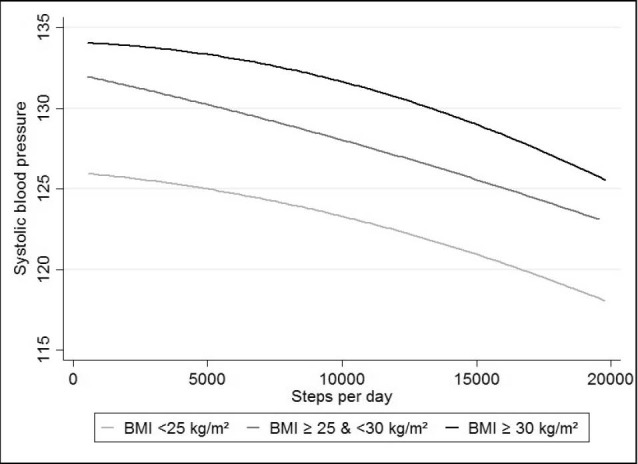
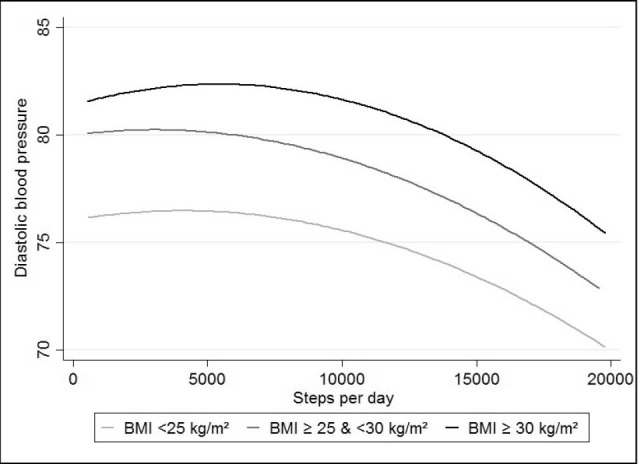
We examined the cross-sectional and longitudinal associations of objectively-measured physical activity (step counts) and blood pressure (BP) among adults spanning 37 countries. Across 37 countries, we used data from a pool of 9238 adult owners of Withings' Pulse activity trackers, which measures steps taken each day, and Wireless Blood Pressure Monitor, which measures BP. Analyses were adjusted on age, sex, number of days where the tracker was worn, and number of BP measurements. Data was collected from 2009 to 2013. Subjects had a mean ± standard deviation (SD) age of 51.6 ± 11.3 years and a body mass index (BMI) of 28.7±5.5 kg/m. A 1-month increase of more than 3000 steps per day was associated with a decrease of systolic BP (SBP) and diastolic BP (DBP) among the obese (1.57mm Hg and 1.29 mm Hg respectively, both P<0.001) and the overweight population (0.79 mm Hg and 0.84 mm Hg respectively, both P≤0.001), but not in the normal weight population (P=0.60 and P=0.36 respectively). One-month increases in daily step counts was associated with a decrease of SBP and DBP in a large obese and overweight free living population.
我们研究了37个国家成年人中客观测量的身体活动(步数)与血压(BP)之间的横断面和纵向关联。在37个国家中,我们使用了来自9238名Withings Pulse活动追踪器成年用户的数据池,该追踪器可测量每日步数,以及无线血压监测仪,可测量血压。分析针对年龄、性别、佩戴追踪器的天数以及血压测量次数进行了调整。数据收集时间为2009年至2013年。受试者的平均年龄±标准差(SD)为51.6±11.3岁,体重指数(BMI)为28.7±5.5kg/m²。在肥胖人群(收缩压[SBP]和舒张压[DBP]分别降低1.57mmHg和1.29mmHg,P均<0.001)和超重人群(分别降低0.79mmHg和0.84mmHg,P均≤0.001)中,每日步数增加超过3000步持续1个月与SBP和DBP降低相关,但在正常体重人群中无此关联(分别为P = 0.60和P = 0.36)。在大量无肥胖和超重的自由生活人群中,每日步数增加1个月与SBP和DBP降低相关。