Center of Research in Epidemiology and Population Health, UMR 1018 INSERM, Institut Gustave Roussy, Paris-Sud Paris-Saclay University, Villejuif, France.
Residual Tumor & Response to Treatment Laboratory (RT2Lab), U932 Immunity and Cancer, INSERM, Institut Curie, Paris, France.
JMIR Mhealth Uhealth. 2021 Apr 15;9(4):e25385. doi: 10.2196/25385.
Physical activity (PA) is a modifiable lifestyle factor that can be targeted to increase energy expenditure and promote weight loss. However, the amount of PA required for weight loss remains inconsistent. Wearable activity trackers constitute a valuable opportunity to obtain objective measurements of PA and study large populations in real-life settings.
We aim to study the associations of initial device-assessed PA characteristics (average step counts and step count variability) and their evolution with 6-month weight change.
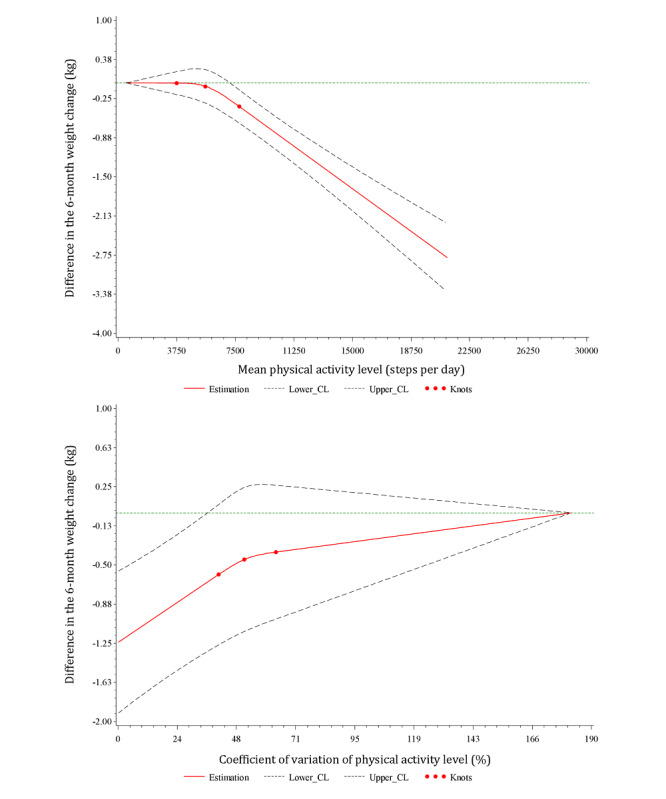
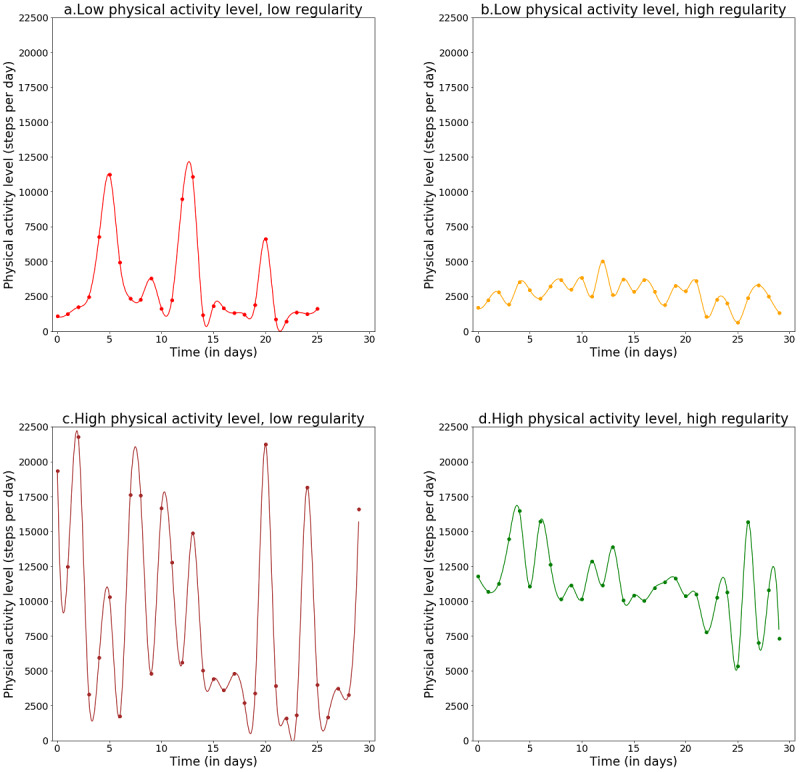
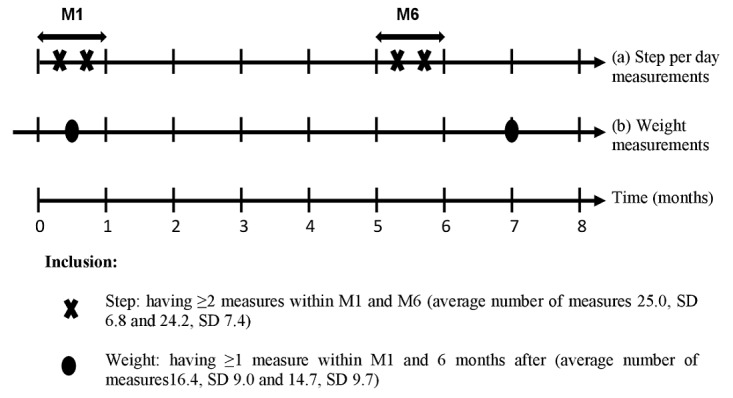
We analyzed data from 26,935 Withings-connected device users (wearable activity trackers and digital scales). To assess the initial PA characteristics and their 6-month changes, we used data recorded during the first and sixth 30-day periods of activity tracker use. For each of these periods, we used the monthly mean of daily step values as a proxy for PA level and derived the monthly coefficient of variation (CV) of daily step values to estimate PA level variability. Associations between initial PA characteristics and 6-month weight change were assessed using multivariable linear regression analyses controlled for age, sex, blood pressure, heart rate, and the predominant season. Restricted cubic spline regression was performed to better characterize the continuous shape of the associations between PA characteristics and weight change. Secondary analyses were performed by analyzing the 6-month evolution of PA characteristics in relation to weight change.
Our results revealed that both a greater PA level and lower PA level variability were associated with weight loss. Compared with individuals who were initially in the sedentary category (<5000 steps/day), individuals who were low active (5000-7499 steps/day), somewhat active (7500-9999 steps/day), and active (≥10,000 steps/day) had a 0.21-kg, a 0.52-kg, and a 1.17-kg greater decrease in weight, respectively (95% CI -0.36 to -0.06, -0.70 to -0.33, and -1.42 to -0.93, respectively). Compared with users whose PA level CV was >63%, users whose PA level CV ranged from 51% to 63%, 40% to 51%, and was ≤40%, had a 0.19-kg, a 0.23-kg, and a 0.33-kg greater decrease in weight, respectively (95% CI -0.38 to -0.01, -0.41 to -0.04, and -0.53 to -0.13, respectively). We also observed that each 1000 steps/day increase in PA level over the 6-month follow-up was associated with a 0.26-kg (95% CI -0.29 to -0.23) decrease in weight. No association was found between the 6-month changes in PA level variability and weight change.
Our results add to the current body of knowledge that health benefits can be observed below the 10,000 steps/day threshold and suggest that not only increased mean PA level but also greater regularity of the PA level may play important roles in short-term weight loss.
体力活动(PA)是一种可改变的生活方式因素,可以通过增加能量消耗和促进体重减轻来实现。然而,减肥所需的体力活动量仍然不一致。可穿戴活动追踪器是获得体力活动客观测量值并在真实环境中研究大量人群的有价值机会。
我们旨在研究初始设备评估的 PA 特征(平均步数和步数变化的可变性)及其变化与 6 个月体重变化的相关性。
我们分析了 26935 名 Withings 连接设备用户(可穿戴活动追踪器和数字秤)的数据。为了评估初始 PA 特征及其 6 个月的变化,我们使用活动追踪器使用的第一个和第六个 30 天期间记录的数据。对于每个时间段,我们使用每日步数的月平均值作为 PA 水平的代表,并得出每日步数变化的月变异系数(CV),以估计 PA 水平的可变性。使用多变量线性回归分析控制年龄、性别、血压、心率和主要季节来评估初始 PA 特征与 6 个月体重变化之间的相关性。使用受限立方样条回归更好地描述 PA 特征与体重变化之间的连续关系。进行了二次分析,以分析与体重变化相关的 PA 特征的 6 个月演变。
我们的结果表明,较高的 PA 水平和较低的 PA 水平可变性与体重减轻相关。与最初处于久坐状态(<5000 步/天)的个体相比,低活跃(5000-7499 步/天)、有点活跃(7500-9999 步/天)和活跃(≥10000 步/天)的个体体重分别下降了 0.21kg、0.52kg 和 1.17kg(95%CI-0.36 至-0.06、-0.70 至-0.33 和-1.42 至-0.93)。与 PA 水平 CV>63%的用户相比,PA 水平 CV 范围为 51%至 63%、40%至 51%和≤40%的用户体重分别下降了 0.19kg、0.23kg 和 0.33kg(95%CI-0.38 至-0.01、-0.41 至-0.04 和-0.53 至-0.13)。我们还观察到,在 6 个月的随访期间,PA 水平每增加 1000 步/天,体重就会下降 0.26kg(95%CI-0.29 至-0.23)。PA 水平可变性的 6 个月变化与体重变化之间没有关联。
我们的研究结果增加了目前关于健康益处可以在 10000 步/天阈值以下观察到的知识体系,并表明,不仅增加平均 PA 水平,而且 PA 水平的更大规律性可能在短期体重减轻中发挥重要作用。