Lyu Zhe, Li Zhi-Gang, He Fei, Zhang Ziding
College of Resources and Environmental Sciences, China Agricultural University, Beijing, China.
Department of Microbiology, University of Georgia, Athens, Georgia, USA.
mSystems. 2017 Oct 24;2(5). doi: 10.1128/mSystems.00112-17. eCollection 2017 Sep-Oct.
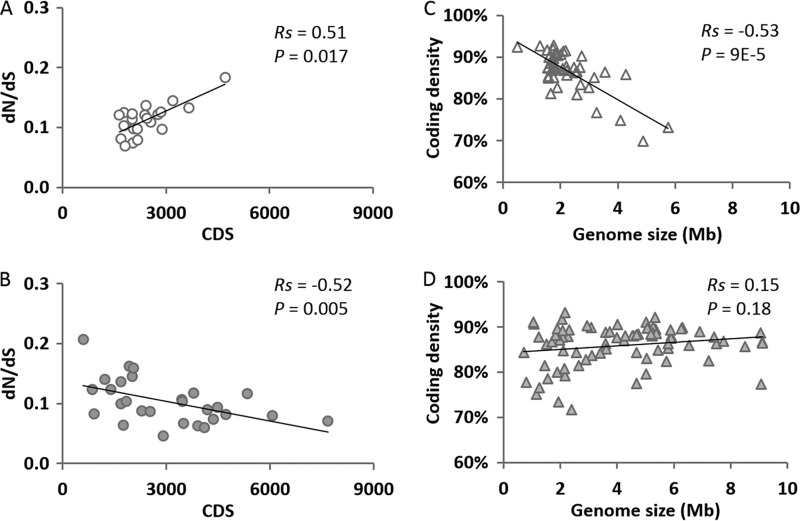
As the null hypothesis of genome evolution, population genetic theory suggests that selection strength controls genome size. Through the process of genetic drift, this theory predicts that compact genomes are maintained by strong purifying selection while complex genomes are enabled by weak purifying selection. It offers a unifying framework that explains why prokaryotic genomes are much smaller than their eukaryotic counterparts. However, recent findings suggest that bigger prokaryotic genomes appear to experience stronger purifying selection, indicating that purifying selection may not dominate prokaryotic genome evolution. Since archaeal genomes were underrepresented in those studies, generalization of the conclusions to both archaeal and bacterial genomes may not be warranted. In this study, we revisited this matter by focusing on archaeal and bacterial genomes separately. We found that bigger bacterial genomes indeed experienced stronger purifying selection, but the opposite was observed in archaeal genomes. This new finding would predict an enrichment of noncoding sequences in large archaeal genomes, which was confirmed by an analysis of coding density. In contrast, coding density remained stable regardless of bacterial genome size. In conclusion, this study suggests that purifying selection may play a more important role in archaeal genome evolution than previously hypothesized, indicating that there could be a major difference between the evolutionary regimes of and . The evolution of genome complexity is a fundamental question in biology. A hallmark of eukaryotic genome complexity is that larger genomes tend to have more noncoding sequences, which are believed to be minimal in archaeal and bacterial genomes. However, we found that archaeal genomes also possessed this eukaryotic feature while bacterial genomes did not. This could be predicted from our analysis on genetic drift, which showed a relaxation of purifying selection in larger archaeal genomes, also a eukaryotic feature. In contrast, the opposite was evident in bacterial genomes.
作为基因组进化的零假设,群体遗传学理论表明选择强度控制基因组大小。通过遗传漂变过程,该理论预测紧凑基因组由强纯化选择维持,而复杂基因组由弱纯化选择促成。它提供了一个统一的框架,解释了为什么原核生物基因组比其真核生物对应物小得多。然而,最近的研究结果表明,更大的原核生物基因组似乎经历更强的纯化选择,这表明纯化选择可能并不主导原核生物基因组进化。由于在这些研究中,古菌基因组的代表性不足,将这些结论推广到古菌和细菌基因组可能并不合理。在本研究中,我们分别聚焦于古菌和细菌基因组重新审视了这个问题。我们发现更大的细菌基因组确实经历了更强的纯化选择,但在古菌基因组中观察到的情况则相反。这一新发现预测大型古菌基因组中非编码序列会富集,这一点通过编码密度分析得到了证实。相比之下,无论细菌基因组大小如何,编码密度都保持稳定。总之,本研究表明纯化选择在古菌基因组进化中可能比先前假设的发挥更重要的作用,这表明古菌和细菌的进化机制之间可能存在重大差异。基因组复杂性的进化是生物学中的一个基本问题。真核生物基因组复杂性的一个标志是,更大的基因组往往有更多的非编码序列,而在古菌和细菌基因组中这些序列被认为是最少的。然而,我们发现古菌基因组也具有这种真核生物特征,而细菌基因组则没有。这可以从我们对遗传漂变的分析中预测到,该分析表明在更大的古菌基因组中纯化选择有所放松,这也是真核生物的一个特征。相比之下,在细菌基因组中情况则相反。