a Center for Behavioral Health , Connecticut Children's Medical Center.
b Department of Pediatrics and Psychiatry , University of Connecticut School of Medicine and Center for Behavioral Health, Connecticut Children's Medical Center.
J Clin Child Adolesc Psychol. 2018 Sep-Oct;47(5):785-795. doi: 10.1080/15374416.2017.1390755. Epub 2017 Oct 31.
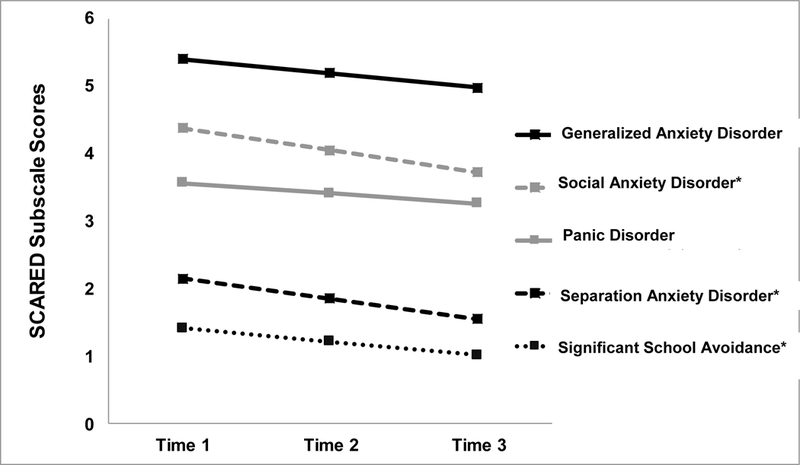
The primary goal of this study was to examine the associations between baseline body image dissatisfaction (BID) and subsequent anxiety trajectories in a diverse, community sample of adolescent girls and boys. Participants were 581 adolescents (baseline age: M = 16.1, SD = 0.7; 58% female; 65% non-Hispanic White) from U.S. public high schools. Self-report questionnaires were administered during school at 3 annual assessment waves. Latent growth curve modeling examined the association between baseline BID and growth factors of anxiety disorder symptom trajectories. Covariates included baseline gender, age, race/ethnicity, parental education attainment, body mass index standard scores, and depressive symptoms. Higher BID at baseline was significantly associated with higher initial symptoms of generalized anxiety disorder (GAD), panic disorder (PD), social anxiety disorder (SAD), and significant school avoidance (SSA; ps = .001-.04) but was unrelated to initial separation anxiety disorder (SEP) symptoms (p = .27). Higher baseline BID also was associated with attenuated decreases in SAD symptoms across time (p = .001). Among adolescents with low baseline anxiety symptoms only, higher BID was associated with more attenuated decreases in SAD symptoms (p = .01) and greater increases in PD symptoms (p = .02). BID was unrelated to changes in GAD, SEP, and SSA symptoms (ps = .11-.94). Findings suggest that BID is associated with concurrent symptoms of multiple anxiety disorders and may have a prospective link to SAD and PD symptoms during adolescence. As such, assessing body image issues may be important to assess when identifying adolescents at risk for exacerbated SAD and PD symptoms.
本研究的主要目的是检验基线身体意象不满(BID)与美国公立高中 581 名青少年(基线年龄:M=16.1,SD=0.7;58%为女性;65%为非西班牙裔白人)后续焦虑轨迹之间的关联。在 3 次年度评估中,通过学校发放自我报告问卷。潜在增长曲线模型检验了基线 BID 与焦虑障碍症状轨迹增长因素之间的关联。协变量包括基线性别、年龄、种族/民族、父母教育程度、体重指数标准分数和抑郁症状。基线 BID 较高与广泛性焦虑障碍(GAD)、惊恐障碍(PD)、社交焦虑障碍(SAD)和严重学校回避(SSA)的初始症状较高显著相关(ps=.001-.04),但与初始分离焦虑障碍(SEP)症状无关(p=.27)。较高的基线 BID 也与 SAD 症状随时间的衰减减少有关(p=.001)。仅在基线焦虑症状较低的青少年中,较高的 BID 与 SAD 症状的衰减减少更大(p=.01)和 PD 症状的增加更大有关(p=.02)。BID 与 GAD、SEP 和 SSA 症状的变化无关(ps=.11-.94)。研究结果表明,BID 与多种焦虑障碍的并发症状有关,并且可能与青少年时期 SAD 和 PD 症状的发展有关。因此,在识别易出现 SAD 和 PD 症状加重的青少年时,评估身体意象问题可能很重要。