Massachusetts General Hospital Center for Cancer Research and Harvard Medical School, Charlestown, MA 02129.
Massachusetts General Hospital Center for Cancer Research and Harvard Medical School, Charlestown, MA 02129;
Proc Natl Acad Sci U S A. 2017 Nov 14;114(46):E9913-E9922. doi: 10.1073/pnas.1707779114. Epub 2017 Oct 30.
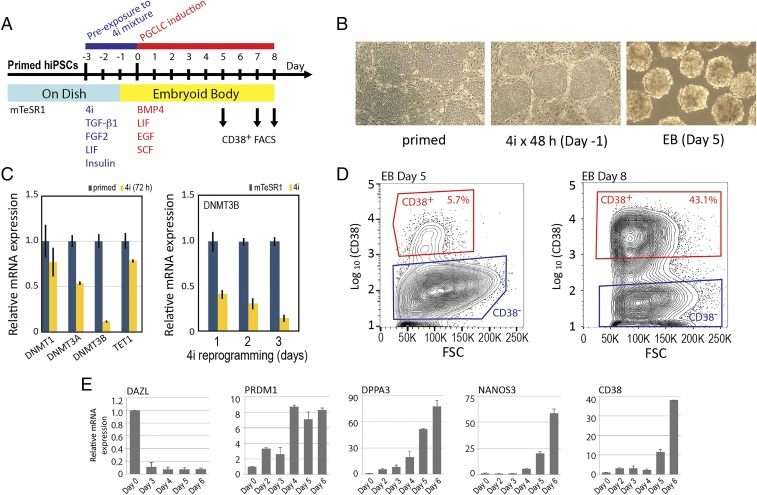
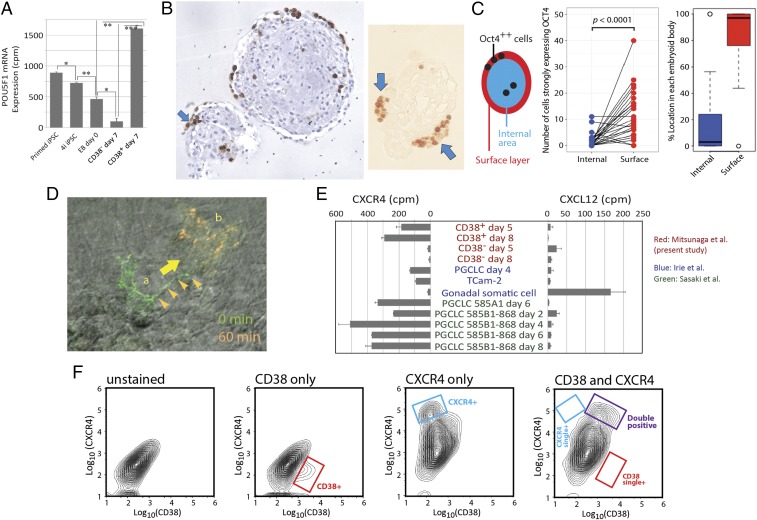
Pluripotent stem cell-derived human primordial germ cell-like cells (hPGCLCs) provide important opportunities to study primordial germ cells (PGCs). We robustly produced CD38 hPGCLCs [∼43% of FACS-sorted embryoid body (EB) cells] from primed-state induced pluripotent stem cells (iPSCs) after a 72-hour transient incubation in the four chemical inhibitors (4i)-naïve reprogramming medium and showed transcriptional consistency of our hPGCLCs with hPGCLCs generated in previous studies using various and distinct protocols. Both CD38 hPGCLCs and CD38 EB cells significantly expressed and , although PRDM1 mRNA in CD38 cells lacked the 3'-UTR harboring miRNA binding sites regulating mRNA stability. Genes up-regulated in hPGCLCs were enriched for cell migration genes, and their promoters were enriched for the binding motifs of TFAP2 (which was identified in promoters of , , and ) and the RREB-1 cell adhesion regulator. In EBs, hPGCLCs were identified exclusively in the outermost surface monolayer as dispersed cells or cell aggregates with strong and specific expression of POU5F1/OCT4 protein. Time-lapse live cell imaging revealed active migration of hPGCLCs on Matrigel. Whereas all hPGCLCs strongly expressed the CXCR4 chemotaxis receptor, its ligand CXCL12/SDF1 was not significantly expressed in the whole EBs. Exposure of hPGCLCs to CXCL12/SDF1 induced cell migration genes and antiapoptosis genes. Thus, our study shows that transcriptionally consistent hPGCLCs can be readily produced from hiPSCs after transition of their pluripotency from the primed state using various methods and that hPGCLCs resemble the early-stage PGCs randomly migrating in the midline region of human embryos before initiation of the CXCL12/SDF1-guided chemotaxis.
多能干细胞衍生的人类原始生殖细胞样细胞 (hPGCLCs) 为研究原始生殖细胞 (PGCs) 提供了重要机会。我们从初始状态的诱导多能干细胞 (iPSCs) 中,在含有四种化学抑制剂 (4i) 的无重编程培养基中短暂孵育 72 小时,成功地产生了 CD38 hPGCLCs[∼43% 的 FACS 分选胚胎体 (EB) 细胞],并显示我们的 hPGCLCs 与先前使用各种不同方案生成的 hPGCLCs 在转录上具有一致性。CD38 hPGCLCs 和 CD38 EB 细胞均显著表达了 和 ,尽管 CD38 细胞中的 PRDM1 mRNA 缺乏调节 mRNA 稳定性的含有 miRNA 结合位点的 3'-UTR。在 hPGCLCs 中上调的基因富集了参与细胞迁移的基因,其启动子富含 TFAP2 的结合基序(在 、 和 的启动子中被鉴定)和 RREB-1 细胞黏附调节剂。在 EB 中,hPGCLCs 仅在最外层表面单层中被鉴定为分散的细胞或细胞聚集体,其特征是 POU5F1/OCT4 蛋白的强烈和特异性表达。延时活细胞成像显示 hPGCLCs 在 Matrigel 上的活跃迁移。尽管所有 hPGCLCs 均强烈表达 CXCR4 趋化受体,但在整个 EB 中其配体 CXCL12/SDF1 并未显著表达。将 hPGCLCs 暴露于 CXCL12/SDF1 中可诱导细胞迁移基因和抗凋亡基因的表达。因此,我们的研究表明,使用各种方法从初始状态的 hiPSCs 中很容易产生转录一致的 hPGCLCs,并且 hPGCLCs 类似于人类胚胎中线粒体区域中随机迁移的早期 PGCs,在此之前,它们开始进行 CXCL12/SDF1 导向的趋化运动。