Toriola Adetunji T, Dang Ha X, Hagemann Ian S, Appleton Catherine M, Colditz Graham A, Luo Jingqin, Maher Christopher A
Department of Surgery, Division of Public Health Sciences, and Siteman Cancer Center, Washington University School of Medicine, St. Louis, MO, USA.
The McDonnell Genome Institute, and Department of Medicine, Washington University, St. Louis, MO, USA.
Oncotarget. 2017 May 17;8(43):73787-73792. doi: 10.18632/oncotarget.17909. eCollection 2017 Sep 26.
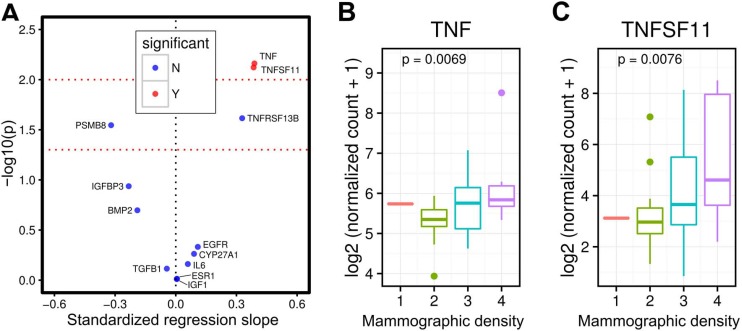
Increased mammographic breast density is associated with a 4-6-fold increased risk of breast cancer, yet lifestyle factors that can reduce dense breasts are yet to be identified, and viable prevention strategies to reduce breast density-associated breast cancer development are yet to be developed. We investigated the associations of breast tissue receptor activator of nuclear factor-κB (RANK) pathway gene expression with mammographic density in 48 premenopausal women, with no previous history of cancer. Gene expression levels were measured in total RNA isolated from formalin-fixed paraffin-embedded breast tissue samples, using the NanoString nCounter platform. Mammographic density was classified based on the American College of Radiology Breast Imaging Reporting and Data (BI-RADS). Linear regression was used to evaluate associations between gene expression and mammographic density. The mean age of participants was 44.4 years. Women with higher breast tissue RANKL () (-value = 0.0076), and TNF (-value = 0.007) gene expression had higher mammographic density. Our finding provides mechanistic support for a breast cancer chemoprevention trial with a RANKL inhibitor among high-risk premenopausal women with dense breasts.
乳腺钼靶密度增加与乳腺癌风险增加4至6倍相关,但尚未确定可降低乳腺致密性的生活方式因素,也尚未制定出可行的预防策略来减少与乳腺密度相关的乳腺癌发生。我们调查了48名无癌症病史的绝经前女性乳腺组织中核因子κB受体激活剂(RANK)通路基因表达与乳腺钼靶密度之间的关联。使用NanoString nCounter平台,对从福尔马林固定石蜡包埋的乳腺组织样本中分离的总RNA进行基因表达水平测量。乳腺钼靶密度根据美国放射学会乳腺影像报告和数据系统(BI-RADS)进行分类。采用线性回归评估基因表达与乳腺钼靶密度之间的关联。参与者的平均年龄为44.4岁。乳腺组织中RANKL(P值 = 0.0076)和TNF(P值 = 0.007)基因表达较高的女性,其乳腺钼靶密度也较高。我们的研究结果为在乳腺致密的高危绝经前女性中开展使用RANKL抑制剂的乳腺癌化学预防试验提供了机制支持。