Citrus Research Institute, Southwest University, Chongqing, China.
United States Department of Agriculture-Agricultural Research Service, Molecular Plant Pathology Laboratory, Beltsville, MD, USA.
BMC Genomics. 2017 Oct 31;18(1):837. doi: 10.1186/s12864-017-4174-8.
Citrus worldwide is threatened by huanglongbing (HLB) and tristeza diseases caused by 'Candidatus Liberibacter asiaticus' (CaLas) and Citrus tristeza virus (CTV). Although the pathogens are members of the α-proteobacteria and Closteroviridae, respectively, both are restricted to phloem cells in infected citrus and are transmitted by insect vectors. The response of sweet orange to single infection by either of these two pathogens has been characterized previously by global gene expression analysis. But because of the ubiquity of these pathogens where the diseases occur, co-infection by both pathogens is very common and could lead to increased disease severity based on synergism. We therefore co-inoculated sweet orange trees with CaLas and either a mild or a severe strain of CTV, and measured changes of gene expression in host plants.
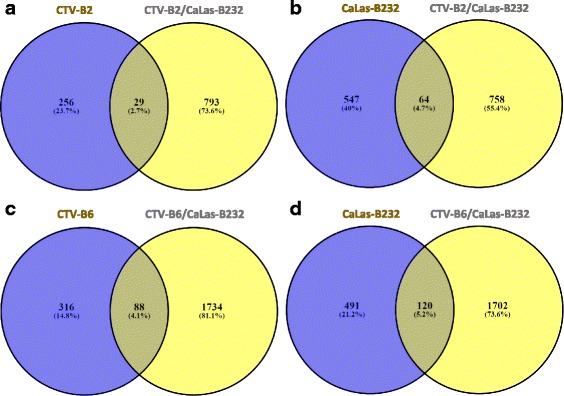
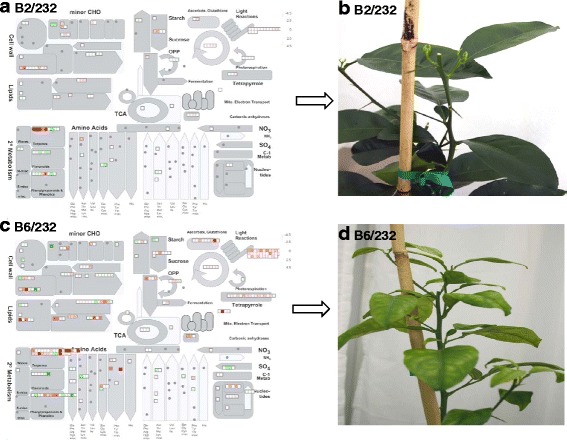
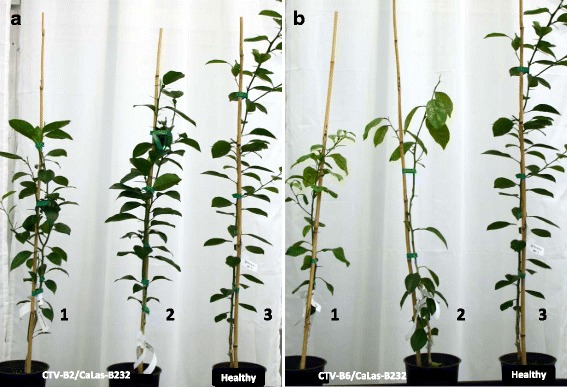
In plants infected with CaLas-B232, the overall alteration in gene expression was much greater in plants co-inoculated with the severe strain of CTV, B6, than when co-infected with the mild strain of CTV, B2. Plants co-infected with CaLas-B232 and either strain of CTV died but trees co-infected with CTV-B2 survived much longer than those co-infected with CTV-B6. Many important pathways were perturbed by both CTV-B2/CaLas-B232 and/or CTV-B6/CaLas-B232, but always more severely by CTV-B6/CaLas-B232. Genes related to cell wall modification and metal transport responded differently to infection by the pathogens in combination than by the same pathogens singly. The expressions of genes encoding phloem proteins and sucrose loading proteins were also differentially altered in response to CTV-B2 or CTV-B6 in combination with CaLas-B232, leading to different phloem environments in plants co-infected by CaLas and mild or severe CTV.
Many host genes were expressed differently in response to dual infection as compared to single infections with the same pathogens. Interactions of the pathogens within the host may lead to a better or worse result for the host plant. CTV-B6 may exert a synergistic effect with CaLas-B232 in weakening the plant; on the other hand, the responses activated by the mild strain CTV-B2 may provide some beneficial effects against CaLas-B232 by increasing the defense response of the host.
黄龙病(HLB)和衰退病由“亚洲韧皮杆菌”(CaLas)和柑橘衰退病毒(CTV)引起,对世界范围内的柑橘构成威胁。尽管这两种病原体分别属于α-变形菌和杆状病毒科,但它们都局限于感染柑橘的韧皮部细胞,并通过昆虫媒介传播。先前已经通过全基因表达分析对单一感染这两种病原体的甜橙的反应进行了描述。但是,由于这些病原体在发生疾病的地方无处不在,因此两者的共同感染非常普遍,并且可能由于协同作用而导致疾病严重程度增加。因此,我们将 CaLas 与 CTV 的轻度或重度菌株共同接种甜橙树,并测量宿主植物中基因表达的变化。
在感染 CaLas-B232 的植物中,与感染轻度 CTV 菌株 B2 相比,与严重 CTV 菌株 B6 共同感染的植物中基因表达的整体变化更大。与感染 CTV-B2/CaLas-B232 或 CTV-B6/CaLas-B232 的植物死亡,但与感染 CTV-B6/CaLas-B232 的树木相比,与感染 CTV-B2/CaLas-B232 的树木存活的时间长得多。许多重要途径受到 CTV-B2/CaLas-B232 和/或 CTV-B6/CaLas-B232 的干扰,但总是受到 CTV-B6/CaLas-B232 的干扰更为严重。细胞壁修饰和金属转运相关基因对病原体组合感染的反应与单一病原体感染的反应不同。与 CaLas-B232 共同感染时,编码韧皮部蛋白和蔗糖加载蛋白的基因的表达也不同,导致 CaLas 和轻度或重度 CTV 共同感染的植物中的韧皮部环境不同。
与单一感染相同病原体相比,许多宿主基因的表达在双重感染时有所不同。病原体在宿主体内的相互作用可能会给宿主植物带来更好或更差的结果。CTV-B6 可能与 CaLas-B232 协同作用削弱植物;另一方面,CTV-B2 引起的轻度反应可能会通过增加宿主的防御反应而对 CaLas-B232 产生一些有益的影响。