Fu Shimin, Shao Jonathan, Zhou Changyong, Hartung John S
Citrus Research Institute, Southwest UniversityChongqing, China.
Molecular Plant Pathology Laboratory, United States Department of Agriculture-Agricultural Research ServiceBeltsville, MD, United States.
Front Plant Sci. 2017 Aug 31;8:1419. doi: 10.3389/fpls.2017.01419. eCollection 2017.
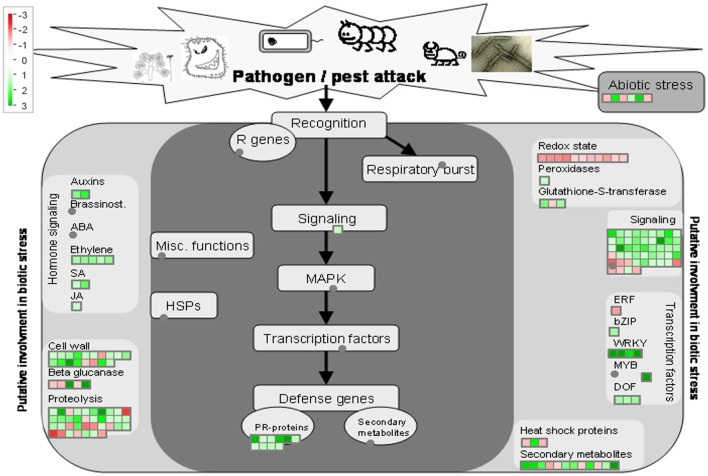
Citrus tristeza is one of the most destructive citrus diseases and is caused by the phloem-restricted Closterovirus, . Mild strain CTV-B2 does not cause obvious symptoms on indicators whereas severe strain CTV-B6 causes symptoms, including stem pitting, cupping, yellowing, and stiffening of leaves, and vein corking. Our laboratory has previously characterized changes in transcription in sweet orange separately infected with CTV-B2 and CTV-B6. In the present study, transcriptome analysis of in response to double infection by CTV-B2 and CTV-B6 was carried out. Four hundred and eleven transcripts were up-regulated and 356 transcripts were down-regulated prior to the onset of symptoms. Repressed genes were overwhelmingly associated with photosynthesis, and carbon and nucleic acid metabolism. Expression of genes related to the glycolytic, oxidative pentose phosphate (OPP), tricarboxylic acid cycle (TCA) pathways, tetrapyrrole synthesis, redox homeostasis, nucleotide metabolism, protein synthesis and post translational protein modification and folding, and cell organization were all reduced. Ribosomal composition was also greatly altered in response to infection by CTV-B2/CTV-B6. Genes that were induced were related to cell wall structure, secondary and hormone metabolism, responses to biotic stress, regulation of transcription, signaling, and secondary metabolism. Transport systems dedicated to metal ions were especially disturbed and ZIPs (Zinc Transporter Precursors) showed different expression patterns in response to co-infection by CTV-B2/CTV-B6 and single infection by CTV-B2. Host plants experienced root decline that may have contributed to Zn, Fe, and other nutrient deficiencies. Though defense responses, such as, strengthening of the cell wall, alteration of hormone metabolism, secondary metabolites, and signaling pathways, were activated, these defense responses did not suppress the spread of the pathogens and the development of symptoms. The mild strain CTV-B2 did not provide a useful level of cross-protection to citrus against the severe strain CTV-B6.
柑橘衰退病是最具毁灭性的柑橘病害之一,由韧皮部限制型的柑橘速衰病毒引起。温和株系CTV-B2在指示植物上不引起明显症状,而强毒株系CTV-B6则会引发症状,包括茎陷点、叶片杯状卷曲、黄化和僵硬以及叶脉木栓化。我们实验室之前已经分别对感染CTV-B2和CTV-B6的甜橙转录变化进行了表征。在本研究中,对CTV-B2和CTV-B6双重感染的甜橙进行了转录组分析。在症状出现之前,有411个转录本上调,356个转录本下调。受抑制的基因绝大多数与光合作用、碳和核酸代谢相关。与糖酵解、氧化戊糖磷酸途径(OPP)、三羧酸循环(TCA)途径、四吡咯合成、氧化还原稳态、核苷酸代谢、蛋白质合成以及翻译后蛋白质修饰和折叠以及细胞组织相关的基因表达均降低。核糖体组成也因CTV-B2/CTV-B6感染而发生了很大改变。被诱导的基因与细胞壁结构、次生代谢和激素代谢、对生物胁迫的反应、转录调控、信号传导以及次生代谢相关。专门负责金属离子的转运系统尤其受到干扰,锌转运体前体(ZIPs)在CTV-B2/CTV-B6双重感染和CTV-B2单一感染时表现出不同的表达模式。寄主植物出现根系衰退,这可能导致了锌、铁和其他营养元素缺乏。尽管激活了防御反应,如细胞壁强化、激素代谢改变、次生代谢产物和信号传导途径,但这些防御反应并未抑制病原体的传播和症状的发展。温和株系CTV-B2并未为柑橘提供有效的交叉保护以抵御强毒株系CTV-B6。