Department of Computer Science & Engineering, University of Connecticut, Storrs, CT, USA.
The Jackson Laboratory for Genomic Medicine, Farmington, CT, USA.
Sci Rep. 2017 Oct 31;7(1):14466. doi: 10.1038/s41598-017-14389-7.
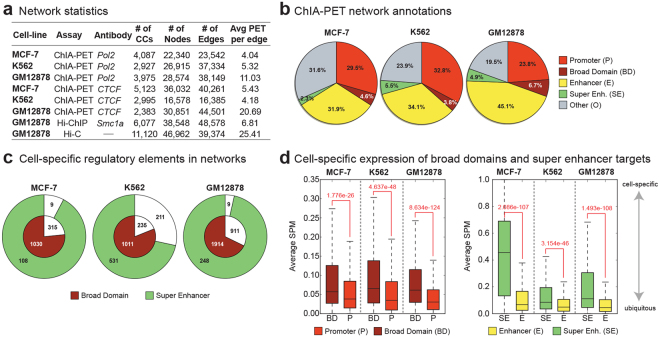
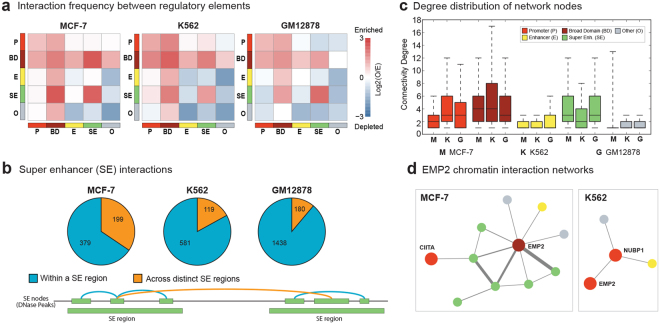
Broad domain promoters and super enhancers are regulatory elements that govern cell-specific functions and harbor disease-associated sequence variants. These elements are characterized by distinct epigenomic profiles, such as expanded deposition of histone marks H3K27ac for super enhancers and H3K4me3 for broad domains, however little is known about how they interact with each other and the rest of the genome in three-dimensional chromatin space. Using network theory methods, we studied chromatin interactions between broad domains and super enhancers in three ENCODE cell lines (K562, MCF7, GM12878) obtained via ChIA-PET, Hi-C, and Hi-CHIP assays. In these networks, broad domains and super enhancers interact more frequently with each other compared to their typical counterparts. Network measures and graphlets revealed distinct connectivity patterns associated with these regulatory elements that are robust across cell types and alternative assays. Machine learning models showed that these connectivity patterns could effectively discriminate broad domains from typical promoters and super enhancers from typical enhancers. Finally, targets of broad domains in these networks were enriched in disease-causing SNPs of cognate cell types. Taken together these results suggest a robust and unique organization of the chromatin around broad domains and super enhancers: loci critical for pathologies and cell-specific functions.
广泛域启动子和超级增强子是调节元件,它们控制细胞特异性功能,并拥有与疾病相关的序列变异。这些元件的特征是具有独特的表观基因组特征,例如超级增强子的 H3K27ac 组蛋白标记的扩展沉积和广泛域的 H3K4me3,然而,关于它们如何在三维染色质空间中与彼此以及基因组的其余部分相互作用,知之甚少。使用网络理论方法,我们通过 ChIA-PET、Hi-C 和 Hi-CHIP 测定法,在三个 ENCODE 细胞系(K562、MCF7、GM12878)中研究了广泛域和超级增强子之间的染色质相互作用。在这些网络中,与典型的对应物相比,广泛域和超级增强子之间相互作用更为频繁。网络度量和图元揭示了与这些调节元件相关的独特连接模式,这些模式在细胞类型和替代测定中是稳健的。机器学习模型表明,这些连接模式可以有效地将广泛域与典型启动子区分开来,将超级增强子与典型增强子区分开来。最后,这些网络中广泛域的靶标在同源细胞类型的致病 SNP 中富集。总之,这些结果表明,广泛域和超级增强子周围的染色质具有稳健而独特的组织:这些是与病理和细胞特异性功能相关的关键基因座。