Koroukian Siran M, Schiltz Nicholas K, Warner David F, Sun Jiayang, Stange Kurt C, Given Charles W, Dor Avi
Department of Epidemiology and Biostatistics, School of Medicine, Case Western Reserve University, Cleveland, OH, USA.
Department of Sociology, University of Nebraska-Lincoln, Lincoln, NE, USA.
J Comorb. 2017 Apr 10;7(1):33-43. doi: 10.15256/joc.2017.7.91. eCollection 2017.
The Department of Health and Human Services' 2010 Strategic Framework on Multiple Chronic Conditions called for the identification of common constellations of conditions in older adults.
To analyze patterns of conditions constituting multimorbidity (CCMM) and expenditures in a US representative sample of midlife and older adults (50-64 and ≥65 years of age, respectively).
A cross-sectional study of the 2010 Health and Retirement Study (HRS; =17,912). The following measures were used: (1) count and combinations of CCMM, including (i) chronic conditions (hypertension, arthritis, heart disease, lung disease, stroke, diabetes, cancer, and psychiatric conditions), (ii) functional limitations (upper body limitations, lower body limitations, strength limitations, limitations in activities of daily living, and limitations in instrumental activities of daily living), and (iii) geriatric syndromes (cognitive impairment, depressive symptoms, incontinence, visual impairment, hearing impairment, severe pain, and dizziness); and (2) annualized 2011 Medicare expenditures for HRS participants who were Medicare fee-for-service beneficiaries (=5,677). Medicaid beneficiaries were also identified based on their self-reported insurance status.
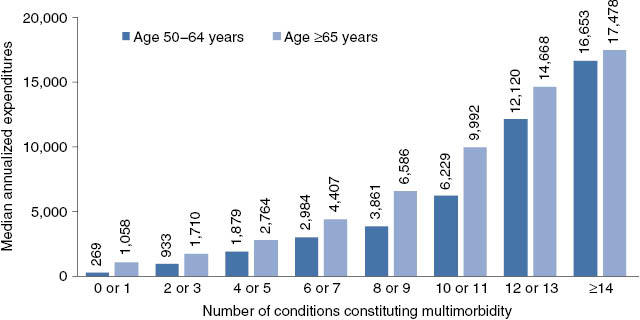
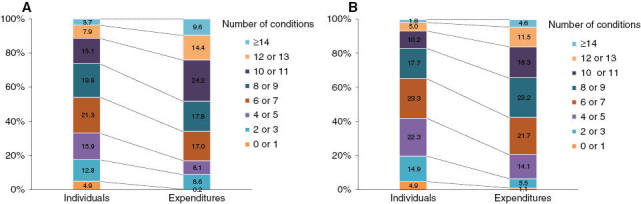
No large representations of participants within specific CCMM categories were observed; however, functional limitations and geriatric syndromes were prominently present with higher CCMM counts. Among fee-for-service Medicare beneficiaries aged 50-64 years, 26.7% of the participants presented with ≥10 CCMM, but incurred 48% of the expenditure. In those aged ≥65 years, these percentages were 16.9% and 34.4%, respectively.
Functional limitations and geriatric syndromes considerably add to the MM burden in midlife and older adults. This burden is much higher than previously reported.
美国卫生与公众服务部2010年《多重慢性病战略框架》呼吁确定老年人常见的疾病组合。
分析美国中年及老年成年人(分别为50 - 64岁和≥65岁)代表性样本中构成多重疾病的疾病模式(CCMM)及支出情况。
对2010年健康与退休研究(HRS;n = 17,912)进行横断面研究。采用了以下测量方法:(1)CCMM的计数及组合,包括(i)慢性病(高血压、关节炎、心脏病、肺病、中风、糖尿病、癌症和精神疾病),(ii)功能受限(上身受限、下身受限、力量受限、日常生活活动受限和工具性日常生活活动受限),以及(iii)老年综合征(认知障碍、抑郁症状、尿失禁、视力障碍、听力障碍、重度疼痛和头晕);(2)2011年HRS参与者(n = 5,677)的年化医疗保险支出,这些参与者为医疗保险按服务付费受益人。还根据自我报告的保险状况确定了医疗补助受益人。
未观察到特定CCMM类别中有大量参与者;然而,功能受限和老年综合征在CCMM计数较高时显著存在。在50 - 64岁的按服务付费医疗保险受益人中,26.7%的参与者患有≥10种CCMM,但产生了48%的支出。在≥65岁的人群中,这些百分比分别为16.9%和34.4%。
功能受限和老年综合征显著增加了中年及老年成年人的多重疾病负担。这一负担比先前报告的要高得多。