Longo Jean De Dieu, Simaléko Marcel Mbéko, Ngbale Richard, Grésenguet Gérard, Brücker Gilles, Bélec Laurent
a MD, MSc, PhD in Public Health, at the Centre National de Référence des Maladies Sexuellement Transmissibles et de la Thérapie Antirétrovirale , Bangui , Central African Republic .
b MD at the Service de Gynéco-obstétrique, hôpital Communautaire , Bangui , Central African Republic.
SAHARA J. 2017 Dec;14(1):171-184. doi: 10.1080/17290376.2017.1394907.
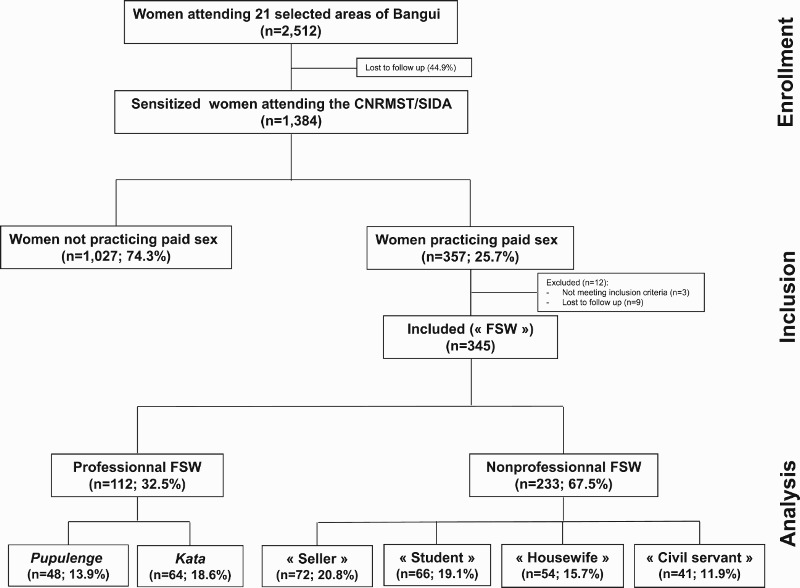
Classification of professional and non-professional female sex workers (FSWs) into different categories, never previously reported in the Central African Republic (CAR), may be useful to assess the dynamics of the human immunodeficiency virus (HIV) epidemic, design operational intervention programmes to combat HIV and other sexually transmitted infections (STIs) and to adapt these programmes to the broad spectrum of sexual transactions in the CAR. Our study proposes a socio-behavioural classification of FSWs living in the CAR and engaged in transactional and commercial sex. Thus, the aims of the study were these: (i) to categorize FSWs according to socio-anthropologic criteria in Bangui and (ii) to examine the association between a selection of demographic and risk variables with the different categories of female sex work as an outcome. A cross-sectional questionnaire survey was conducted in 2013 to describe the spectrum of commercial sex work (CSW) in Bangui among 345 sexually active women having more than 2 sexual partners, other than their regular partner, during the prior 3 months and reporting to have received money or gifts in return for their sexual relationships. According to socio-behavioural characteristics, FSWs were classified into six different categories. Professional FSWs, constituting 32.5% of the interviewed women, were divided in two categories: pupulenge (13.9%), i.e., dragonflies (sometimes called gba moundjou, meaning literally look at the White) consisting of roamers, who travel around the city to hotels and nightclubs seeking wealthy clients, with a preference for French men; and the category of kata (18.6%), i.e., FSWs working in poor neighbourhoods. Non-professional FSWs, constituting 67.5% of the interviewed women, were divided into four categories: street and market vendors (20.8%), students (19.1%), housewives (15.7%) and unskilled civil servants (11.9%). In general, CSW in the CAR presents a remarkably heterogeneous phenomenon. Risk-taking behaviour regarding STI/HIV infection appears to be different according to the different categories of female CSW. The groups of katas and street vendors were poorer and less educated, consumed more alcohol or other psycho-active substances (cannabis, tramadol and glue) and, consequently, were more exposed to STI. Our results emphasise the high level of vulnerability of both poor professional FSWs (kata) and non-professional sex workers, especially street vendors, who should be taken into account when designing prevention programmes targeting this population for STI/HIV control purposes.
将职业和非职业女性性工作者(FSW)划分为不同类别,这在中非共和国(CAR)此前从未有过报道,对于评估人类免疫缺陷病毒(HIV)流行态势、设计抗击HIV及其他性传播感染(STI)的行动干预项目以及使这些项目适应中非共和国广泛的性交易情况可能会有所帮助。我们的研究提出了对生活在中非共和国且从事交易性和商业性性行为的女性性工作者进行社会行为分类的方法。因此,本研究的目的如下:(i)根据班吉的社会人类学标准对女性性工作者进行分类,以及(ii)将一系列人口统计学和风险变量与不同类别的女性性工作作为结果进行关联分析。2013年开展了一项横断面问卷调查,以描述班吉商业性性行为(CSW)的范围,调查对象为345名在过去3个月内除其固定伴侣外有超过2个性伴侣且报告因性行为获得金钱或礼物的性活跃女性。根据社会行为特征,女性性工作者被分为六个不同类别。职业女性性工作者占受访女性的32.5%,分为两类:“pupulenge”(13.9%),即“蜻蜓”(有时称为“gba moundjou”,字面意思是“看白人”),由在城市中四处游荡到酒店和夜总会寻找有钱客户、偏好法国男性的流动者组成;以及“kata”类(18.6%),即在贫困社区工作的女性性工作者。非职业女性性工作者占受访女性的67.5%,分为四类:街头和市场小贩(20.8%)、学生(19.1%)、家庭主妇(15.7%)和非技术公务员(11.9%)。总体而言,中非共和国的商业性性行为呈现出显著的异质性现象。不同类别的女性商业性性行为者在性传播感染/艾滋病毒感染方面的冒险行为似乎有所不同。“kata”组和街头小贩群体较为贫困且受教育程度较低,饮酒或使用其他精神活性物质(大麻、曲马多和胶水)更多,因此更容易感染性传播感染。我们的结果强调了贫困的职业女性性工作者(“kata”)和非职业性工作者,尤其是街头小贩的高度脆弱性,在设计针对该人群进行性传播感染/艾滋病毒控制的预防项目时应将其考虑在内。