Tonen-Wolyec Serge, Batina-Agasa Salomon, Longo Jean De Dieu, Mboumba Bouassa Ralph-Sydney, Bélec Laurent
Ecole Doctorale Régionale d'Afrique Centrale en Infectiologie Tropicale, Franceville, Gabon.
Faculté de Médecine, Université de Bunia, Bunia.
Medicine (Baltimore). 2019 Feb;98(6):e14218. doi: 10.1097/MD.0000000000014218.
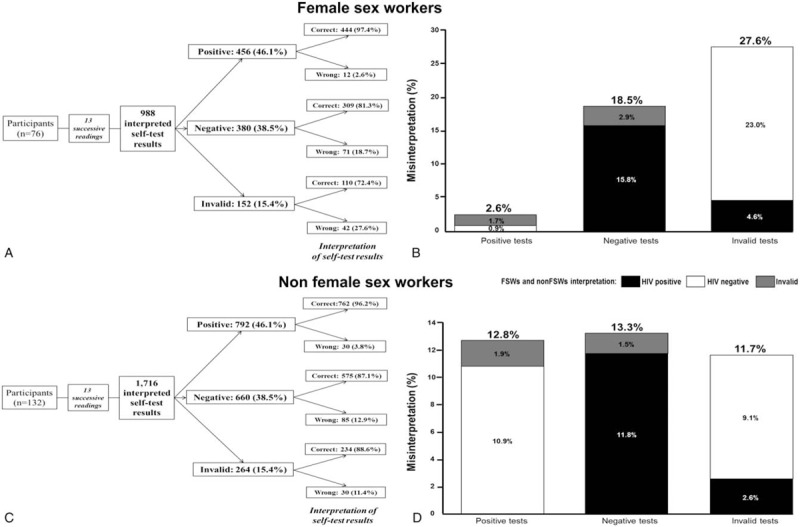
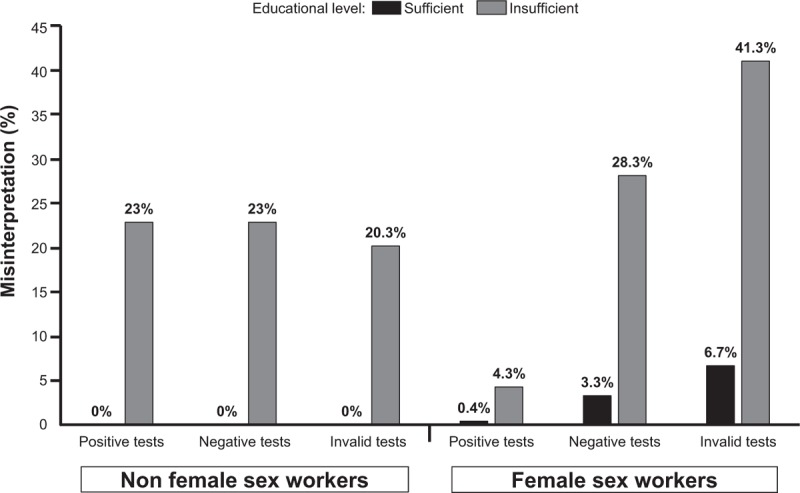
We report on field interpretation of HIV self-testing among female sex workers (FSWs) and non-FSWs living in Democratic Republic of the Congo.Two hundred and eight participants [76 (36.5%) FSWs; 132 (63.5%) non-FSWs] were enrolled in Kisangani and Bunia to evaluate their ability to read and interpret the results of a prototype HIV self-test (Exacto Test HIV, Biosynex, Strasbourg, France), according to WHO recommendations. Thirteen standardized tests (6 positive, 5 negative, 2 invalid) were proposed after successive random selection.Two thousand seven hundred and four standardized tests (1248 positive, 1040 negative, 416 invalid) were interpreted; 2435 (90.1%) were correctly interpreted, whereas 269 (9.9%) were misinterpreted. In FSWs and non-FSWs, the test results were similarly correctly interpreted in 87.4% (864/988) and 91.6% (1571/1716), respectively. In multivariate logistic regression analysis, only the variable "educational level" remained strongly associated with the interpretation of positive, negative, and invalid HIV self-test results, but not the variables "commercial sex work" and "language chosen for instructions for use." Incorrect interpretation was significantly higher in participants with insufficient educational level than in those with sufficient education level for positive (13.1% vs 2.6%; adjusted OR: 4.5), negative (22.3% vs 2.6%; adjusted OR: 5.3), and invalid test results (23.8% v 6.4%; adjusted OR: 3.6).Incorrect interpretation of HIV self-test was as common in FSWs and non-FSWs. The lower was the educational level, the greater was the difficulty to interpret results correctly. These observations point that insufficient education level, rather than commercial sex work by itself, constitutes a key factor of incorrect interpretation of HIV self-test.
我们报告了刚果民主共和国女性性工作者(FSW)和非女性性工作者中HIV自我检测的现场解读情况。208名参与者[76名(36.5%)女性性工作者;132名(63.5%)非女性性工作者]在基桑加尼和布尼亚登记入组,以根据世界卫生组织的建议评估她们阅读和解读HIV自我检测原型(Exacto Test HIV,法国斯特拉斯堡的Biosynex公司)结果的能力。经过连续随机选择后,提供了13次标准化检测(6次阳性、5次阴性、2次无效)。共解读了2704次标准化检测(1248次阳性、1040次阴性、416次无效);2435次(90.1%)被正确解读,而269次(9.9%)被错误解读。在女性性工作者和非女性性工作者中,检测结果的正确解读率分别为87.4%(864/988)和91.6%(1571/1716)。在多因素逻辑回归分析中,只有“教育水平”变量与HIV自我检测阳性、阴性和无效结果的解读仍有强烈关联,而“商业性工作”和“使用说明所选用的语言”变量则没有。教育水平不足的参与者对阳性(13.1%对2.6%;调整后的比值比:4.5)、阴性(22.3%对2.6%;调整后的比值比:5.3)和无效检测结果的错误解读率显著高于教育水平充足的参与者(23.8%对6.4%;调整后的比值比:3.6)。HIV自我检测的错误解读在女性性工作者和非女性性工作者中同样常见。教育水平越低,正确解读结果的难度就越大。这些观察结果表明,教育水平不足而非商业性工作本身是HIV自我检测错误解读的关键因素。