Rey-Martinez Jorge, Yanes Joaquin, Esteban Jonathan, Sanz Ricardo, Martin-Sanz Eduardo
ENT Unit ORLGipuzkoa, Hospital Quironsalud Donostia, San Sebastián, Spain.
ENT Department, Hospital Universitario Donostia, San Sebastián, Spain.
Front Neurol. 2017 Oct 18;8:536. doi: 10.3389/fneur.2017.00536. eCollection 2017.
In the suppression head impulse paradigm (SHIMP) vHIT protocol, the participant is instructed to follow with his gaze a mobile target generated by a laser placed on the participant's head. Recent studies have reported that the refixation saccade latencies are in relation with the time evolution of the vestibular dysfunction in both (standard and SHIMP) procedures. We hypothesized that some central mechanisms like head impulse prediction could be one of the causes for the differences in the saccadic eye responses.
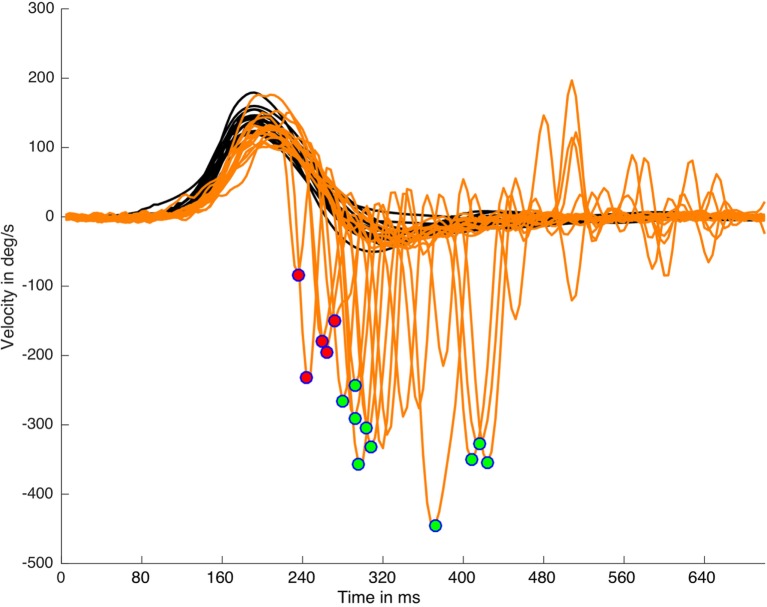
A prospective cohort non-randomized study was designed. For the SHIMP protocol, recorded with the ICS Impulse ver. 4.0 (Otometrics A/S, Taastrup, Denmark) vHIT device, three different algorithms were performed: "predictable," "less predictable," and "unpredictable" depending on the target's predictability. A mathematical method was developed to analyze the SHIMP responses. The method was implemented as an additional tool to the MATLAB open source script for the extended analysis of the vHIT responses named HITCal.
In cohort 1, 52 participants were included in "predictable" SHIMP protocol. In cohort 2, 60 patients were included for the "less predictable" and 35 patients for the "unpredictable" SHIMP protocol. The participants made more early saccades when instructed to perform the "predictable" paradigm compared with the "less predictable" paradigm ( < 0.001). The less predictable protocol did not reveal any significant difference when compared with the unpredictable protocol ( = 0.189). For the latency of the first saccade, there was statistical difference between the "unpredictable" and "predictable" protocols ( < 0.001) and between the "less predictable" and "predictable" protocols ( < 0.001). Finally, we did not find any relationship between the horizontal vestibulo-ocular reflex (hVOR) gain and the latency of the saccades.
We developed a specific method to analyze and detect early SHIMP saccades. Our findings offer evidence regarding the influence of predictability on the latency of the SHIMP saccadic responses, suggesting that early saccades are probably caused by a conditioned response of the participant. The lack of relationship between the hVOR gain and the latency of the saccades suggests that the predictive behavior that caused the early eye saccades are independent of the vestibular function.
在抑制性头脉冲范式(SHIMP)视频眼震图(vHIT)协议中,参与者被要求用目光跟踪置于其头部的激光产生的移动目标。最近的研究报告称,在(标准和SHIMP)两种程序中,重新注视扫视潜伏期与前庭功能障碍的时间演变有关。我们推测,诸如头脉冲预测等一些中枢机制可能是眼跳反应差异的原因之一。
设计了一项前瞻性队列非随机研究。对于SHIMP协议,使用ICS Impulse ver. 4.0(丹麦Taastrup的Otometrics A/S公司)vHIT设备进行记录,根据目标的可预测性执行三种不同的算法:“可预测”、“较不可预测”和“不可预测”。开发了一种数学方法来分析SHIMP反应。该方法作为MATLAB开源脚本的附加工具得以实现,用于对名为HITCal的vHIT反应进行扩展分析。
在队列1中,52名参与者纳入“可预测”的SHIMP协议。在队列2中,60名患者纳入“较不可预测”的SHIMP协议,35名患者纳入“不可预测”的SHIMP协议。与“较不可预测”范式相比,参与者在被指示执行“可预测”范式时出现更多早期扫视(<0.001)。与不可预测协议相比,较不可预测协议未显示出任何显著差异(=0.189)。对于首次扫视的潜伏期,“不可预测”与“可预测”协议之间(<0.001)以及“较不可预测”与“可预测”协议之间(<0.001)存在统计学差异。最后,我们未发现水平前庭眼反射(hVOR)增益与扫视潜伏期之间存在任何关系。
我们开发了一种特定方法来分析和检测早期SHIMP扫视。我们的研究结果提供了关于可预测性对SHIMP眼跳反应潜伏期影响的证据,表明早期扫视可能是参与者的一种条件反应所致。hVOR增益与扫视潜伏期之间缺乏关系表明,导致早期眼跳的预测行为独立于前庭功能。