Institute of Cancer Research Clinical Trials and Statistics Unit, Division of Clinical Studies, The Institute of Cancer Research, London, UK.
Macmillan Survivorship Research Group, Faculty of Health Sciences, University of Southampton, Southampton, UK.
Psychooncology. 2017 Dec;26(12):2276-2284. doi: 10.1002/pon.4556. Epub 2017 Nov 1.
Social support is acknowledged as important in cancer survivorship, but little is known about change in support after cancer diagnosis and factors associated with this, particularly in colorectal cancer. The CREW cohort study investigated social support up to 2 years following curative intent surgery for colorectal cancer.
A total of 871 adults recruited pre-treatment from 29 UK centres 2010 to 2012 consented to follow-up. Questionnaires at baseline, 3, 9, 15, and 24 months post-surgery included assessments of social support (Medical Outcomes Study-Social Support Survey, MOS-SSS) and health-related quality of life (HRQoL). Socio-demographic, clinical and treatment details were collected. Longitudinal analyses assessed social support over follow-up, associations with participant characteristics, and HRQoL.
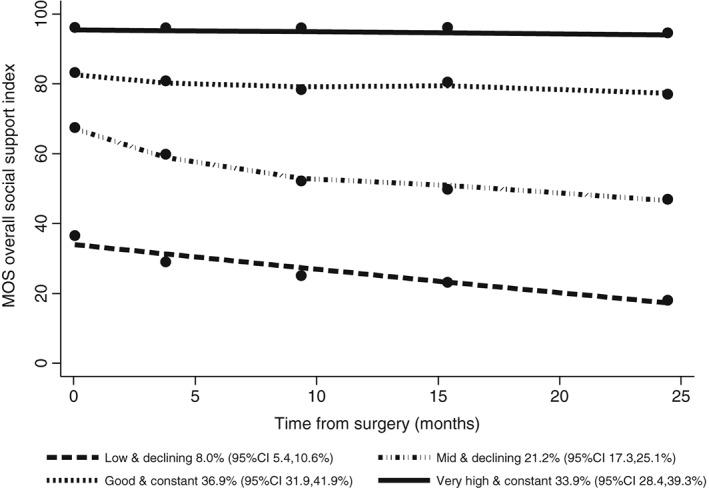
Around 20% were living alone and 30% without a partner. Perceived social support declined in around 29% of participants, with 8% of these reporting very low levels overall from baseline to 2 years (mean MOS-SSS overall score < 40 on a scale from 0 to 100). Older age, female gender, greater neighbourhood deprivation, presence of co-morbidities, and rectal cancer site were significantly associated with reductions in perceived support. Poorer HRQoL outcomes (generic health/QoL, reduced wellbeing, anxiety, and depression) were significantly associated with lower levels of social support.
Levels of social support decline following colorectal cancer diagnosis and treatment in nearly a third of patients and are an important risk factor for recovery of HRQoL. Assessment of support early on and throughout follow-up would enable targeted interventions to improve recovery, particularly in the more vulnerable patient groups at risk of poorer social support.
社会支持在癌症生存中被认为很重要,但人们对癌症诊断后支持的变化以及与之相关的因素知之甚少,特别是在结直肠癌中。CREW 队列研究调查了在接受结直肠癌根治性手术后 2 年内的社会支持情况。
2010 年至 2012 年,共有 871 名成年人在英国 29 个中心接受治疗前招募,同意进行随访。基线、3、9、15 和 24 个月的手术后问卷调查包括社会支持(医疗结局研究社会支持调查,MOS-SSS)和健康相关生活质量(HRQoL)评估。收集了社会人口统计学、临床和治疗细节。纵向分析评估了随访期间的社会支持、与参与者特征的关联以及 HRQoL。
约 20%的人独居,30%的人没有伴侣。约 29%的参与者感知到的社会支持下降,其中 8%的人从基线到 2 年的总体水平报告非常低(MOS-SSS 总分在 0 到 100 的量表上<40)。年龄较大、女性、邻里贫困程度较高、合并症存在以及直肠癌部位与感知支持减少显著相关。较差的 HRQoL 结局(一般健康/生活质量、幸福感降低、焦虑和抑郁)与较低的社会支持水平显著相关。
近三分之一的结直肠癌患者在诊断和治疗后社会支持水平下降,这是影响 HRQoL 恢复的一个重要危险因素。早期和整个随访期间对支持情况进行评估,将有助于实施有针对性的干预措施,改善恢复情况,特别是对社会支持较差的高危患者群体。