Furth Katrina E, McCoy Alex J, Dodge Caroline, Walters Judith R, Buonanno Andres, Delaville Claire
Neurophysiological Pharmacology Section, National Institute of Neurological Disorders and Stroke, National Institutes of Health, Bethesda, Maryland, United States of America.
Graduate Program for Neuroscience, Boston University, Boston, Massachusetts, United States of America.
PLoS One. 2017 Nov 2;12(11):e0186732. doi: 10.1371/journal.pone.0186732. eCollection 2017.
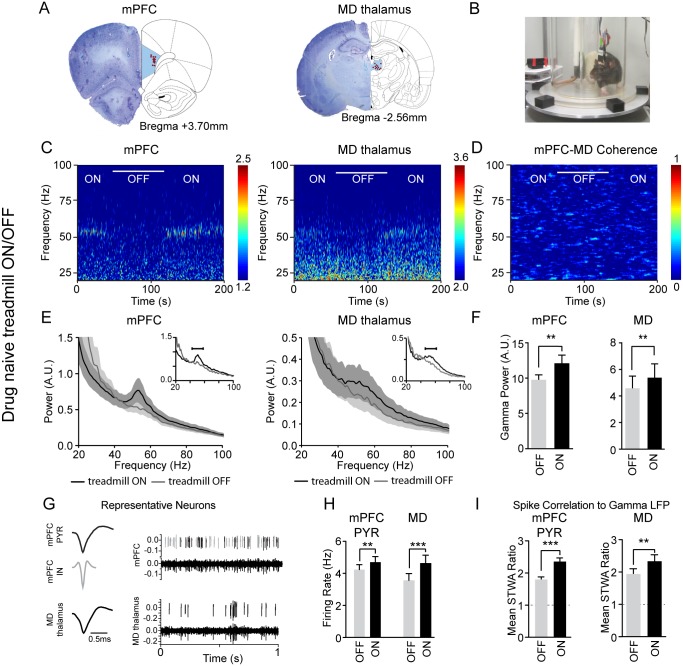
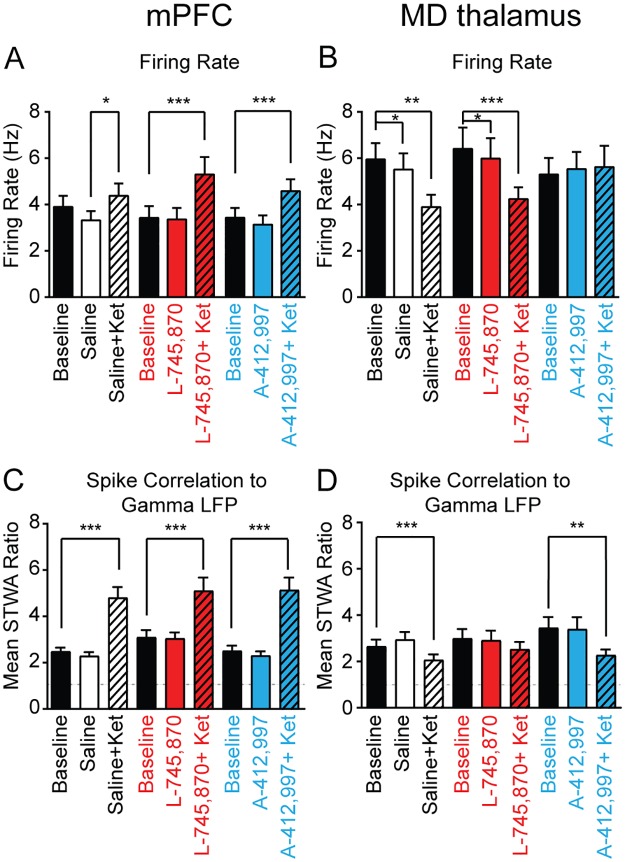
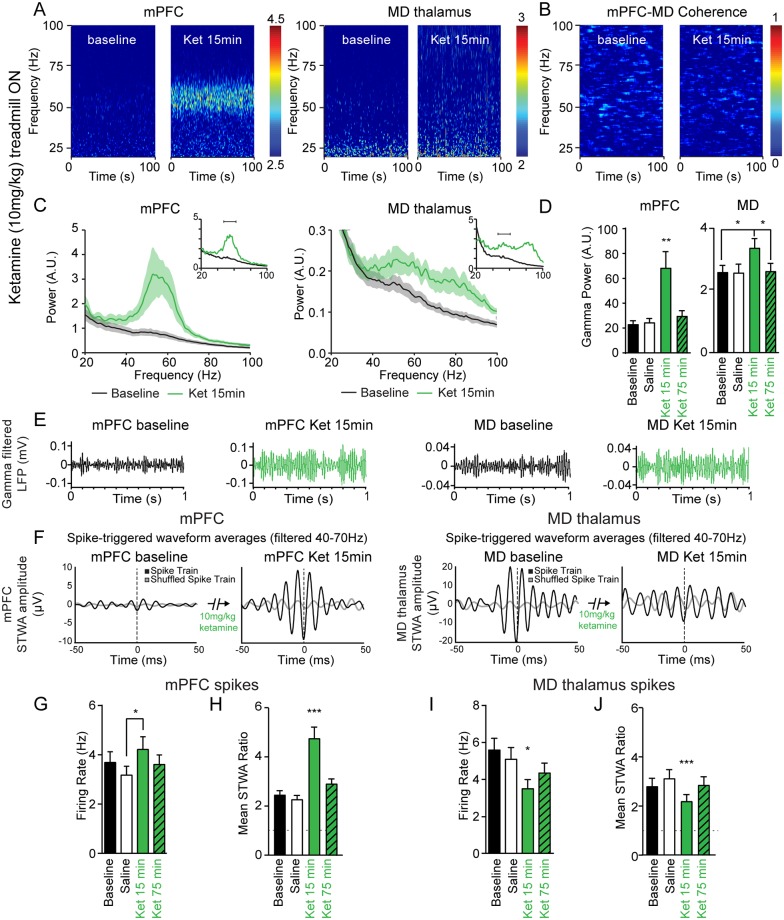
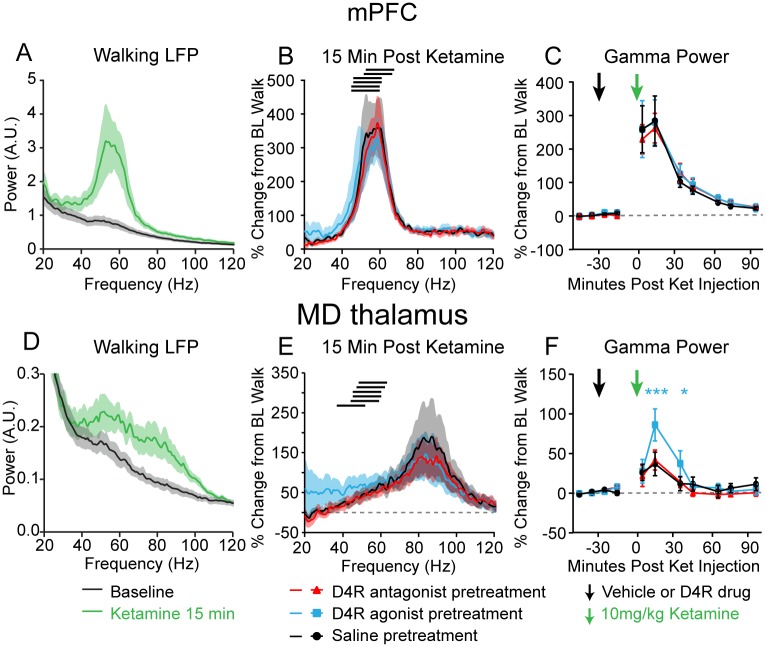
Alterations in the function of the medial prefrontal cortex (mPFC) and its major thalamic source of innervation, the mediodorsal (MD) thalamus, have been hypothesized to contribute to the symptoms of schizophrenia. The NMDAR antagonist ketamine, used to model schizophrenia, elicits a brain state resembling early stage schizophrenia characterized by cognitive deficits and increases in cortical low gamma (40-70 Hz) power. Here we sought to determine how ketamine differentially affects spiking and gamma local field potential (LFP) activity in the rat mPFC and MD thalamus. Additionally, we investigated the ability of drugs targeting the dopamine D4 receptor (D4R) to modify the effects of ketamine on gamma activity as a measure of potential cognitive therapeutic efficacy. Rats were trained to walk on a treadmill to reduce confounds related to hyperactivity after ketamine administration (10 mg/kg s.c.) while recordings were obtained from electrodes chronically implanted in the mPFC and MD thalamus. Ketamine increased gamma LFP power in mPFC and MD thalamus in a similar frequency range, yet did not increase thalamocortical synchronization. Ketamine also increased firing rates and spike synchronization to gamma oscillations in the mPFC but decreased both measures in MD thalamus. Conversely, walking alone increased both firing rates and spike-gamma LFP correlations in both mPFC and MD thalamus. The D4R antagonist alone (L-745,870) had no effect on gamma LFP power during treadmill walking, although it reversed increases induced by the D4R agonist (A-412997) in both mPFC and MD thalamus. Neither drug altered ketamine-induced changes in gamma power or firing rates in the mPFC. However, in MD thalamus, the D4R agonist increased ketamine-induced gamma power and prevented ketamine's inhibitory effect on firing rates. Results provide new evidence that ketamine differentially modulates spiking and gamma power in MD thalamus and mPFC, supporting a potential role for both areas in contributing to ketamine-induced schizophrenia-like symptoms.
内侧前额叶皮质(mPFC)及其主要丘脑神经支配源——背内侧(MD)丘脑的功能改变,被认为与精神分裂症的症状有关。用于模拟精神分裂症的N-甲基-D-天冬氨酸受体(NMDAR)拮抗剂氯胺酮,会引发一种类似于精神分裂症早期阶段的脑状态,其特征为认知缺陷以及皮质低伽马(40 - 70赫兹)功率增加。在此,我们试图确定氯胺酮如何差异性地影响大鼠mPFC和MD丘脑的放电以及伽马局部场电位(LFP)活动。此外,我们研究了靶向多巴胺D4受体(D4R)的药物改变氯胺酮对伽马活动影响的能力,以此作为潜在认知治疗效果的一种衡量指标。大鼠经过训练在跑步机上行走,以减少氯胺酮给药(10毫克/千克,皮下注射)后与多动相关的干扰因素,同时从长期植入mPFC和MD丘脑的电极获取记录。氯胺酮在相似频率范围内增加了mPFC和MD丘脑的伽马LFP功率,但并未增加丘脑皮质同步性。氯胺酮还增加了mPFC中的放电率以及与伽马振荡的放电同步性,但在MD丘脑中这两项指标均降低。相反,单独行走增加了mPFC和MD丘脑中的放电率以及放电与伽马LFP的相关性。单独使用D4R拮抗剂(L - 745,870)在跑步机行走期间对伽马LFP功率没有影响,尽管它逆转了D4R激动剂(A - 412997)在mPFC和MD丘脑中所诱导的增加。两种药物均未改变氯胺酮诱导的mPFC中伽马功率或放电率的变化。然而,在MD丘脑中,D4R激动剂增加了氯胺酮诱导的伽马功率,并阻止了氯胺酮对放电率的抑制作用。结果提供了新的证据,表明氯胺酮差异性地调节MD丘脑和mPFC中的放电和伽马功率,支持这两个区域在导致氯胺酮诱导的精神分裂症样症状中具有潜在作用。