Tseng Ming-Tsung, Kong Yazhuo, Eippert Falk, Tracey Irene
Graduate Institute of Brain and Mind Sciences, National Taiwan University College of Medicine, Taipei, 10051, Taiwan,
Oxford Center for Functional Magnetic Resonance Imaging of the Brain & Nuffield Division of Anaesthetics, Nuffield Department of Clinical Neurosciences, University of Oxford, Oxford, OX3 9DU, United Kingdom.
J Neurosci. 2017 Dec 6;37(49):11806-11817. doi: 10.1523/JNEUROSCI.0750-17.2017. Epub 2017 Nov 2.
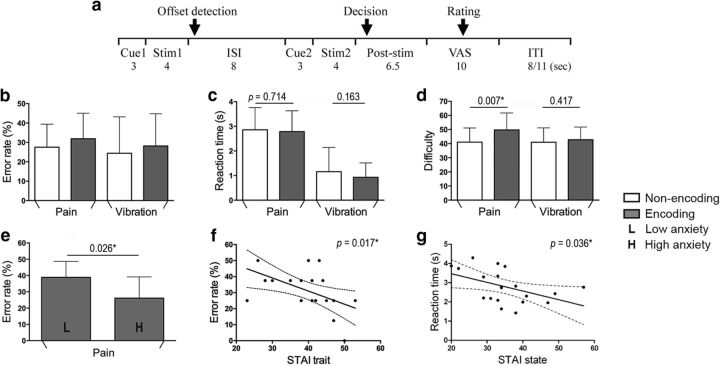
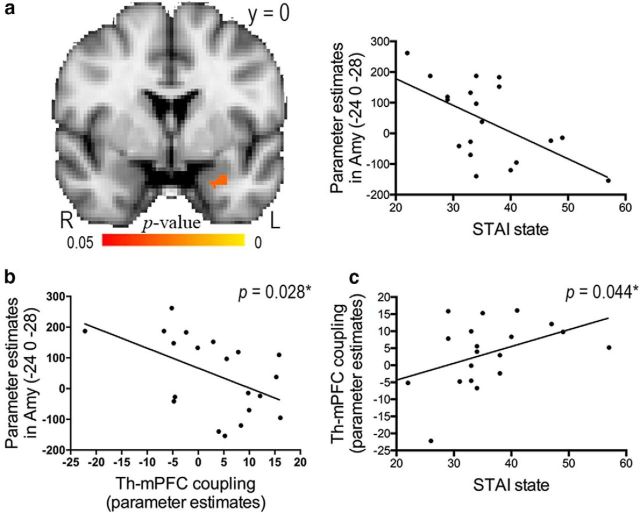
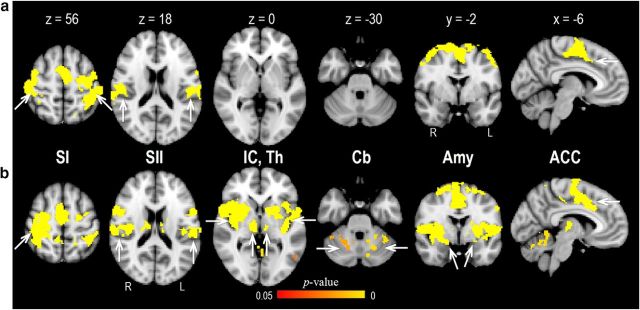
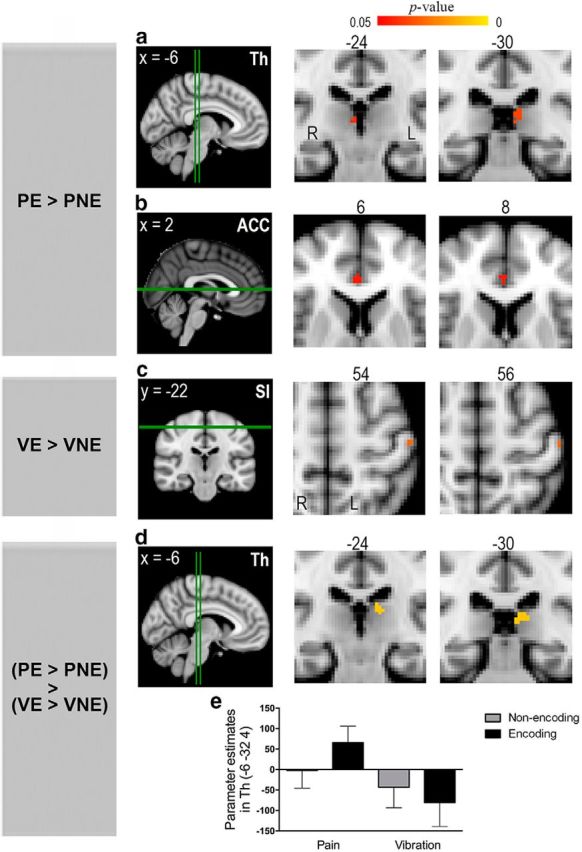
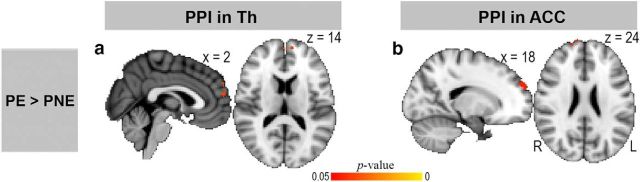
To convert a painful stimulus into a briefly maintainable construct when the painful stimulus is no longer accessible is essential to guide human behavior and avoid dangerous situations. Because of the aversive nature of pain, this encoding process might be influenced by emotional aspects and could thus vary across individuals, but we have yet to understand both the basic underlying neural mechanisms as well as potential interindividual differences. Using fMRI in combination with a delayed-discrimination task in healthy volunteers of both sexes, we discovered that brain regions involved in this working memory encoding process were dissociable according to whether the to-be-remembered stimulus was painful or not, with the medial thalamus and the rostral anterior cingulate cortex encoding painful and the primary somatosensory cortex encoding nonpainful stimuli. Encoding of painful stimuli furthermore significantly enhanced functional connectivity between the thalamus and medial prefrontal cortex (mPFC). With regards to emotional aspects influencing encoding processes, we observed that more anxious participants showed significant performance advantages when encoding painful stimuli. Importantly, only during the encoding of pain, the interindividual differences in anxiety were associated with the strength of coupling between medial thalamus and mPFC, which was furthermore related to activity in the amygdala. These results indicate not only that there is a distinct signature for the encoding of a painful experience in humans, but also that this encoding process involves a strong affective component. To convert the sensation of pain into a briefly maintainable construct is essential to guide human behavior and avoid dangerous situations. Although this working memory encoding process is implicitly contained in the majority of studies, the underlying neural mechanisms remain unclear. Using fMRI in a delayed-discrimination task, we found that the encoding of pain engaged the activation of the medial thalamus and the functional connectivity between the thalamus and medial prefrontal cortex. These fMRI data were directly and indirectly related to participants' self-reported trait and state anxiety. Our findings indicate that the mechanisms responsible for the encoding of noxious stimuli differ from those for the encoding of innocuous stimuli, and that these mechanisms are shaped by an individual's anxiety levels.
当疼痛刺激不再存在时,将其转化为一种可短暂维持的结构对于指导人类行为和避免危险情况至关重要。由于疼痛的厌恶性,这种编码过程可能会受到情绪因素的影响,因此可能因人而异,但我们尚未了解其基本的潜在神经机制以及潜在的个体差异。在健康的男女志愿者中,我们结合功能磁共振成像(fMRI)和延迟辨别任务进行研究,发现参与这种工作记忆编码过程的脑区根据待记忆的刺激是否为疼痛刺激而有所不同,内侧丘脑和喙前扣带回皮质编码疼痛刺激,而初级体感皮质编码非疼痛刺激。此外,疼痛刺激的编码显著增强了丘脑与内侧前额叶皮质(mPFC)之间的功能连接。关于影响编码过程的情绪因素,我们观察到焦虑程度较高的参与者在编码疼痛刺激时表现出显著的性能优势。重要的是,仅在疼痛编码期间,焦虑的个体差异与内侧丘脑和mPFC之间的耦合强度相关,而这又与杏仁核的活动有关。这些结果不仅表明人类对疼痛体验的编码有独特的特征,而且还表明这种编码过程涉及强烈的情感成分。将疼痛感觉转化为一种可短暂维持的结构对于指导人类行为和避免危险情况至关重要。尽管大多数研究中都隐含了这种工作记忆编码过程,但其潜在的神经机制仍不清楚。在一项延迟辨别任务中使用fMRI,我们发现疼痛编码涉及内侧丘脑的激活以及丘脑与内侧前额叶皮质之间的功能连接。这些fMRI数据与参与者自我报告的特质焦虑和状态焦虑直接或间接相关。我们的研究结果表明,负责编码有害刺激的机制与编码无害刺激的机制不同,并且这些机制受个体焦虑水平的影响。