Beijing Key Laboratory of Learning and Cognition, Department of Psychology, Capital Normal University, Beijing, 100037, China.
State Key Laboratory of Brain and Cognitive Science, Institute of Psychology, Chinese Academy of Sciences, Beijing, 100101, China.
Sci Rep. 2017 Nov 6;7(1):14616. doi: 10.1038/s41598-017-14910-y.
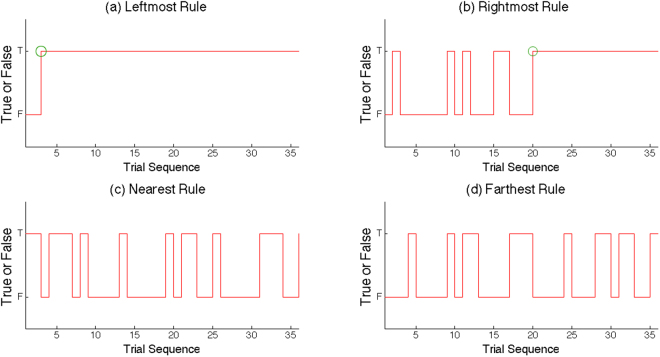
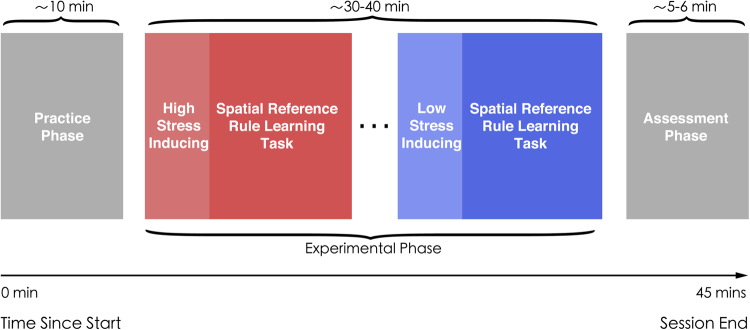
Prior studies have shown that spatial cognition is influenced by stress prior to task. The current study investigated the effects of real-time acute stress on allocentric and egocentric spatial processing. A virtual reality-based spatial reference rule learning (SRRL) task was designed in which participants were instructed to make a location selection by walking to one of three poles situated around a tower. A selection was reinforced by either an egocentric spatial reference rule (leftmost or rightmost pole relative to participant) or an allocentric spatial reference rule (nearest or farthest pole relative to the tower). In Experiment 1, 32 participants (16 males, 16 females; aged from 18 to 27) performed a SRRL task in a normal virtual reality environment (VRE). The hit rates and rule acquisition revealed no difference between allocentric and egocentric spatial reference rule learning. In Experiment 2, 64 participants (32 males, 34 females; aged from 19 to 30) performed the SRRL task in both a low-stress VRE (a mini virtual arena) and a high-stress VRE (mini virtual arena with a fire disaster). Allocentric references facilitated learning in the high-stressful VRE. The results suggested that acute stress facilitate allocentric spatial processing.
先前的研究表明,空间认知会受到任务前压力的影响。本研究探讨了实时急性应激对以自我为中心和以客体为中心的空间处理的影响。设计了一个基于虚拟现实的空间参照规则学习(SRRL)任务,要求参与者通过走到塔周围的三个极点中的一个来进行位置选择。选择通过自我中心空间参照规则(相对于参与者的最左或最右极点)或以客体为中心空间参照规则(相对于塔的最近或最远极点)进行强化。在实验 1 中,32 名参与者(16 名男性,16 名女性;年龄 18 至 27 岁)在正常虚拟现实环境(VRE)中执行了 SRRL 任务。命中率和规则习得显示,以自我为中心和以客体为中心的空间参照规则学习之间没有差异。在实验 2 中,64 名参与者(32 名男性,34 名女性;年龄 19 至 30 岁)在低压力 VRE(迷你虚拟竞技场)和高压力 VRE(带火灾灾难的迷你虚拟竞技场)中执行了 SRRL 任务。在高压力环境中,以客体为中心的参照有助于学习。结果表明,急性应激促进了以客体为中心的空间处理。