Internal Medicine, Department of Medical, Surgical and Health Sciences-University of Trieste, Trieste, Italy.
Azienda Sanitaria Universitaria Integrata di Trieste (ASUITS), Trieste, Italy.
J Cachexia Sarcopenia Muscle. 2017 Dec;8(6):991-998. doi: 10.1002/jcsm.12254. Epub 2017 Nov 3.
Chronic heart failure (CHF) is associated with skeletal muscle abnormalities contributing to exercise intolerance, muscle loss, and negative impact on patient prognosis. A primary role has been proposed for mitochondrial dysfunction, which may be induced by systemic and tissue inflammation and further contribute to low insulin signalling. The acylated form of the gastric hormone ghrelin (AG) may improve mitochondrial oxidative capacity and insulin signalling in both healthy and diseased rodent models.
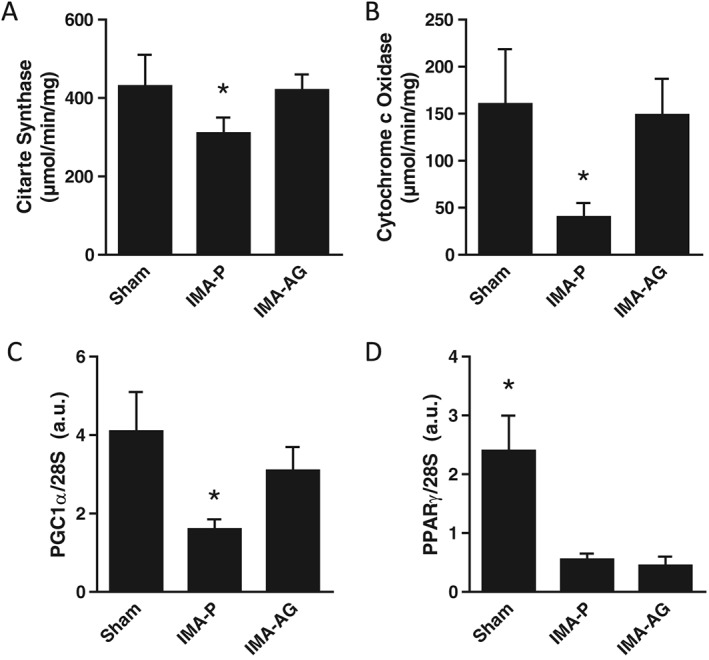
We investigated the impact of AG continuous subcutaneous administration (AG) by osmotic minipump (50 nmol/kg/day for 28 days) compared with placebo (P) on skeletal muscle mitochondrial enzyme activities, mitochondrial biogenesis regulators transcriptional expression and insulin signalling in a rodent post-myocardial infarction CHF model.
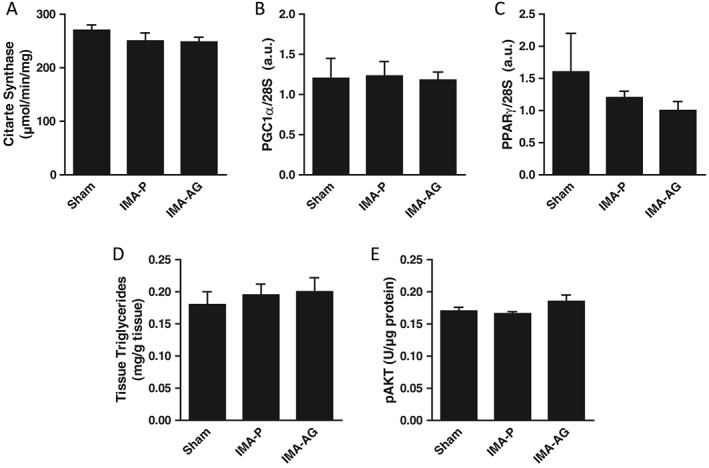
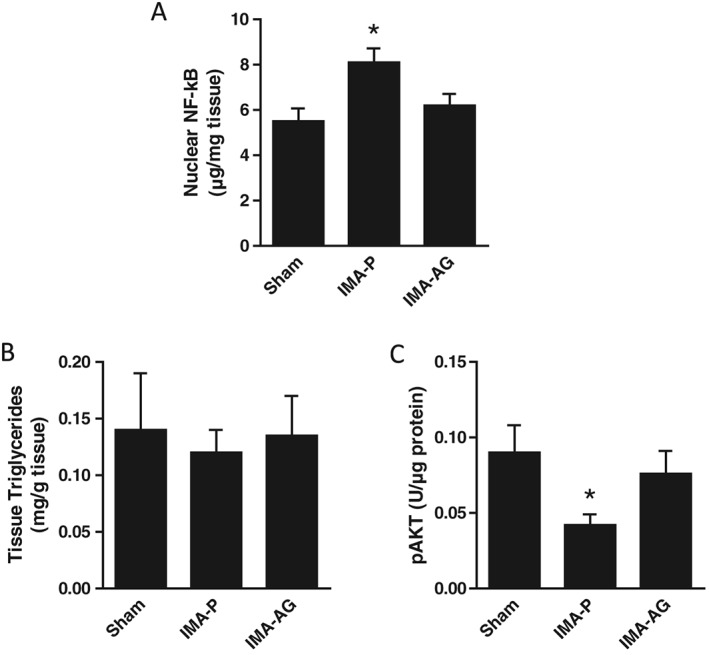
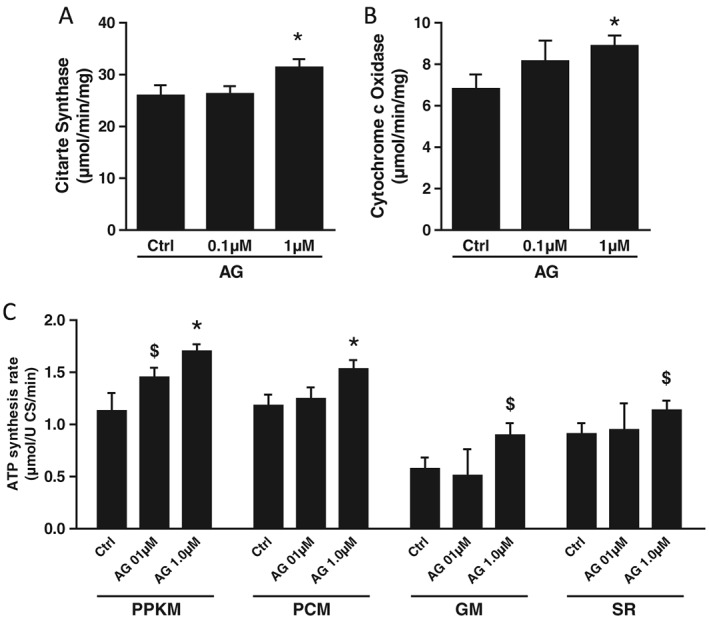
No statistically significant differences (NS) were observed among the three group in cumulative food intake. Compared with sham-operated, P had low mitochondrial enzyme activities, mitochondrial biogenesis regulators transcripts, and insulin signalling activation at AKT level (P < 0.05), associated with activating nuclear translocation of pro-inflammatory transcription factor nuclear factor-κB. AG completely normalized all alterations (P < 0.05 vs P, P = NS vs sham-operated). Direct AG activities were strongly supported by in vitro C2C12 myotubes experiments showing AG-dependent stimulation of mitochondrial enzyme activities. No changes in mitochondrial parameters and insulin signalling were observed in the liver in any group.
Sustained peripheral AG treatment with preserved food intake normalizes a CHF-induced tissue-specific cluster of skeletal muscle mitochondrial dysfunction, pro-inflammatory changes, and reduced insulin signalling. AG is therefore a potential treatment for CHF-associated muscle catabolic alterations, with potential positive impact on patient outcome.
慢性心力衰竭(CHF)与骨骼肌异常有关,导致运动不耐受、肌肉丧失,并对患者预后产生负面影响。已经提出了线粒体功能障碍的主要作用,这可能是由全身和组织炎症引起的,并进一步导致胰岛素信号降低。胃激素 ghrelin 的酰化形式(AG)可能改善健康和患病啮齿动物模型中的线粒体氧化能力和胰岛素信号。
我们通过渗透微型泵(50nmol/kg/天,持续 28 天)连续皮下给予 AG(AG)与安慰剂(P)比较,研究了其对心肌梗死后 CHF 模型中骨骼肌线粒体酶活性、线粒体生物发生调节剂转录表达和胰岛素信号的影响。
在累积食物摄入量方面,三组之间没有统计学差异(NS)。与假手术组相比,P 组的线粒体酶活性、线粒体生物发生调节剂转录物和胰岛素信号激活水平(AKT 水平)较低(P<0.05),与促炎转录因子核因子-κB 的核易位激活有关。AG 完全正常化了所有改变(P<0.05 与 P,P=NS 与假手术组)。体外 C2C12 肌管实验强烈支持 AG 的直接作用,显示 AG 依赖性刺激线粒体酶活性。在任何一组中,肝脏的线粒体参数和胰岛素信号均未发生变化。
持续的外周 AG 治疗,保持食物摄入,可使 CHF 引起的骨骼肌线粒体功能障碍、促炎变化和胰岛素信号降低的组织特异性簇正常化。AG 因此是治疗 CHF 相关肌肉分解代谢改变的潜在方法,可能对患者的预后产生积极影响。