Jahng James Won Suk, Song Erfei, Sweeney Gary
Department of Biology, York University, Toronto, ON, Canada.
Exp Mol Med. 2016 Mar 11;48(3):e217. doi: 10.1038/emm.2016.20.
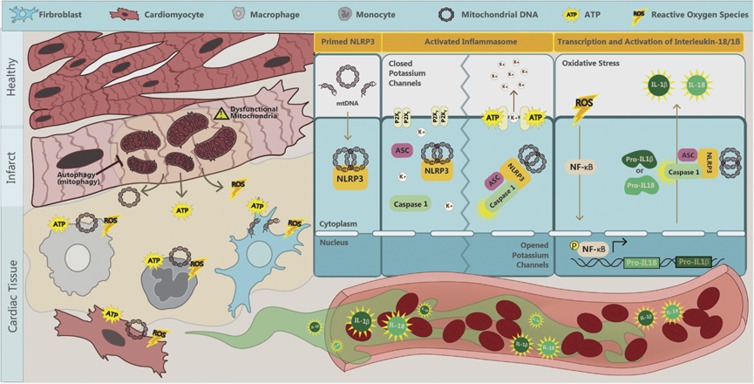
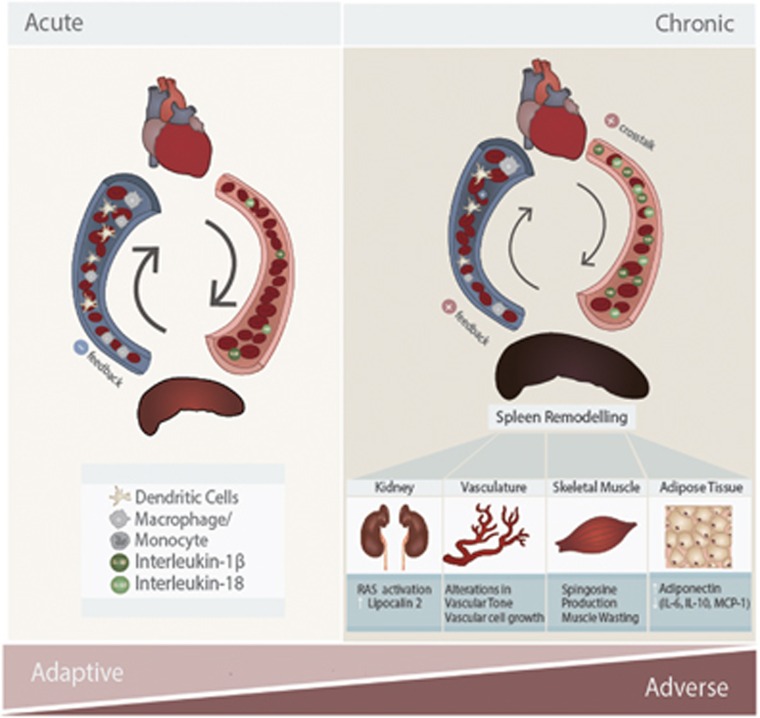
Mediators from peripheral tissues can influence the development and progression of heart failure (HF). For example, in obesity, an altered profile of adipokines secreted from adipose tissue increases the incidence of myocardial infarction (MI). Less appreciated is that heart remodeling releases cardiokines, which can strongly impact various peripheral tissues. Inflammation, and, in particular, activation of the nucleotide-binding oligomerization domain-like receptors with pyrin domain (NLRP3) inflammasome are likely to have a central role in cardiac remodeling and mediating crosstalk with other organs. Activation of the NLRP3 inflammasome in response to cardiac injury induces the production and secretion of the inflammatory cytokines interleukin (IL)-1β and IL-18. In addition to having local effects in the myocardium, these pro-inflammatory cytokines are released into circulation and cause remodeling in the spleen, kidney, skeletal muscle and adipose tissue. The collective effects of various cardiokines on peripheral organs depend on the degree and duration of myocardial injury, with systematic inflammation and peripheral tissue damage observed as HF progresses. In this article, we review mechanisms regulating myocardial inflammation in HF and the role of factors secreted by the heart in communication with peripheral tissues.
来自外周组织的介质可影响心力衰竭(HF)的发生和发展。例如,在肥胖症中,脂肪组织分泌的脂肪因子谱改变会增加心肌梗死(MI)的发生率。鲜为人知的是,心脏重塑会释放心脏因子,其可强烈影响各种外周组织。炎症,尤其是含吡咯结构域的核苷酸结合寡聚化结构域样受体(NLRP3)炎性小体的激活,可能在心脏重塑以及介导与其他器官的串扰中起核心作用。对心脏损伤作出反应时,NLRP3炎性小体的激活会诱导炎性细胞因子白细胞介素(IL)-1β和IL-18的产生和分泌。除了在心肌中具有局部作用外,这些促炎细胞因子还会释放到循环系统中,并导致脾脏、肾脏、骨骼肌和脂肪组织发生重塑。各种心脏因子对外周器官的综合作用取决于心肌损伤的程度和持续时间,随着HF的进展会观察到全身炎症和外周组织损伤。在本文中,我们综述了HF中心肌炎症的调节机制以及心脏分泌的因子在与外周组织通讯中的作用。