Ebner Nicole, Sliziuk Veronika, Scherbakov Nadja, Sandek Anja
Division of Innovative Clinical Trials, Department of Cardiology and Pneumology, University Medical Center Göttingen (UMG), Göttingen, Germany.
University Medical Center Göttingen, Heart Center Göttingen, Department of Cardiology and Pneumology, Göttingen, Germany.
ESC Heart Fail. 2015 Jun;2(2):58-68. doi: 10.1002/ehf2.12033.
As life expectancy increases, muscle wasting is becoming a more and more important public health problem. This review summarizes the current knowledge of pathophysiological mechanisms underlying muscle loss in ageing and chronic diseases such as heart failure and discusses evolving interventional strategies.
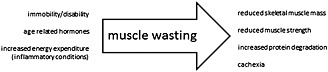
Loss of skeletal muscle mass and strength is a common phenomenon in a wide variety of disorders associated with ageing and morbidity-associated catabolic conditions such as chronic heart failure. Muscle wasting in ageing but otherwise healthy human beings is referred to as sarcopenia. Unlike cachexia in advanced stages of chronic heart failure, muscle wasting per se is not necessarily associated with weight loss. In this review, we discuss pathophysiological mechanisms underlying muscle loss in sarcopenia and cachexia, highlight similarities and differences of both conditions, and discuss therapeutic targets and possible treatments, such as exercise training, nutritional support, and drugs. Candidate drugs to treat muscle wasting disease include myostatin antagonists, ghrelin agonists, selective androgen receptor molecules, megestrol acetate, activin receptor antagonists, espindolol, and fast skeletal muscle troponin inhibitors.
Present approaches to muscle wasting disease include exercise training, nutritional support, and drugs, although particularly the latter remain currently restricted to clinical studies. Optimizing skeletal muscle mass and function in ageing and chronic illness including heart failure is one of the chapters that are far from finished and gains future potential for new therapeutic interventions to come.
随着预期寿命的增加,肌肉萎缩正成为一个日益重要的公共卫生问题。本综述总结了衰老以及诸如心力衰竭等慢性疾病中肌肉丢失的病理生理机制的现有知识,并讨论了不断发展的干预策略。
骨骼肌质量和力量的丧失是与衰老以及诸如慢性心力衰竭等与发病率相关的分解代谢状况相关的多种疾病中的常见现象。在衰老但其他方面健康的人群中发生的肌肉萎缩被称为肌肉减少症。与慢性心力衰竭晚期的恶病质不同,肌肉萎缩本身不一定与体重减轻相关。在本综述中,我们讨论了肌肉减少症和恶病质中肌肉丢失的病理生理机制,强调了这两种情况的异同,并讨论了治疗靶点和可能的治疗方法,如运动训练、营养支持和药物。治疗肌肉萎缩疾病的候选药物包括肌肉生长抑制素拮抗剂、胃饥饿素激动剂、选择性雄激素受体分子、醋酸甲地孕酮、激活素受体拮抗剂、埃斯普利诺尔和快速骨骼肌肌钙蛋白抑制剂。
目前针对肌肉萎缩疾病的方法包括运动训练、营养支持和药物,不过特别是药物目前仍局限于临床研究。在衰老和包括心力衰竭在内的慢性疾病中优化骨骼肌质量和功能是一个远未完成的篇章,并且为未来新的治疗干预措施带来了潜力。