Department of Dermatology, University Hospital, University Duisburg-Essen, Essen, Germany.
Dermatopathologie bei Mainz, Nieder-Olm, Germany.
Mod Pathol. 2018 Mar;31(3):418-428. doi: 10.1038/modpathol.2017.146. Epub 2017 Nov 3.
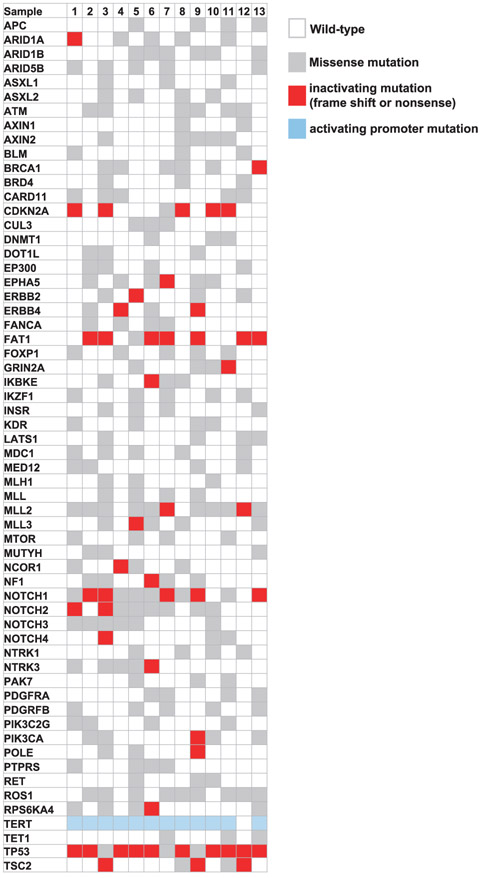
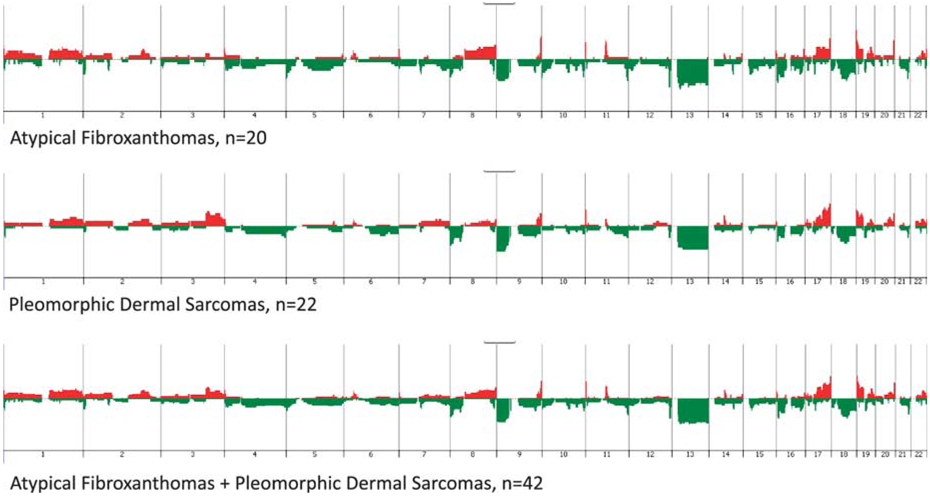
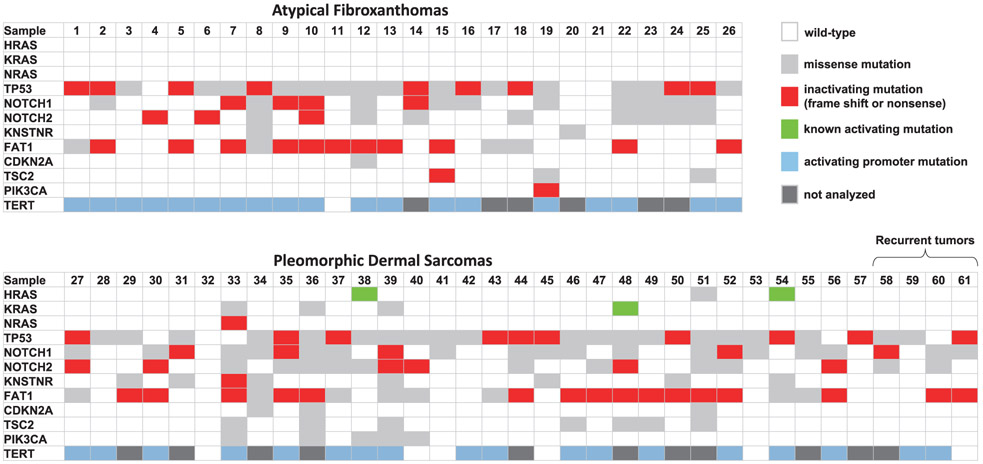
Atypical fibroxanthomas and pleomorphic dermal sarcomas are tumors arising in sun-damaged skin of elderly patients. They have differing prognoses and are currently distinguished using histological criteria, such as invasion of deeper tissue structures, necrosis and lymphovascular or perineural invasion. To investigate the as-yet poorly understood genetics of these tumors, 41 atypical fibroxanthomas and 40 pleomorphic dermal sarcomas were subjected to targeted next-generation sequencing approaches as well as DNA copy number analysis by comparative genomic hybridization. In an analysis of the entire coding region of 341 oncogenes and tumor suppressor genes in 13 atypical fibroxanthomas using an established hybridization-based next-generation sequencing approach, we found that these tumors harbor a large number of mutations. Gene alterations were identified in more than half of the analyzed samples in FAT1, NOTCH1/2, CDKN2A, TP53, and the TERT promoter. The presence of these alterations was verified in 26 atypical fibroxanthoma and 35 pleomorphic dermal sarcoma samples by targeted amplicon-based next-generation sequencing. Similar mutation profiles in FAT1, NOTCH1/2, CDKN2A, TP53, and the TERT promoter were identified in both atypical fibroxanthoma and pleomorphic dermal sarcoma. Activating RAS mutations (G12 and G13) identified in 3 pleomorphic dermal sarcoma were not found in atypical fibroxanthoma. Comprehensive DNA copy number analysis demonstrated a wide array of different copy number gains and losses, with similar profiles in atypical fibroxanthoma and pleomorphic dermal sarcoma. In summary, atypical fibroxanthoma and pleomorphic dermal sarcoma are highly mutated tumors with recurrent mutations in FAT1, NOTCH1/2, CDKN2A, TP53, and the TERT promoter, and a range of DNA copy number alterations. These findings suggest that atypical fibroxanthomas and pleomorphic dermal sarcomas are genetically related, potentially representing two ends of a common tumor spectrum and distinguishing these entities is at present still best performed using histological criteria.
非典型性纤维黄色瘤和多形性真皮肉瘤是发生于老年患者日晒损伤皮肤的肿瘤。它们具有不同的预后,目前使用组织学标准(如更深组织结构的浸润、坏死、淋巴血管或神经周围浸润)来区分。为了研究这些肿瘤尚未被充分了解的遗传学,对 41 例非典型性纤维黄色瘤和 40 例多形性真皮肉瘤进行了靶向下一代测序方法以及比较基因组杂交的 DNA 拷贝数分析。在使用既定的基于杂交的下一代测序方法对 13 例非典型性纤维黄色瘤的 341 个癌基因和肿瘤抑制基因的整个编码区进行分析后,我们发现这些肿瘤存在大量突变。在 FAT1、NOTCH1/2、CDKN2A、TP53 和 TERT 启动子中,超过一半分析样本的基因改变被鉴定出来。通过靶向扩增子的下一代测序在 26 例非典型性纤维黄色瘤和 35 例多形性真皮肉瘤样本中验证了这些改变的存在。在非典型性纤维黄色瘤和多形性真皮肉瘤中均发现了 FAT1、NOTCH1/2、CDKN2A、TP53 和 TERT 启动子的相似突变谱。在 3 例多形性真皮肉瘤中发现的激活 RAS 突变(G12 和 G13)未在非典型性纤维黄色瘤中发现。综合 DNA 拷贝数分析显示出广泛的不同拷贝数增益和丢失,非典型性纤维黄色瘤和多形性真皮肉瘤的谱相似。总之,非典型性纤维黄色瘤和多形性真皮肉瘤是高度突变的肿瘤,在 FAT1、NOTCH1/2、CDKN2A、TP53 和 TERT 启动子中存在反复突变,并存在一系列 DNA 拷贝数改变。这些发现表明非典型性纤维黄色瘤和多形性真皮肉瘤在遗传学上相关,可能代表了一个共同肿瘤谱的两个极端,目前仍然最好使用组织学标准来区分这些实体。