Beres Stephen B, Olsen Randall J, Ojeda Saavedra Matthew, Ure Roisin, Reynolds Arlene, Lindsay Diane S J, Smith Andrew J, Musser James M
Center for Molecular and Translational Human Infectious Diseases Research, Department of Pathology and Genomic Medicine, Houston Methodist Research Institute, and Houston Methodist Hospital, Houston, TX 77030, USA.
Departments of Pathology and Laboratory Medicine and Microbiology and Immunology, Weill Cornell Medical College, NY 10021, USA.
J Med Microbiol. 2017 Dec;66(12):1765-1773. doi: 10.1099/jmm.0.000622. Epub 2017 Nov 3.
Strains of type emm89 Streptococcus pyogenes have recently increased in frequency as a cause of human infections in several countries in Europe and North America. This increase has been molecular epidemiologically linked with the emergence of a new genetically distinct clone, designated clade 3. We sought to extend our understanding of this epidemic behavior by the genetic characterization of type emm89 strains responsible in recent years for an increased frequency of infections in Scotland.
We sequenced the genomes of a retrospective cohort of 122 emm89 strains recovered from patients with invasive and noninvasive infections throughout Scotland during 2010 to 2016.
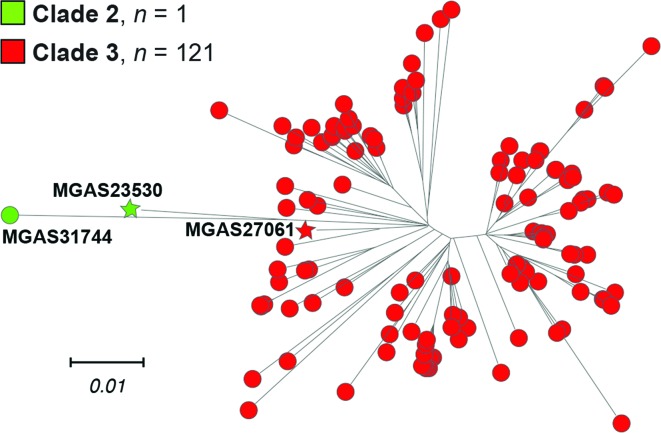
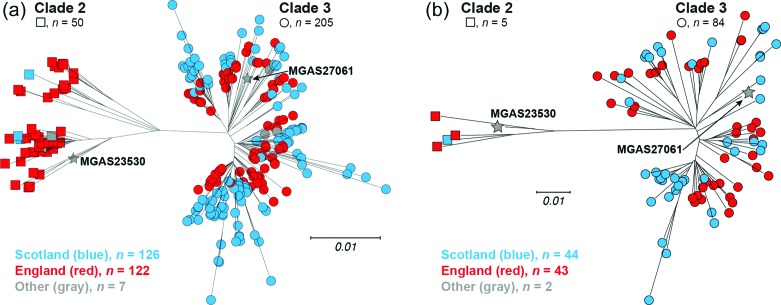
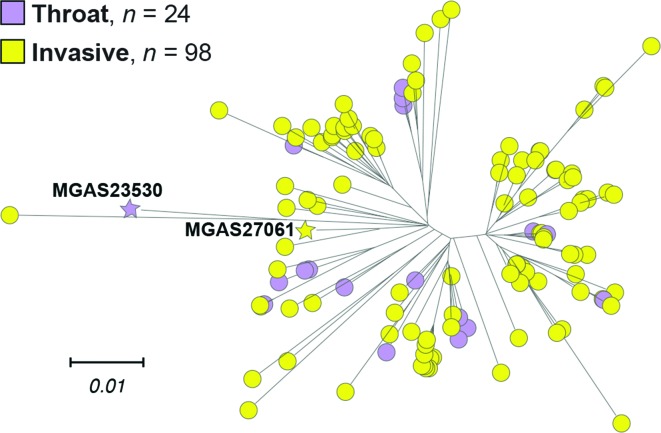
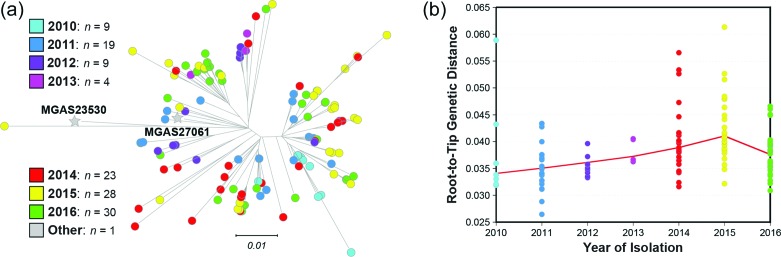
All but one of the 122 emm89 infection isolates are of the recently emerged epidemic clade 3 clonal lineage. The Scotland isolates are closely related to and not genetically distinct from recent emm89 strains from England, they constitute a single genetic population.
The clade 3 clone causes virtually all-contemporary emm89 infections in Scotland. These findings add Scotland to a growing list of countries of Europe and North America where, by whole genome sequencing, emm89 clade 3 strains have been demonstrated to be the cause of an ongoing epidemic of invasive infections and to be genetically related due to descent from a recent common progenitor.
近年来,化脓性链球菌emm89型菌株在欧洲和北美的几个国家作为人类感染病因的出现频率有所增加。这种增加在分子流行病学上与一个新的基因独特克隆(命名为进化枝3)的出现有关。我们试图通过对近年来在苏格兰导致感染频率增加的emm89型菌株进行基因特征分析,来扩展我们对这种流行行为的理解。
我们对2010年至2016年期间从苏格兰各地侵袭性和非侵袭性感染患者中分离出的122株emm89菌株的回顾性队列进行了基因组测序。
122株emm89感染分离株中,除一株外,均属于最近出现的流行进化枝3克隆谱系。苏格兰分离株与来自英格兰的近期emm89菌株密切相关,在基因上并无差异,它们构成一个单一的基因群体。
进化枝3克隆几乎导致了苏格兰所有当代emm89感染。这些发现使苏格兰加入了欧洲和北美的越来越多国家的行列,在这些国家,通过全基因组测序,已证明emm89进化枝3菌株是侵袭性感染持续流行的病因,并且由于来自最近的共同祖先而在基因上相关。