Cardiff University Brain Research Imaging Centre, School of Psychology, Cardiff University, Cardiff CF24 4HQ, UK.
Neuroimage. 2018 Feb 1;166:219-229. doi: 10.1016/j.neuroimage.2017.10.069. Epub 2017 Nov 2.
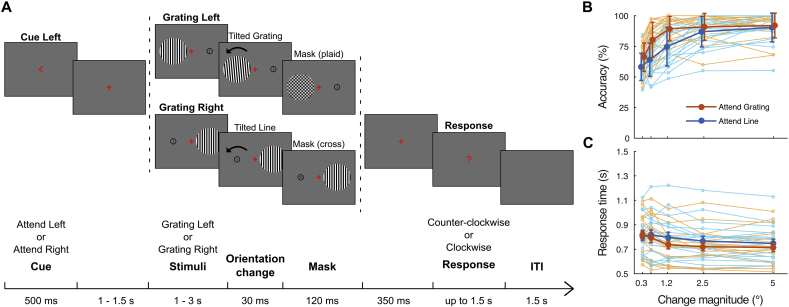
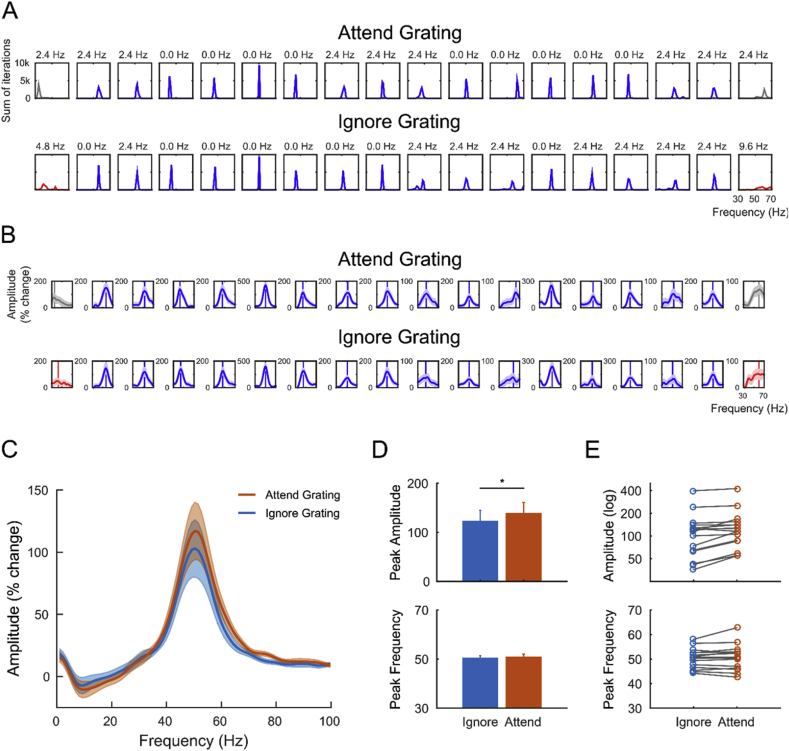
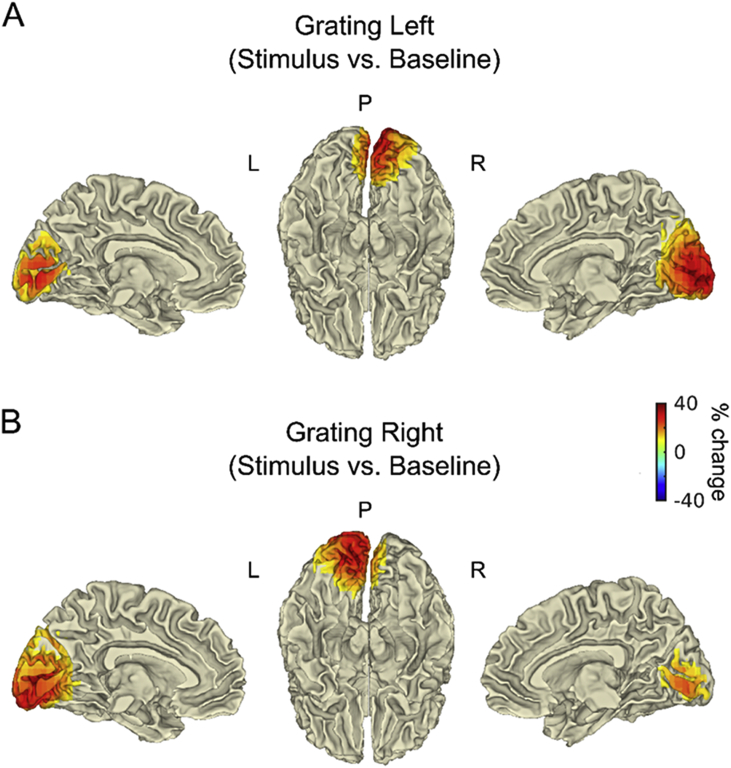
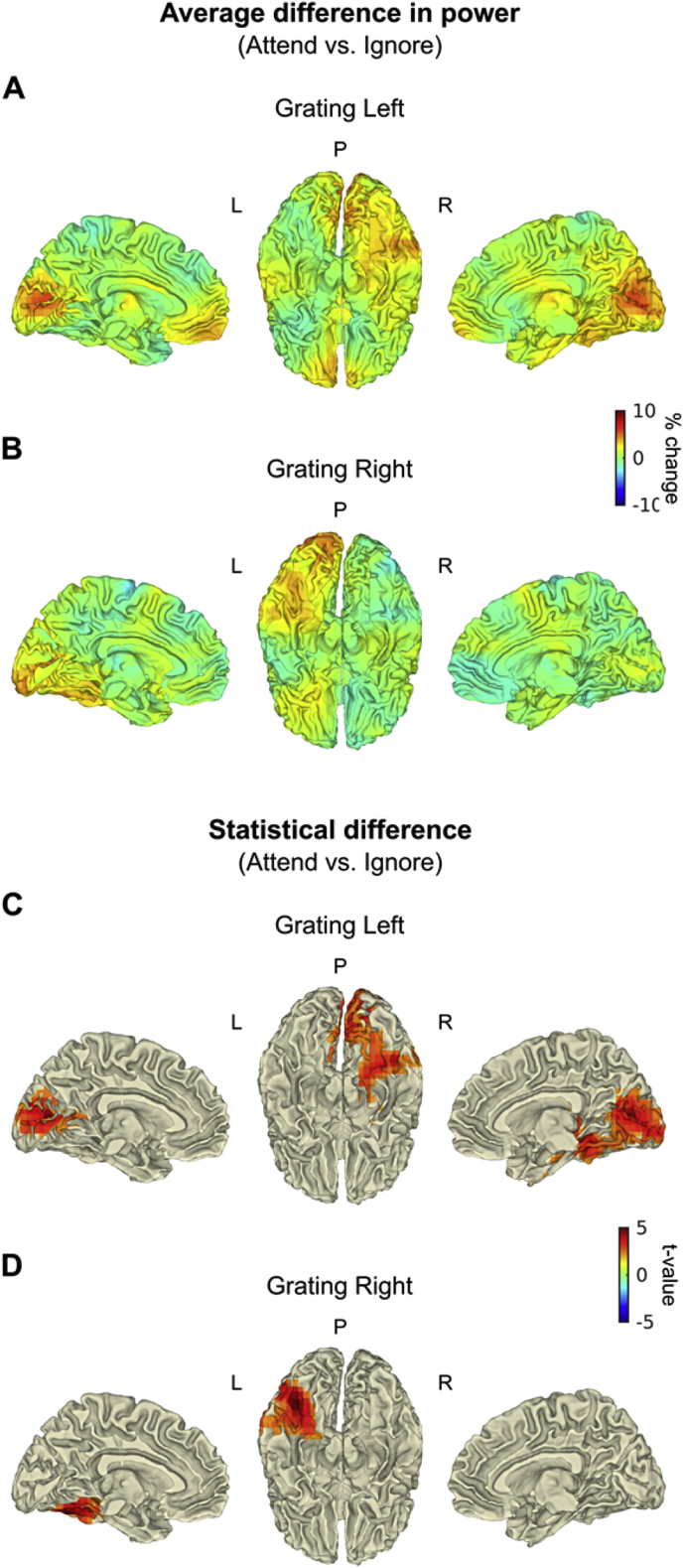
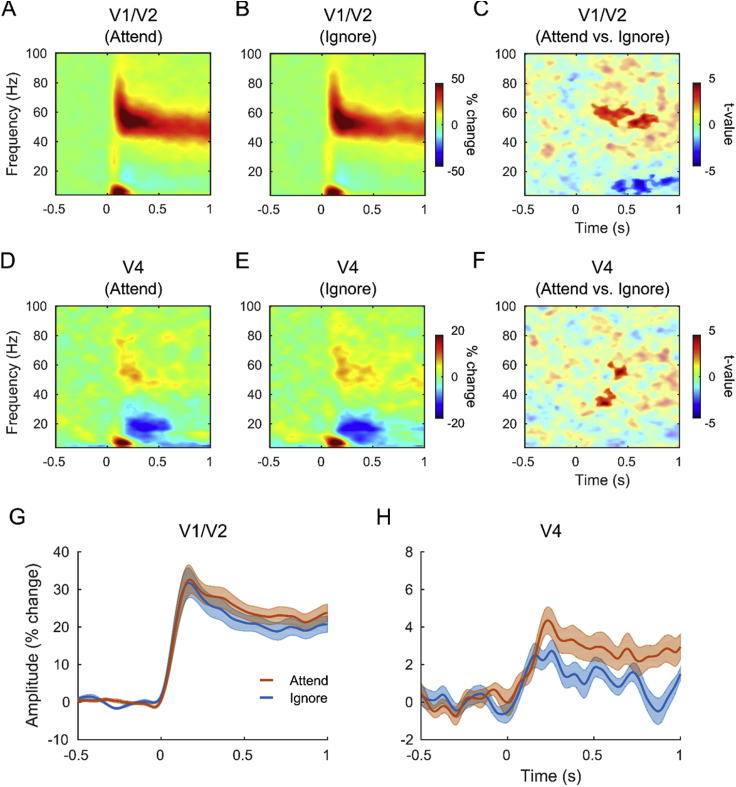
Oscillatory synchronization in the gamma frequency range has been proposed as a neuronal mechanism to prioritize processing of relevant stimuli over competing ones. Recent studies in animals found that selective spatial attention enhanced gamma-band synchronization in high-order visual areas (V4) and increased the gamma peak frequency in V1. The existence of such mechanisms in the human visual system is yet to be fully demonstrated. In this study, we used MEG, in combination with an optimised stimulus design, to record visual gamma oscillations from human early visual cortex, while participants performed a visuospatial attention cueing task. First, we reconstructed virtual sensors in V1/V2, where gamma oscillations were strongly induced by visual stimulation alone. Second, following the results of a statistical comparison between conditions of attention, we reconstructed cortical activity also in inferior occipital-temporal regions (V4). The results indicated that gamma amplitude was modulated by spatial attention across the cortical hierarchy, both in the early visual cortex and in higher-order regions of the ventral visual pathway. In contrast, we found no evidence for an increase in the gamma peak frequency in V1/V2 with attention. The gamma response tended to peak earlier in V1/V2 than in V4 by approximately 70 ms, consistent with a feed-forward role of gamma-band activity in propagating sensory representations across the visual cortical hierarchy. Together, these findings suggest that differences in experimental design or methodology can account for the inconsistencies in previous animal and human studies. Furthermore, our results are in line with the hypothesis of enhanced gamma-band synchronization as an attentional mechanism in the human visual cortex.
振荡同步在伽马频带范围内被提出作为一种神经元机制,以优先处理相关刺激而不是竞争刺激。最近的动物研究发现,选择性空间注意增强了高级视觉区域(V4)中的伽马带同步,并增加了 V1 中的伽马峰值频率。这种机制在人类视觉系统中的存在尚未得到充分证明。在这项研究中,我们使用 MEG 结合优化的刺激设计,记录人类早期视觉皮层的视觉伽马振荡,同时参与者执行视觉空间注意提示任务。首先,我们在 V1/V2 中重建了虚拟传感器,在那里单独的视觉刺激强烈地诱导了伽马振荡。其次,根据注意力条件之间的统计比较结果,我们还在枕下颞叶区域(V4)重建了皮质活动。结果表明,伽马振幅在皮质层次结构中受到空间注意力的调制,无论是在早期视觉皮层还是在腹侧视觉通路的高级区域。相比之下,我们没有发现 V1/V2 中伽马峰值频率随注意力增加的证据。伽马响应在 V1/V2 中比在 V4 中更早地达到峰值,大约提前 70 毫秒,这与伽马带活动在视觉皮质层次结构中传播感觉表示的前馈作用一致。总之,这些发现表明,实验设计或方法学的差异可以解释以前动物和人类研究中的不一致。此外,我们的结果与伽马带同步增强作为人类视觉皮层注意力机制的假设一致。