Ballesteros-Martinez Constanza, Mendez-Barbero Nerea, Montalvo-Yuste Alma, Jensen Bettina M, Gomez-Cardenosa Aída, Klitfod Lotte, Garrido-Arandia María, Alvarez-Llamas Gloria, Pastor-Vargas Carlos, Vivanco Fernando, Garvey Lene Heise, Cuesta-Herranz Javier, Poulsen Lars K, Esteban Vanesa
Department of Immunology, IIS-Fundación Jiménez Díaz, Autonomous University of Madrid, Madrid, Spain.
Department of Vascular Physiopathology, IIS-Fundación Jiménez Díaz, Autonomous University of Madrid, Madrid, Spain.
Front Immunol. 2017 Oct 20;8:1323. doi: 10.3389/fimmu.2017.01323. eCollection 2017.
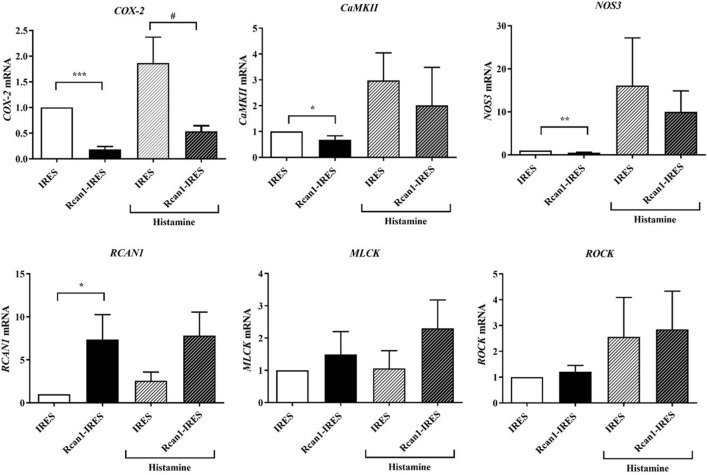
Anaphylaxis, the most serious and life-threatening allergic reaction, produces the release of inflammatory mediators by mast cells and basophils. Regulator of calcineurin 1 (Rcan1) is a negative regulator of mast-cell degranulation. The action of mediators leads to vasodilation and an increase in vascular permeability, causing great loss of intravascular volume in a short time. Nevertheless, the molecular basis remains unexplored on the vascular level. We investigated Rcan1 expression induced by histamine, platelet-activating factor (PAF), and epinephrine in primary human vein (HV)-/artery (HA)-derived endothelial cells (ECs) and human dermal microvascular ECs (HMVEC-D). Vascular permeability was analyzed in human ECs with forced Rcan1 expression using Transwell migration assays and using Rcan1 knockout mice. Histamine, but neither PAF nor epinephrine, induced Rcan1-4 mRNA and protein expression in primary HV-ECs, HA-ECs, and HMVEC-D through histamine receptor 1 (H1R). These effects were prevented by pharmacological inhibition of calcineurin with cyclosporine A. Moreover, intravenous histamine administration increased Rcan1 expression in lung tissues of mice undergoing experimental anaphylaxis. Functional assays showed that overexpression of Rcan1 promotes barrier integrity, suggesting a role played by this molecule in vascular permeability. Consistent with these findings, models of subcutaneous and intravenous histamine-mediated fluid extravasation showed increased response in skin, aorta, and lungs of -deficient mice compared with wild-type animals. These findings reveal that endothelial Rcan1 is synthesized in response to histamine through a calcineurin-sensitive pathway and may reduce barrier breakdown, thus contributing to the strengthening of the endothelium and resistance to anaphylaxis. These new insights underscore its potential role as a regulator of sensitivity to anaphylaxis in humans.
过敏反应是最严重且危及生命的过敏反应,可导致肥大细胞和嗜碱性粒细胞释放炎症介质。钙调神经磷酸酶1调节因子(Rcan1)是肥大细胞脱颗粒的负调节因子。介质的作用导致血管舒张和血管通透性增加,在短时间内造成血管内液体大量流失。然而,在血管层面,其分子基础仍未得到探索。我们研究了组胺、血小板活化因子(PAF)和肾上腺素在原代人静脉(HV)/动脉(HA)来源的内皮细胞(ECs)和人真皮微血管内皮细胞(HMVEC-D)中诱导的Rcan1表达。使用Transwell迁移试验和Rcan1基因敲除小鼠,对强制表达Rcan1的人内皮细胞的血管通透性进行了分析。组胺而非PAF或肾上腺素通过组胺受体1(H1R)诱导原代HV-ECs、HA-ECs和HMVEC-D中Rcan1-4 mRNA和蛋白表达。用环孢素A对钙调神经磷酸酶进行药理抑制可阻止这些作用。此外,静脉注射组胺可增加实验性过敏反应小鼠肺组织中Rcan1的表达。功能试验表明,Rcan1的过表达促进屏障完整性,表明该分子在血管通透性中发挥作用。与这些发现一致,皮下和静脉注射组胺介导的液体外渗模型显示,与野生型动物相比,Rcan1缺陷小鼠的皮肤、主动脉和肺中的反应增强。这些发现揭示,内皮Rcan1通过钙调神经磷酸酶敏感途径响应组胺而合成,并可能减少屏障破坏,从而有助于加强内皮和抵抗过敏反应。这些新见解强调了其作为人类过敏反应敏感性调节因子的潜在作用。