Kitagawa Melanie G, Reynolds Julia O, Wehrens Xander H T, Bryan Robert M, Pandit Lavannya M
Baylor College of Medicine, Texas Children's Hospital, Houston, TX, United States.
Michael E. DeBakey Veterans Affairs Medical Center, Houston, TX, United States.
Front Med (Lausanne). 2017 Oct 23;4:177. doi: 10.3389/fmed.2017.00177. eCollection 2017.
Pulmonary hypertension (PH) carries significant associated morbidity and mortality and the underlying molecular mechanisms of PH are not well understood. Loss-of-function mutations in TASK-1 potassium channels are associated with PH in humans. Although TASK-1 has been considered in the development of PH for over a decade, characterization of TASK-1 knockout mice has been limited to studies or studies in room air at isolated time points. The purpose of this study was twofold. First, we sought to determine if TASK male and female mice developed PH over the span of one year. Second, we sought to determine the effect of chronic hypoxia, a stimulus for PH, and its recovery on PH in TASK-1 mice.
We measured right ventricular systolic pressure (RVSP) and vascular remodeling in male and female C57BL/6 WT and TASK-1 mice at separate time points: 20-24 weeks and 1 year of age. Additionally, we measured RVSP and vascular remodeling in TASK-1 and wild-type mice between 13 and 16 weeks of age exposed to 10% hypoxia for 3 weeks followed by recovery to room air conditions for an additional 6 weeks.
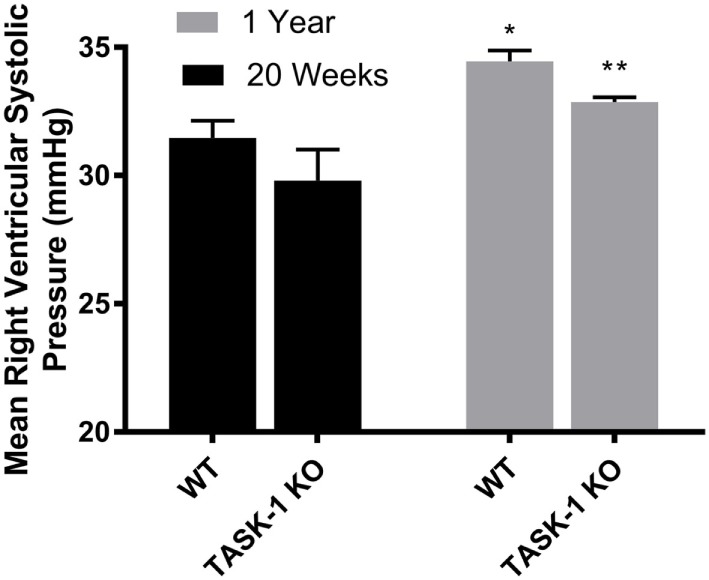
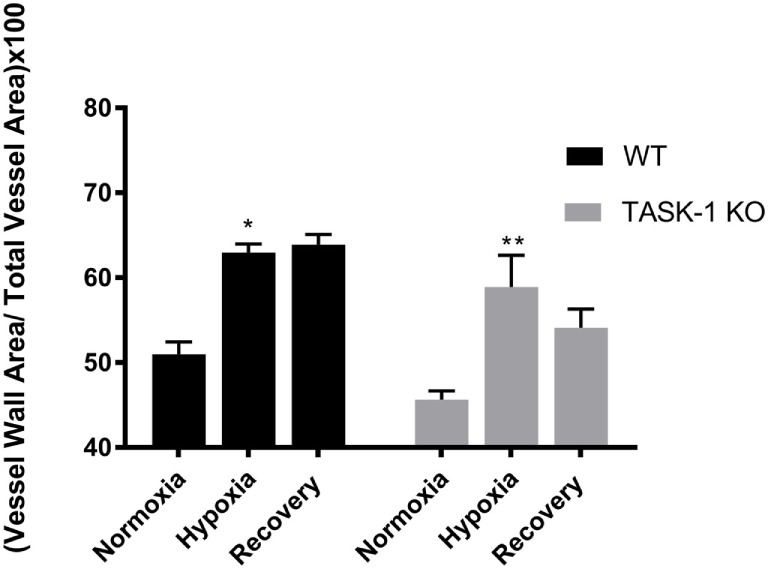
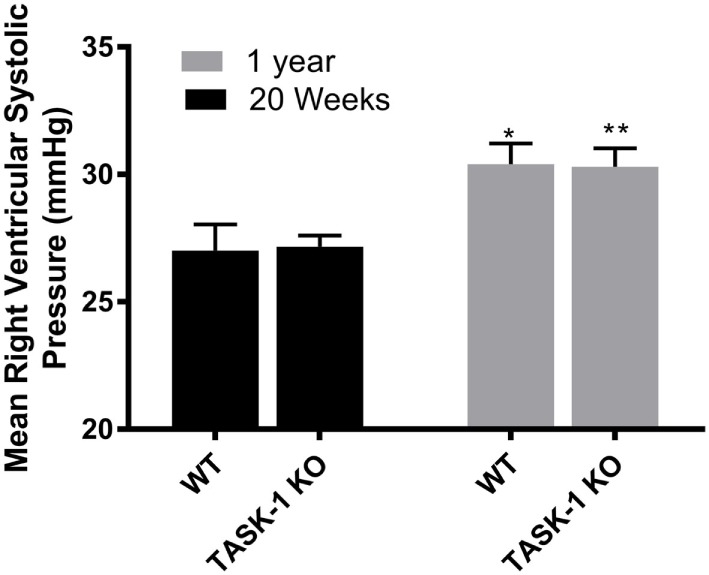
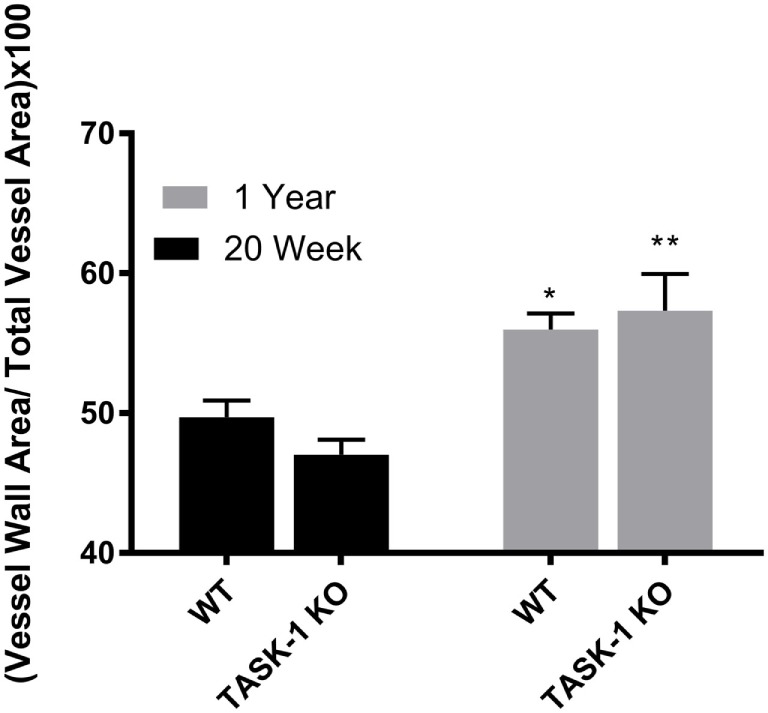
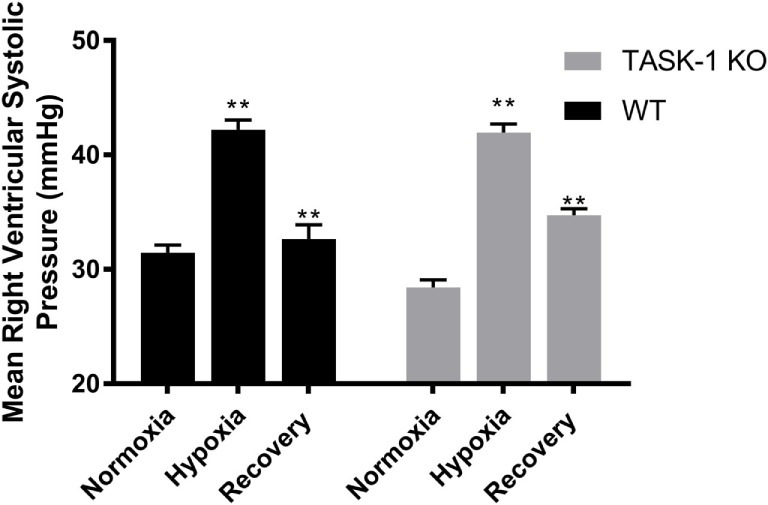
RVSP was similar between WT and TASK mice. Male and female WT and TASK-1 mice all demonstrated age-related increases in RVSP, which correlated to age-related vascular remodeling in male mice but not in female mice. Male TASK-1 and WT mice exposed to chronic hypoxia demonstrated increased RVSP, which decreased following room air recovery. WT and TASK-1 male mice demonstrated vascular remodeling upon exposure to hypoxia that persisted in room air recovery.
Female and male TASK-1 mice do not develop hemodynamic or vascular evidence for PH, but RVSP rises in an age-dependent manner independent of genotype. TASK-1 and WT male mice develop hypoxia-induced elevations in RVSP that decrease to baseline after recovery in room air. TASK-1 and WT male mice demonstrate vascular remodeling after exposure to hypoxia that persists despite recovery to room air conditions and does not correlate with RVSP normalization.
肺动脉高压(PH)伴有显著的发病率和死亡率,其潜在的分子机制尚未完全明确。TASK-1钾通道功能丧失突变与人类肺动脉高压相关。尽管在肺动脉高压的研究中已经考虑TASK-1超过十年,但对TASK-1基因敲除小鼠的特征描述仅限于在孤立时间点于室内空气中进行的研究。本研究有两个目的。首先,我们试图确定TASK基因敲除的雄性和雌性小鼠在一年时间内是否会发生肺动脉高压。其次,我们试图确定慢性低氧(一种肺动脉高压刺激因素)及其恢复对TASK-1基因敲除小鼠肺动脉高压的影响。
我们在不同时间点测量了雄性和雌性C57BL/6野生型(WT)和TASK-1基因敲除小鼠的右心室收缩压(RVSP)和血管重塑情况:20 - 24周龄和1岁时。此外,我们还测量了13 - 16周龄暴露于10%低氧环境3周后再恢复到室内空气环境6周的TASK-1基因敲除小鼠和野生型小鼠的RVSP和血管重塑情况。
野生型小鼠和TASK基因敲除小鼠的RVSP相似。雄性和雌性野生型及TASK-1基因敲除小鼠的RVSP均随年龄增长而升高,这与雄性小鼠年龄相关的血管重塑相关,但与雌性小鼠无关。暴露于慢性低氧的雄性TASK-1基因敲除小鼠和野生型小鼠的RVSP升高,在恢复到室内空气环境后降低。野生型和TASK-1基因敲除的雄性小鼠在暴露于低氧后出现血管重塑,在恢复到室内空气环境后仍持续存在。
雌性和雄性TASK-1基因敲除小鼠未出现肺动脉高压的血流动力学或血管方面证据,但RVSP以与基因型无关的年龄依赖性方式升高。TASK-1基因敲除和野生型雄性小鼠在低氧诱导下RVSP升高,恢复到室内空气环境后降至基线。TASK-1基因敲除和野生型雄性小鼠在暴露于低氧后出现血管重塑,尽管恢复到室内空气环境仍持续存在,且与RVSP恢复正常无关。