Institute of Immunology and Infection Research, University of Edinburgh, Ashworth Laboratories, Charlotte Auerbach Road, Edinburgh, EH9 3FL, UK.
Leeds Institute of Cancer and Pathology, University of Leeds, Wellcome Trust Brenner Building, St James's University Hospital, Leeds, LS9 7TF, UK.
Nat Commun. 2017 Nov 7;8(1):1343. doi: 10.1038/s41467-017-01427-1.
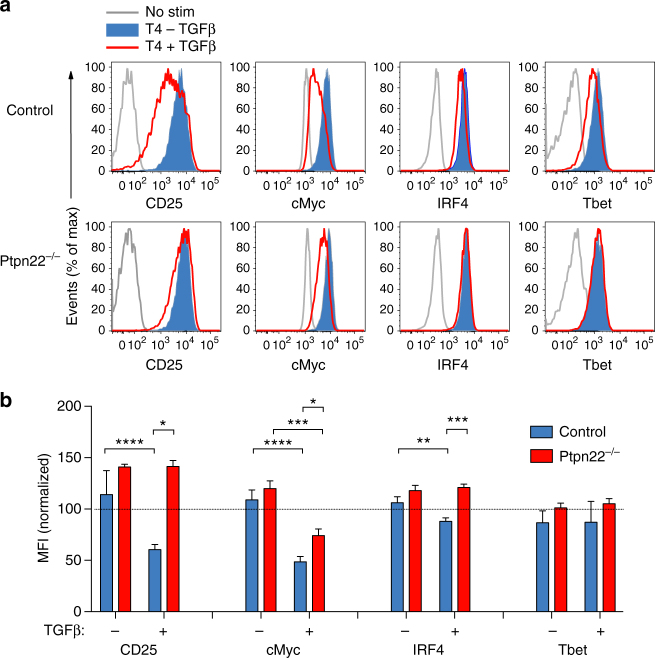
Transforming growth factor β (TGFβ) is important in maintaining self-tolerance and inhibits T cell reactivity. We show that CD8 T cells that lack the tyrosine phosphatase Ptpn22, a major predisposing gene for autoimmune disease, are resistant to the suppressive effects of TGFβ. Resistance to TGFβ suppression, while disadvantageous in autoimmunity, helps Ptpn22 T cells to be intrinsically superior at clearing established tumors that secrete TGFβ. Mechanistically, loss of Ptpn22 increases the capacity of T cells to produce IL-2, which overcomes TGFβ-mediated suppression. These data suggest that a viable strategy to improve anti-tumor adoptive cell therapy may be to engineer tumor-restricted T cells with mutations identified as risk factors for autoimmunity.
转化生长因子β(TGFβ)在维持自身耐受和抑制 T 细胞反应方面很重要。我们表明,缺乏酪氨酸磷酸酶 Ptpn22 的 CD8 T 细胞对 TGFβ的抑制作用具有抗性,Ptpn22 是自身免疫疾病的主要易感基因。尽管 TGFβ抑制的抗性在自身免疫中是不利的,但它有助于 Ptpn22 T 细胞在清除分泌 TGFβ的已建立肿瘤方面具有内在优势。从机制上讲,Ptpn22 的缺失增加了 T 细胞产生 IL-2 的能力,从而克服了 TGFβ介导的抑制。这些数据表明,一种可行的策略是通过工程改造肿瘤特异性 T 细胞,使其具有作为自身免疫风险因素的突变,从而提高抗肿瘤过继细胞治疗的效果。