Robinson Bruce M, Larkina Maria, Bieber Brian, Kleophas Werner, Li Yun, Locatelli Francesco, McCullough Keith P, Nolen Jackie G, Port Friedrich K, Pisoni Ronald L
Arbor Research Collaborative for Health, 340 E. Huron, Suite 300, Ann Arbor, MI, 48104, USA.
University of Michigan, 1415 Washington Heights, Ann Arbor, MI, 48109, USA.
BMC Nephrol. 2017 Nov 9;18(1):330. doi: 10.1186/s12882-017-0745-9.
Anemia management protocols in hemodialysis (HD) units differ conspicuously regarding optimal intravenous (IV) iron dosing; consequently, patients receive markedly different cumulative exposures to IV iron and erythropoiesis-stimulating agents (ESAs). Complementary to IV iron safety studies, our goal was to gain insight into optimal IV iron dosing by estimating the effects of IV iron doses on Hgb, TSAT, ferritin, and ESA dose in common clinical practice.
9,471 HD patients (11 countries, 2009-2011) in the DOPPS, a prospective cohort study, were analyzed. Associations of IV iron dose (3-month average, categorized as 0, <300, ≥300 mg/month) with 3-month change in Hgb, TSAT, ferritin, and ESA dose were evaluated using adjusted GEE models.
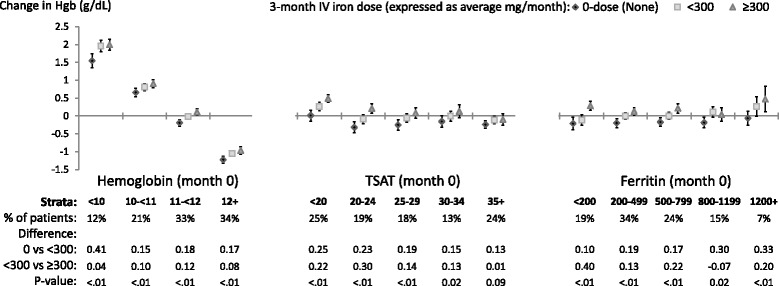
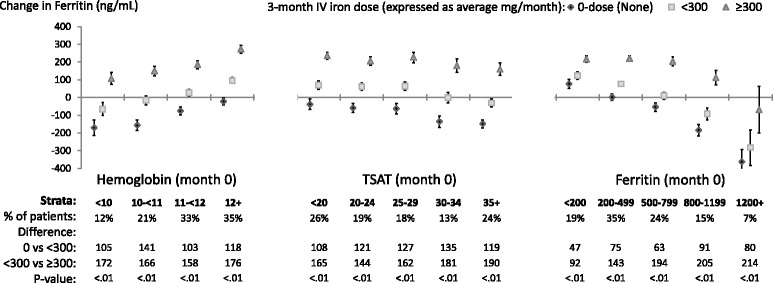
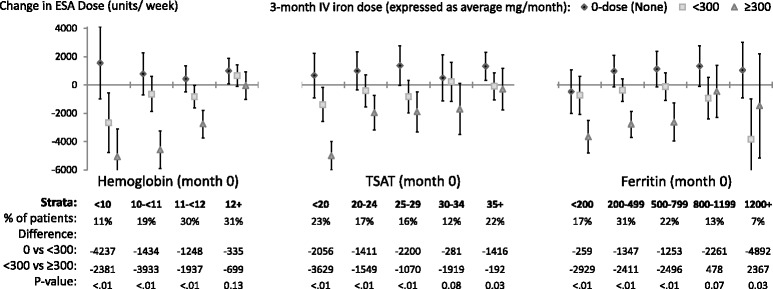
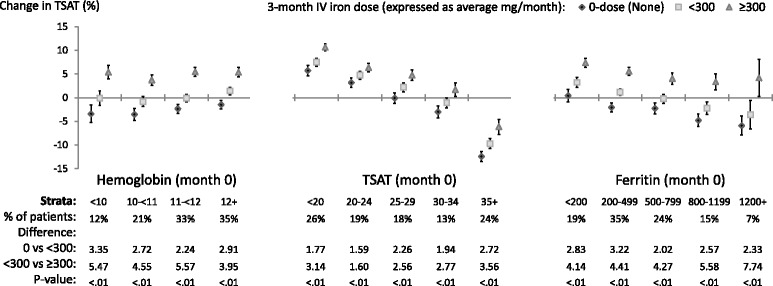
Relative change: Monotonically positive associations between IV iron dose and Hgb, TSAT, and ferritin change, and inverse associations with ESA dose change, were observed across multiple strata of prior Hgb, TSAT, and ferritin levels. Absolute change: TSAT, ferritin, and ESA dose changes were nearest zero with IV iron <300 mg/month, rather than 0 mg/month or ≥300 mg/month by maintenance or replacement dosing. Findings were robust to numerous sensitivity analyses.
Though residual confounding cannot be ruled out in this observational study, findings suggest that IV iron dosing <300 mg/month, as commonly seen with maintenance dosing of 100-200 mg/month, may be a more effective approach to support Hgb than the higher IV iron doses (300-400 mg/month) often given in many European and North American hemodialysis clinics. Alongside studies supporting the safety of IV iron in 100-200 mg/month dose range, these findings help guide the rational dosing of IV iron in anemia management protocols for everyday hemodialysis practice.
血液透析(HD)单位的贫血管理方案在最佳静脉注射(IV)铁剂剂量方面存在显著差异;因此,患者接受的静脉注射铁剂和促红细胞生成素(ESA)的累积暴露量明显不同。作为静脉注射铁剂安全性研究的补充,我们的目标是通过估计静脉注射铁剂剂量对血红蛋白(Hgb)、转铁蛋白饱和度(TSAT)、铁蛋白和ESA剂量在常见临床实践中的影响,深入了解最佳静脉注射铁剂剂量。
对前瞻性队列研究DOPPS中的9471名HD患者(11个国家,2009 - 2011年)进行分析。使用调整后的广义估计方程(GEE)模型评估静脉注射铁剂剂量(3个月平均值,分类为0、<300、≥300毫克/月)与Hgb、TSAT、铁蛋白和ESA剂量的3个月变化之间的关联。
相对变化:在先前Hgb、TSAT和铁蛋白水平的多个分层中,观察到静脉注射铁剂剂量与Hgb、TSAT和铁蛋白变化之间呈单调正相关,与ESA剂量变化呈负相关。绝对变化:通过维持或补充给药,静脉注射铁剂<300毫克/月时,TSAT、铁蛋白和ESA剂量变化最接近零,而不是0毫克/月或≥300毫克/月。研究结果在众多敏感性分析中都很稳健。
尽管在这项观察性研究中不能排除残余混杂因素,但研究结果表明,每月静脉注射铁剂剂量<300毫克,如常见的每月100 - 200毫克维持剂量,可能比许多欧洲和北美血液透析诊所经常给予的较高静脉注射铁剂剂量(300 - 400毫克/月)更有效地支持血红蛋白水平。除了支持每月100 - 200毫克剂量范围内静脉注射铁剂安全性的研究外,这些发现有助于指导日常血液透析实践中贫血管理方案中铁剂的合理给药。