Jin He, Liu Liangping, Ding Hui, He Miao, Zhang Chi, Zhong Xingwu
State Key Laboratory of Ophthalmology, Zhongshan Ophthalmic Center, Sun Yat-sen University, Guangzhou, 510060, China.
Hainan Eye Hospital, Hainan Key Laboratory of Ophthalmology, Zhongshan Ophthalmic Center, Sun Yat-sen University, Haikou, 570000, China.
BMC Ophthalmol. 2017 Nov 9;17(1):202. doi: 10.1186/s12886-017-0595-z.
In our previous study, we showed that both allogeneic and autogeneic small-incision femtosecond laser-assisted corneal intrastromal transplantation are safe and effective surgeries. However, the results of small-incision femtosecond laser-assisted intrastromal xenotransplantation have not yet been explored. Additionally, we suggest that glycerol-dehydrated corneal lamellae might provide a possible alternative for this xenogenic implantation approach.
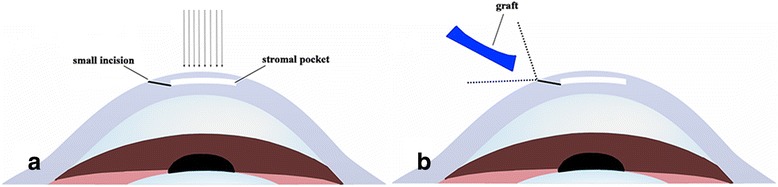
Corneal inlay lamellae were produced from rabbits and humans using femtosecond laser-assisted surgeries and were dehydrated in glycerol for 1 week at 4 °C. These xenogeneic glycerol-dehydrated grafts and fresh allogeneic monkey lamellae were then implanted into rhesus monkeys using small-incision femtosecond laser assistance. Postoperatively, clinical examinations, AS-OCT measurements and tear inflammatory mediator assays were performed.
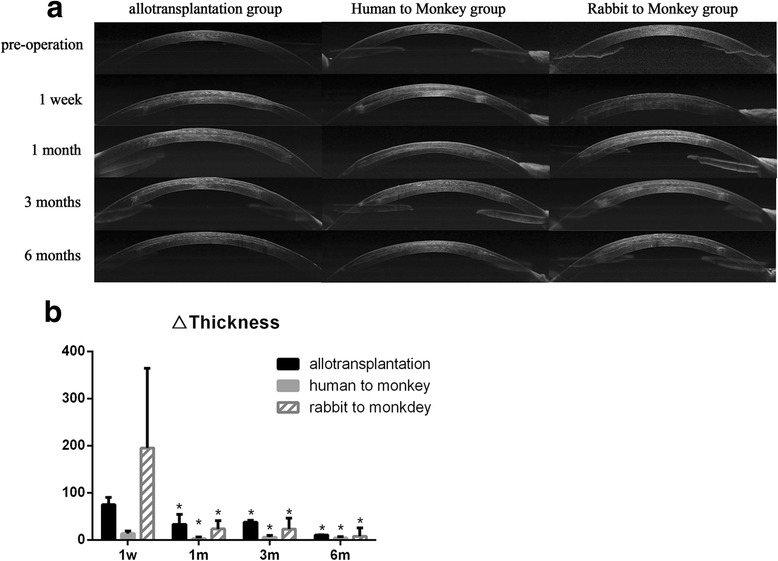
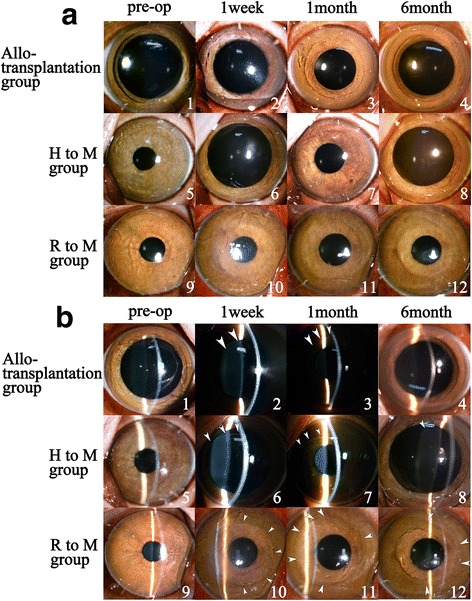
There were no significant changes in the transparency of the corneal lamellae after glycerol dehydration. Following implantation, no evidence of tissue rejection or severe inflammatory responses was observed in the monkeys, and the host corneas remained transparent throughout a 6-month observation period. The grafts were clearly visible via AS-OCT. Corneal thickness increased 1 week postoperatively but subsequently declined and remained unchanged 1 month after surgery. Significant changes were observed in all tear inflammatory mediators in the 'Rabbit to Monkey' group. The trends in changes of tear inflammatory mediators in the 'Human to Monkey' group were similar to those in the 'Rabbit to Monkey' group. At 1 month post-surgery, the levels of most tear inflammatory mediators had decreased, with the exception of IL-1β, TGF-β1 and IFN-γ in the allotransplantation group.
Small-incision femtosecond laser-assisted intrastromal transplantation minimized invasiveness and improved surgical efficiency. In addition, the host cornea maintained a high level of biocompatibility. Glycerol-dehydrated corneal lamellae might be potentially useful as an alternative inlay xenogeneic material. In this study, we also describe a new treatment that can be used in keratoconus, corneal ectasia, presbyopia, hyperpresbyopia and other diseases.
在我们之前的研究中,我们表明同种异体和自体小切口飞秒激光辅助角膜基质内移植都是安全有效的手术。然而,小切口飞秒激光辅助角膜基质内异种移植的结果尚未得到探索。此外,我们认为甘油脱水角膜片可能为这种异种植入方法提供一种可能的替代方案。
使用飞秒激光辅助手术从兔子和人类身上制作角膜嵌片,并在4℃的甘油中脱水1周。然后使用小切口飞秒激光辅助将这些异种甘油脱水移植物和新鲜的同种异体猴角膜片植入恒河猴体内。术后进行临床检查、AS-OCT测量和泪液炎症介质检测。
甘油脱水后角膜片的透明度没有明显变化。植入后,猴子未观察到组织排斥或严重炎症反应的迹象,并且在6个月的观察期内宿主角膜保持透明。通过AS-OCT可以清楚地看到移植物。术后1周角膜厚度增加,但随后下降,术后1个月保持不变。“兔到猴”组所有泪液炎症介质均观察到显著变化。“人到猴”组泪液炎症介质的变化趋势与“兔到猴”组相似。术后1个月,除同种异体移植组中的IL-1β、TGF-β1和IFN-γ外,大多数泪液炎症介质水平均下降。
小切口飞秒激光辅助角膜基质内移植将侵袭性降至最低并提高了手术效率。此外,宿主角膜保持了高度的生物相容性。甘油脱水角膜片可能作为一种替代的异种嵌片材料具有潜在用途。在本研究中,我们还描述了一种可用于圆锥角膜、角膜扩张、老花眼、超高度老花眼和其他疾病的新治疗方法。