Research Institute of Pancreatic Disease, Ruijin Hospital, School of Medicine, Shanghai Jiao Tong University, Shanghai, China.
Pancreatic Disease Centre, Ruijin Hospital, School of Medicine, Shanghai Jiao Tong University, Shanghai, China.
Mol Cancer. 2017 Nov 9;16(1):169. doi: 10.1186/s12943-017-0738-0.
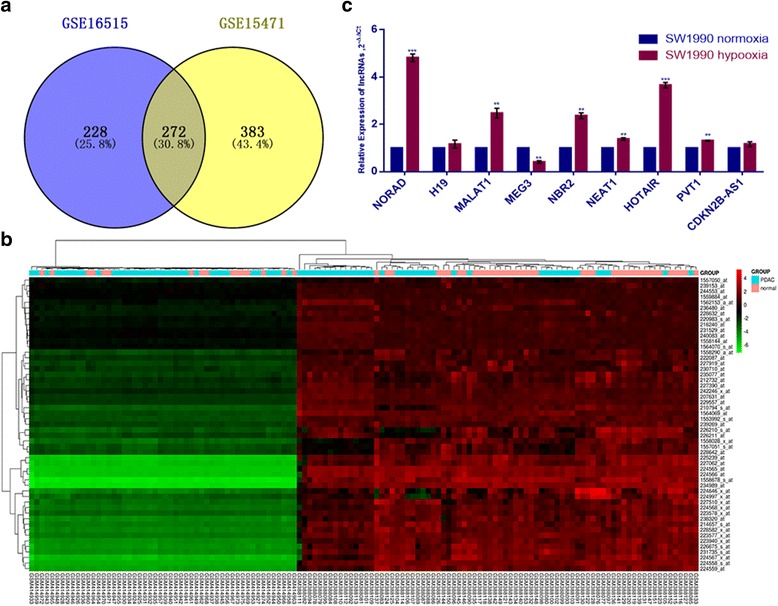
Pancreatic cancer, one of the top two most fatal cancers, is characterized by a desmoplastic reaction that creates a dense microenvironment, promoting hypoxia and inducing the epithelial-to-mesenchymal transition (EMT) to facilitate invasion and metastasis. Recent evidence indicates that the long noncoding RNA NORAD may be a potential oncogenic gene and that this lncRNA is significantly upregulated during hypoxia. However, the overall biological role and clinical significance of NORAD remains largely unknown.
NORAD expression was measured in 33 paired cancerous and noncancerous tissue samples by real-time PCR. The effects of NORAD on pancreatic cancer cells were studied by overexpression and knockdown in vitro. Insights into the mechanism of competitive endogenous RNAs (ceRNAs) were gained from bioinformatics analyses and luciferase assays. In vivo, metastatic potential was identified using an orthotopic model of PDAC and quantified using bioluminescent signals. Alterations in RhoA expression and EMT levels were identified and verified by immunohistochemistry and Western blotting.
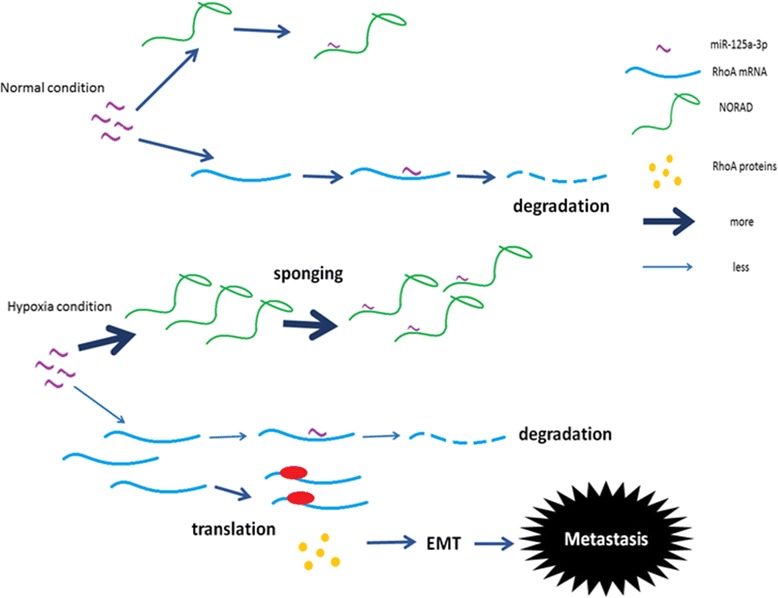
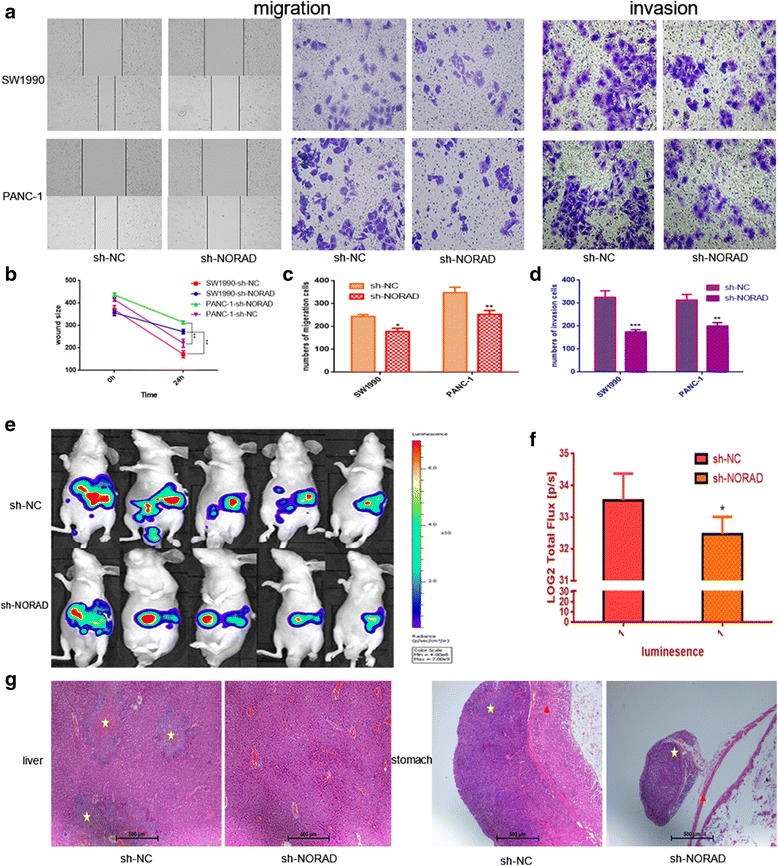
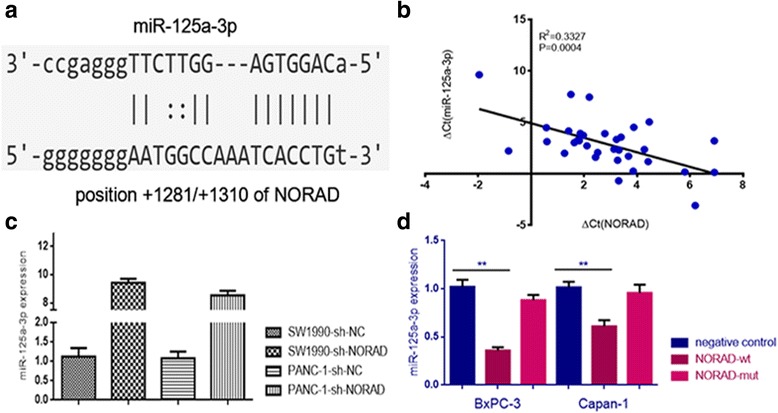
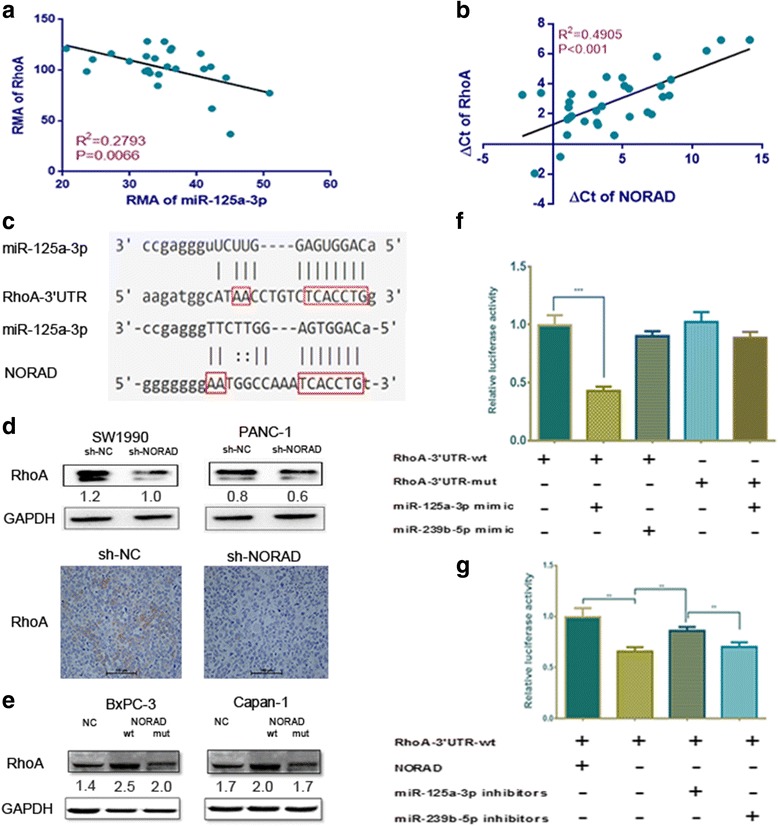
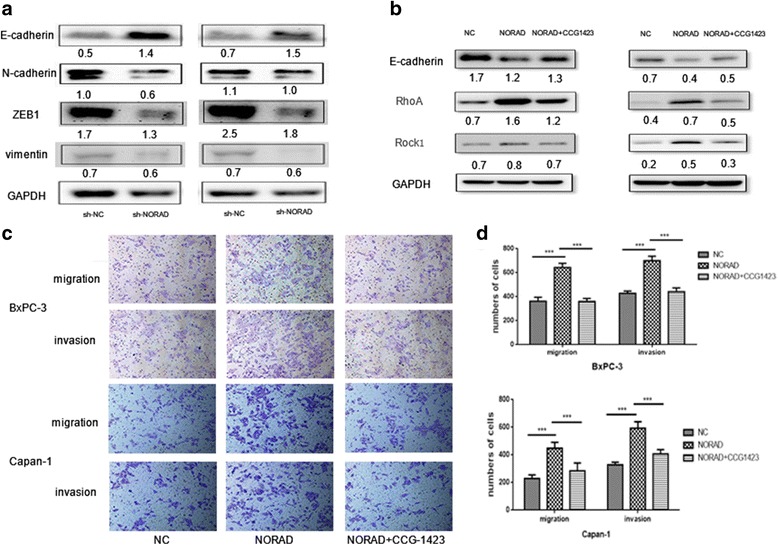
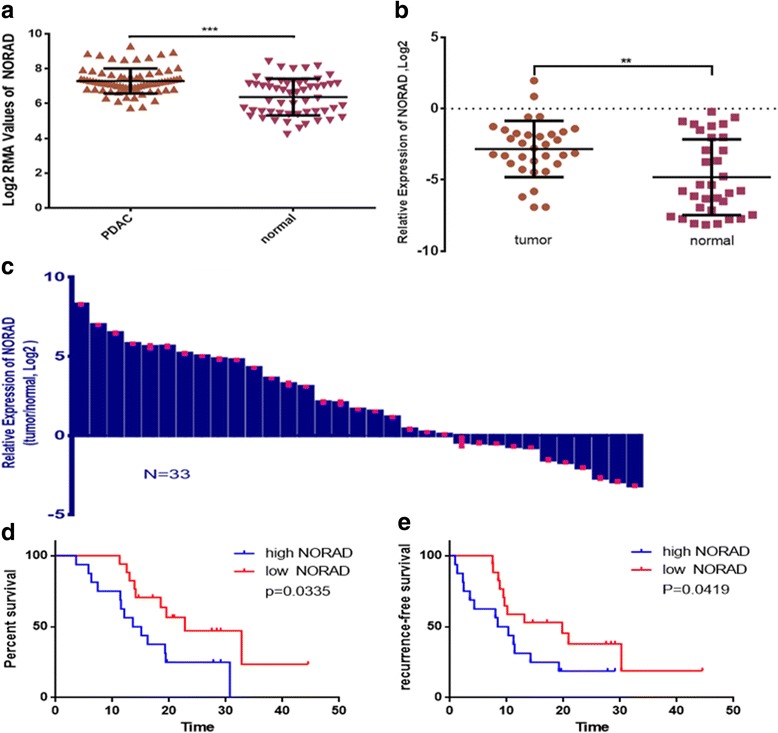
NORAD is highly expressed in pancreatic cancer tissues and upregulated in hypoxic conditions. NORAD upregulation is correlated with shorter overall survival in pancreatic cancer patients. Furthermore, NORAD overexpression promoted the migration and invasion of pancreatic carcinoma cells, while NORAD depletion inhibited EMT and metastasis in vitro and in vivo. In particular, NORAD may function as a ceRNA to regulate the expression of the small GTP binding protein RhoA through competition for hsa-miR-125a-3p, thereby promoting EMT.
Elevated expression of NORAD in pancreatic cancer tissues is linked to poor prognosis and may confer a malignant phenotype upon tumor cells. NORAD may function as a ceRNA to regulate the expression of the small GTP binding protein RhoA through competition for hsa-miR-125a-3p. This finding may contribute to a better understanding of the role played by lncRNAs in hypoxia-induced EMT and provide a potential novel diagnostic and therapeutic target for pancreatic cancer.
胰腺癌是致死率最高的两种癌症之一,其特征是形成致密的微环境的促结缔组织反应,从而导致缺氧,并诱导上皮间质转化(EMT)以促进侵袭和转移。最近的证据表明,长链非编码 RNA NORAD 可能是一种潜在的致癌基因,并且这种 lncRNA 在缺氧时显著上调。然而,NORAD 的整体生物学作用和临床意义在很大程度上仍不清楚。
通过实时 PCR 测量 33 对癌组织和非癌组织样本中的 NORAD 表达。通过体外过表达和敲低研究 NORAD 对胰腺癌细胞的影响。通过生物信息学分析和荧光素酶测定获得竞争性内源性 RNA(ceRNA)机制的见解。在体内,使用 PDAC 的原位模型鉴定转移潜力,并使用生物发光信号进行量化。通过免疫组化和 Western blot 鉴定和验证 RhoA 表达和 EMT 水平的改变。
NORAD 在胰腺癌组织中高表达,并在缺氧条件下上调。NORAD 的上调与胰腺癌患者的总生存期缩短相关。此外,NORAD 过表达促进胰腺癌细胞的迁移和侵袭,而 NORAD 耗竭则抑制 EMT 和体外及体内转移。特别是,NORAD 可能作为 ceRNA 通过竞争 hsa-miR-125a-3p 来调节小 GTP 结合蛋白 RhoA 的表达,从而促进 EMT。
胰腺癌组织中 NORAD 的高表达与不良预后相关,并且可能赋予肿瘤细胞恶性表型。NORAD 可能作为 ceRNA 通过竞争 hsa-miR-125a-3p 来调节小 GTP 结合蛋白 RhoA 的表达。这一发现可能有助于更好地理解 lncRNA 在缺氧诱导的 EMT 中的作用,并为胰腺癌提供潜在的新的诊断和治疗靶点。