Jobe Ousman, Kim Jiae, Tycksen Eric, Onkar Sayali, Michael Nelson L, Alving Carl R, Rao Mangala
U.S. Military HIV Research Program, Henry M. Jackson Foundation for the Advancement of Military Medicine, Bethesda, MD, United States.
Laboratory of Adjuvant and Antigen Research, U.S. Military HIV Research Program, Walter Reed Army Institute of Research, Silver Spring, MD, United States.
Front Immunol. 2017 Oct 23;8:1352. doi: 10.3389/fimmu.2017.01352. eCollection 2017.
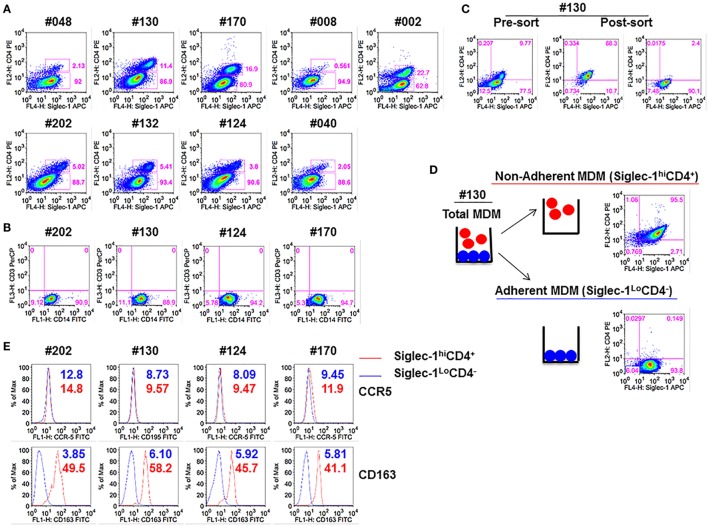
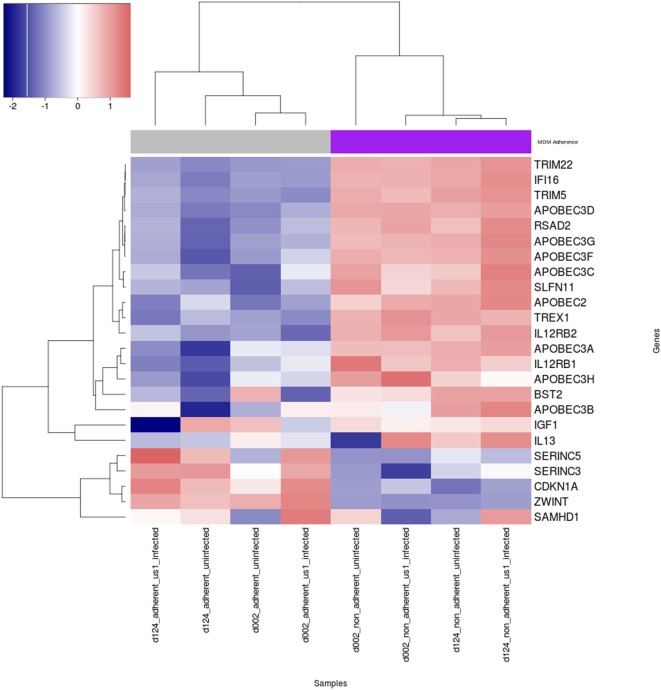
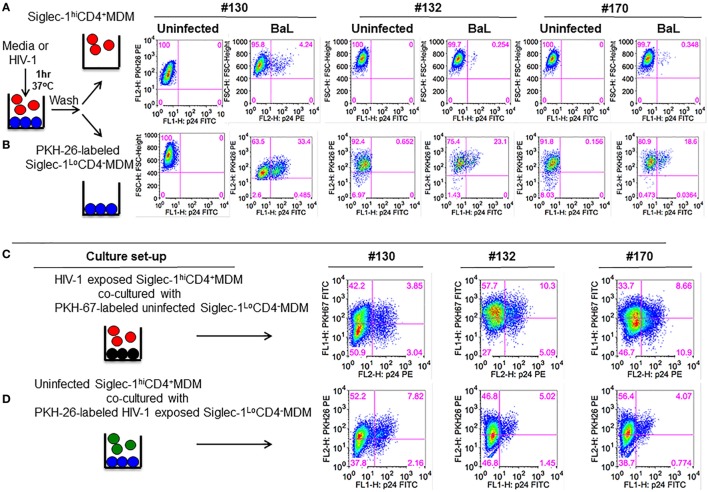
Macrophages are a major target for human immunodeficiency virus type 1 (HIV-1) infection. However, macrophages are largely heterogeneous and may exhibit differences in permissiveness to HIV-1 infection. This study highlights the interplay of macrophage heterogeneity in HIV-1 pathogenesis. We show that monocyte-derived macrophages (MDMs) could be divided into two distinct subsets: CD14Siglec-1CD4 (non-adherent MDM) and CD14Siglec-1CD4 (adherent MDM). The CD14Siglec-1CD4MDM subset represented the smaller proportion in the macrophage pool, and varied among different donors. Fractionation and subsequent exposure of the two MDM subsets to HIV-1 revealed opposite outcomes in terms of HIV-1 capture and infection. Although the CD14Siglec-1CD4MDM captured significantly more HIV-1, infection was significantly higher in the CD14Siglec-1CD4MDM subset. Thus, CD14Siglec-1CD4MDM were less permissive to infection. Depletion of CD14Siglec-1CD4MDM or a decrease in their percentage, resulted in increased infection of MDM, suggestive of a capacity of these cells to capture and sequester HIV-1 in an environment that hinders its infectivity. Increased expression of innate restriction factors and cytokine genes were observed in the non-adherent CD14Siglec-1CD4MDM, both before and after HIV-1 infection, compared to the adherent CD14Siglec-1CD4MDM. We speculate that the differential expression of gene expression profiles in the two macrophage subsets may provide an explanation for the differences observed in HIV-1 infectivity.
巨噬细胞是1型人类免疫缺陷病毒(HIV-1)感染的主要靶细胞。然而,巨噬细胞在很大程度上是异质性的,并且在对HIV-1感染的易感性方面可能存在差异。本研究强调了巨噬细胞异质性在HIV-1发病机制中的相互作用。我们发现,单核细胞衍生的巨噬细胞(MDM)可分为两个不同的亚群:CD14Siglec-1CD4(非黏附性MDM)和CD14Siglec-1CD4(黏附性MDM)。CD14Siglec-1CD4MDM亚群在巨噬细胞池中所占比例较小,且在不同供体之间存在差异。将这两个MDM亚群分离并随后暴露于HIV-1后,在HIV-1捕获和感染方面呈现出相反的结果。虽然CD14Siglec-1CD4MDM捕获的HIV-1明显更多,但CD14Siglec-1CD4MDM亚群中的感染率明显更高。因此,CD14Siglec-1CD4MDM对感染的易感性较低。去除CD14Siglec-1CD4MDM或其百分比降低会导致MDM感染增加,这表明这些细胞有能力在一个阻碍其感染性的环境中捕获和隔离HIV-1。与黏附性CD14Siglec-1CD4MDM相比,在HIV-1感染之前和之后,非黏附性CD14Siglec-1CD4MDM中均观察到固有限制因子和细胞因子基因的表达增加。我们推测,两个巨噬细胞亚群中基因表达谱的差异表达可能为观察到的HIV-1感染性差异提供了解释。