Soultan Alaaeldin, Safi Kamran
Max Planck Institute for Ornithology, Department of Migration and Immuno-ecology, Am Obstberg 1, Radolfzell, Germany.
University of Konstanz, Department of Biology, Universitätsstraße 10, Konstanz, Germany.
PLoS One. 2017 Nov 13;12(11):e0187906. doi: 10.1371/journal.pone.0187906. eCollection 2017.
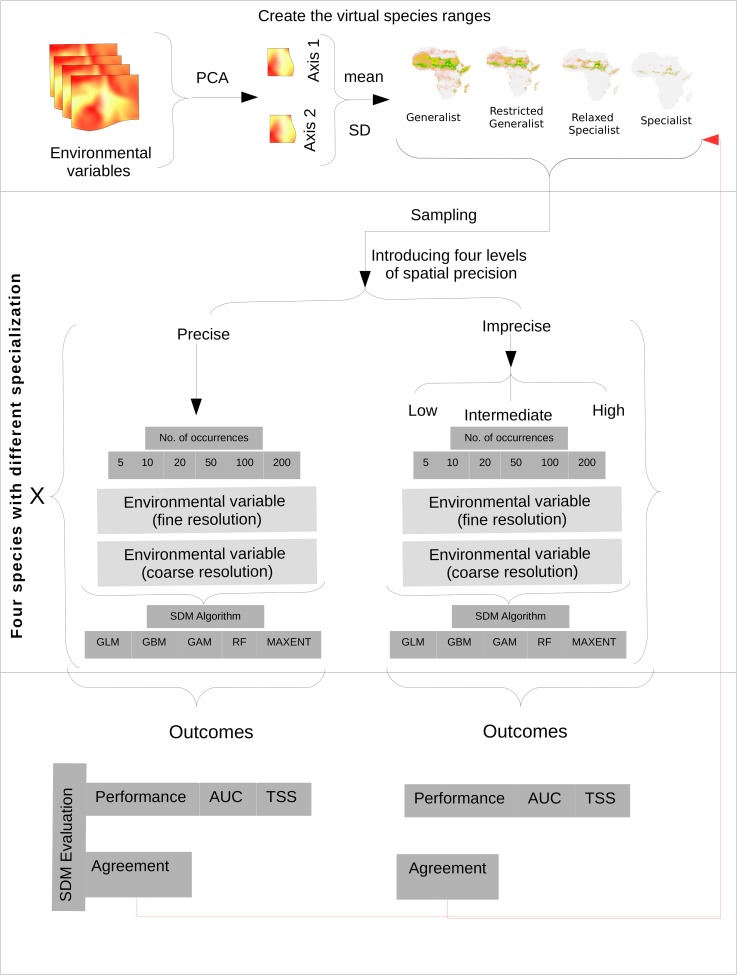
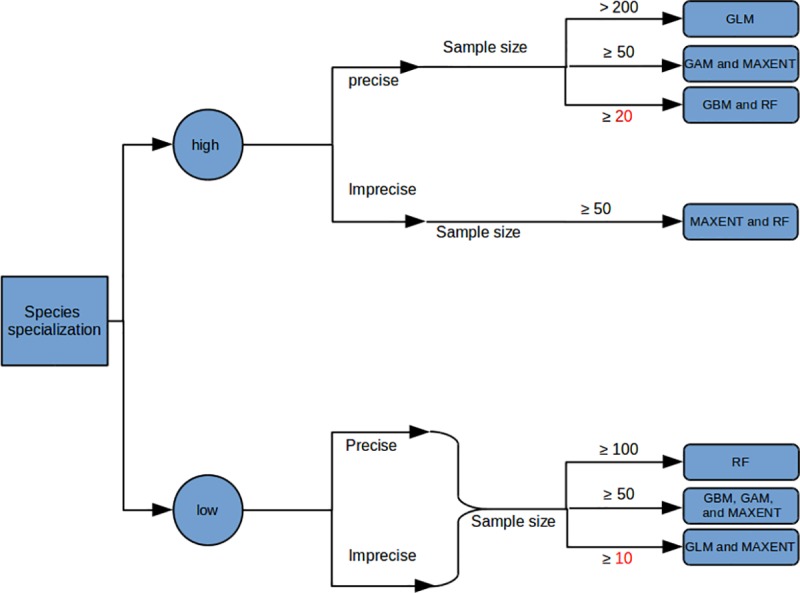
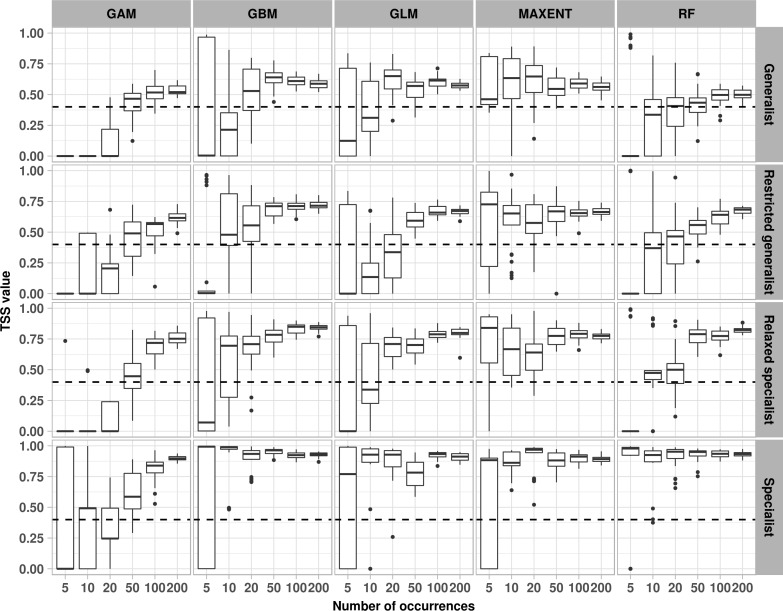
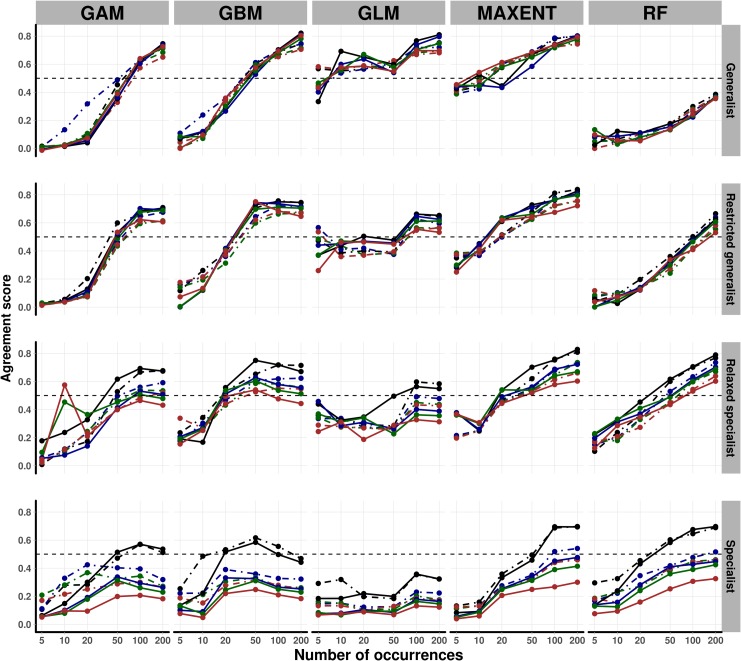
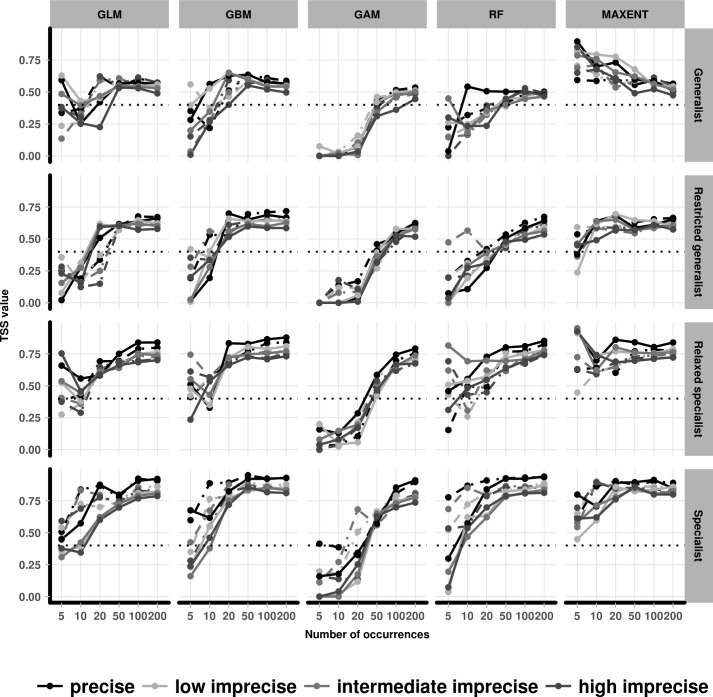
Digitized species occurrence data provide an unprecedented source of information for ecologists and conservationists. Species distribution model (SDM) has become a popular method to utilise these data for understanding the spatial and temporal distribution of species, and for modelling biodiversity patterns. Our objective is to study the impact of noise in species occurrence data (namely sample size and positional accuracy) on the performance and reliability of SDM, considering the multiplicative impact of SDM algorithms, species specialisation, and grid resolution. We created a set of four 'virtual' species characterized by different specialisation levels. For each of these species, we built the suitable habitat models using five algorithms at two grid resolutions, with varying sample sizes and different levels of positional accuracy. We assessed the performance and reliability of the SDM according to classic model evaluation metrics (Area Under the Curve and True Skill Statistic) and model agreement metrics (Overall Concordance Correlation Coefficient and geographic niche overlap) respectively. Our study revealed that species specialisation had by far the most dominant impact on the SDM. In contrast to previous studies, we found that for widespread species, low sample size and low positional accuracy were acceptable, and useful distribution ranges could be predicted with as few as 10 species occurrences. Range predictions for narrow-ranged species, however, were sensitive to sample size and positional accuracy, such that useful distribution ranges required at least 20 species occurrences. Against expectations, the MAXENT algorithm poorly predicted the distribution of specialist species at low sample size.
数字化的物种出现数据为生态学家和保护主义者提供了前所未有的信息来源。物种分布模型(SDM)已成为一种流行的方法,用于利用这些数据来理解物种的时空分布,并对生物多样性模式进行建模。我们的目标是研究物种出现数据中的噪声(即样本大小和位置精度)对SDM性能和可靠性的影响,同时考虑SDM算法、物种专业化和网格分辨率的乘积影响。我们创建了一组四个具有不同专业化水平特征的“虚拟”物种。对于每个物种,我们在两种网格分辨率下使用五种算法构建了适宜栖息地模型,样本大小不同且位置精度水平各异。我们分别根据经典模型评估指标(曲线下面积和真实技能统计量)和模型一致性指标(总体一致性相关系数和地理生态位重叠)评估了SDM的性能和可靠性。我们的研究表明,物种专业化对SDM的影响最为显著。与之前的研究不同,我们发现对于分布广泛的物种,低样本大小和低位置精度是可以接受的,仅10个物种出现记录就能预测出有用的分布范围。然而,对于分布范围狭窄的物种,范围预测对样本大小和位置精度很敏感,以至于有用的分布范围至少需要20个物种出现记录。与预期相反,MAXENT算法在低样本大小时对特化物种的分布预测不佳。