Department of Molecular Ecology, Max-Planck-Institute for Chemical Ecology, Hans-Knöll-Str. 8, D-07745, Jena, Germany.
Present address: Department of Plant and Microbial Biology, University of Zurich, Zollikerstrasse 107, CH-8008, Zurich, Switzerland.
BMC Plant Biol. 2017 Nov 13;17(1):199. doi: 10.1186/s12870-017-1149-5.
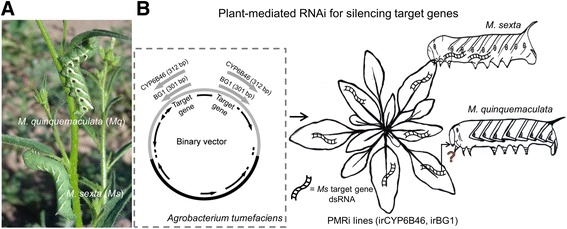
Plant-mediated RNAi (PMRi) silencing of insect genes has enormous potential for crop protection, but whether it works robustly under field conditions, particularly with lepidopteran pests, remains controversial. Wild tobacco Nicotiana attenuata and cultivated tobacco (N. tabacum) (Solanaceae) is attacked by two closely related specialist herbivores Manduca sexta and M. quinquemaculata (Lepidoptera, Sphingidae). When M. sexta larvae attack transgenic N. attenuata plants expressing double-stranded RNA(dsRNA) targeting M. sexta's midgut-expressed genes, the nicotine-ingestion induced cytochrome P450 monooxygenase (invert repeat (ir)CYP6B46-plants) and the lyciumoside-IV-ingestion induced β-glucosidase1 (irBG1-plants), these larval genes which are important for the larvae's response to ingested host toxins, are strongly silenced.
Here we show that the PMRi procedure also silences the homologous genes in native M. quinquemaculata larvae feeding on irCYP6B46 and irBG1-transgenic N. attenuata plants in nature. The PMRi lines shared 98 and 96% sequence similarity with M. quinquemaculata homologous coding sequences, and CYP6B46 and BG1 transcripts were reduced by ca. 90 and 80%, without reducing the transcripts of the larvae's most similar, potential off-target genes.
We conclude that the PMRi procedure can robustly and specifically silence genes in native congeneric insects that share sufficient sequence similarity and with the careful selection of targets, might protect crops from attack by congeneric-groups of insect pests.
植物介导的 RNAi(PMRi)沉默昆虫基因在作物保护方面具有巨大潜力,但它在田间条件下是否能稳健运行,特别是针对鳞翅目害虫,仍然存在争议。野生烟草 Nicotiana attenuata 和栽培烟草(N. tabacum)(茄科)受到两种密切相关的专食性草食性昆虫 Manduca sexta 和 M. quinquemaculata(鳞翅目,夜蛾科)的攻击。当 M. sexta 幼虫攻击表达靶向 M. sexta 中肠表达基因的双链 RNA(dsRNA)的转基因 N. attenuata 植物时,尼古丁摄入诱导的细胞色素 P450 单加氧酶(反向重复(ir)CYP6B46-植物)和茄碱-IV 摄入诱导的β-葡萄糖苷酶 1(irBG1-植物),这些幼虫基因对于幼虫对摄入的宿主毒素的反应非常重要,被强烈沉默。
在这里,我们表明 PMRi 程序还可以沉默在自然界中以 irCYP6B46 和 irBG1 转基因 N. attenuata 植物为食的本地 M. quinquemaculata 幼虫中的同源基因。PMRi 系与 M. quinquemaculata 同源编码序列具有 98%和 96%的序列相似性,CYP6B46 和 BG1 转录物分别减少了约 90%和 80%,而不减少幼虫最相似的潜在靶基因的转录物。
我们得出结论,PMRi 程序可以稳健且特异性地沉默具有足够序列相似性的本地同源昆虫中的基因,并且通过谨慎选择靶标,可能保护作物免受同种类群的害虫攻击。