Nitnavare Rahul B, Bhattacharya Joorie, Singh Satnam, Kour Amardeep, Hawkesford Malcolm J, Arora Naveen
Division of Plant and Crop Sciences, School of Biosciences, University of Nottingham, Nottingham, United Kingdom.
Department of Plant Science, Rothamsted Research, Harpenden, United Kingdom.
Front Plant Sci. 2021 Oct 18;12:673576. doi: 10.3389/fpls.2021.673576. eCollection 2021.
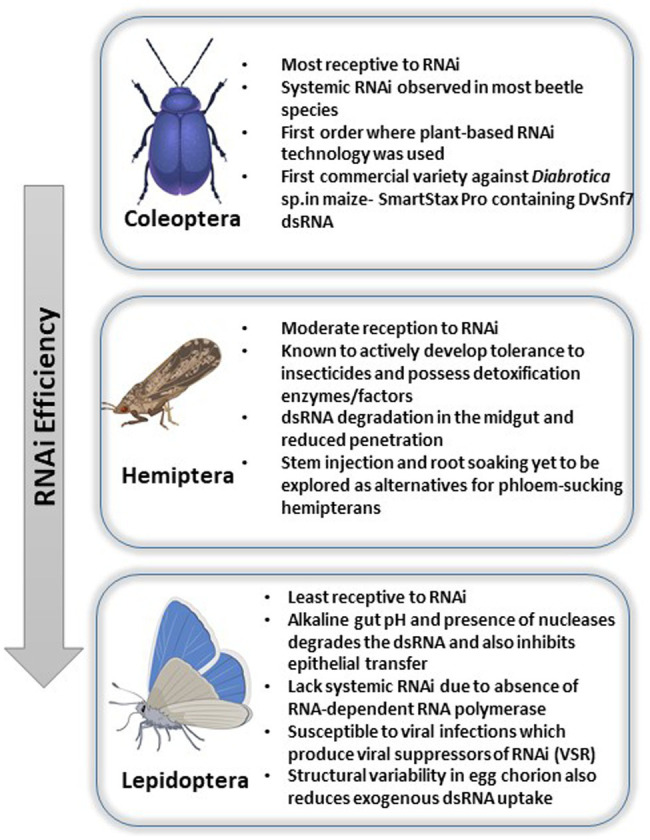
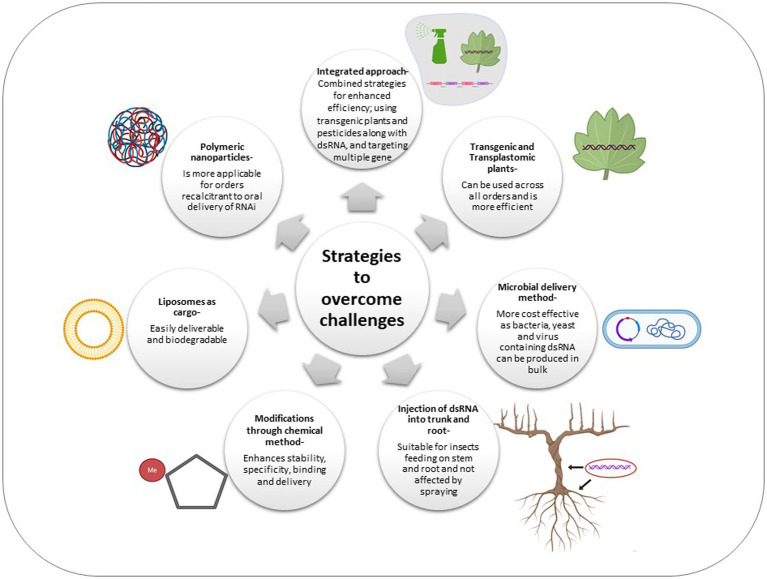
RNA interference (RNAi) is a method of gene silencing where dsRNA is digested into small interfering RNA (siRNA) in the presence of enzymes. These siRNAs then target homologous mRNA sequences aided by the RNA-induced silencing complex (RISC). The mechanism of dsRNA uptake has been well studied and established across many living organisms including insects. In insects, RNAi is a novel and potential tool to develop future pest management means targeting various classes of insects including dipterans, coleopterans, hemipterans, lepidopterans, hymenopterans and isopterans. However, the extent of RNAi in individual class varies due to underlying mechanisms. The present review focuses on three major insect classes hemipterans, lepidopterans and coleopterans and the rationale behind this lies in the fact that studies pertaining to RNAi has been extensively performed in these groups. Additionally, these classes harbour major agriculturally important pest species which require due attention. Interestingly, all the three classes exhibit varying levels of RNAi efficiencies with the coleopterans exhibiting maximum response, while hemipterans are relatively inefficient. Lepidopterans on the other hand, show minimum response to RNAi. This has been attributed to many facts and few important being endosomal escape, high activity dsRNA-specific nucleases, and highly alkaline gut environment which renders the dsRNA unstable. Various methods have been established to ensure safe delivery of dsRNA into the biological system of the insect. The most common method for dsRNA administration is supplementing the diet of insects spraying onto leaves and other commonly eaten parts of the plant. This method is environment-friendly and superior to the hazardous effects of pesticides. Another method involves submergence of root systems in dsRNA solutions and subsequent uptake by the phloem. Additionally, more recent techniques are nanoparticle- and -mediated delivery systems. However, due to the novelty of these biotechnological methods and recalcitrant nature of certain crops, further optimization is required. This review emphasizes on RNAi developments in agriculturally important insect species and the major hurdles for efficient RNAi in these groups. The review also discusses in detail the development of new techniques to enhance RNAi efficiency using liposomes and nanoparticles, transplastomics, microbial-mediated delivery and chemical methods.
RNA干扰(RNAi)是一种基因沉默方法,在酶的作用下,双链RNA(dsRNA)被消化成小干扰RNA(siRNA)。然后,这些siRNA在RNA诱导沉默复合体(RISC)的帮助下靶向同源mRNA序列。dsRNA的摄取机制已在包括昆虫在内的许多生物中得到充分研究和确立。在昆虫中,RNAi是一种新颖且有潜力的工具,可用于开发未来针对各类昆虫(包括双翅目、鞘翅目、半翅目、鳞翅目、膜翅目和等翅目)的害虫管理手段。然而,由于潜在机制的不同,RNAi在各个类别中的程度也有所不同。本综述聚焦于半翅目、鳞翅目和鞘翅目这三个主要昆虫类别,其依据在于针对RNAi在这些类群中已进行了广泛研究。此外,这些类别包含主要的具有农业重要性的害虫物种,需要给予应有关注。有趣的是,这三个类别均表现出不同程度的RNAi效率,其中鞘翅目表现出最大反应,而半翅目相对效率较低。另一方面,鳞翅目对RNAi的反应最小。这归因于许多因素,其中一些重要因素包括内体逃逸、高活性的dsRNA特异性核酸酶以及使dsRNA不稳定的高度碱性肠道环境。已建立了各种方法来确保dsRNA安全递送至昆虫的生物系统。最常见的dsRNA施用方法是将其添加到昆虫的食物中——喷洒在叶片和植物其他常见食用部位上。这种方法对环境友好,且优于农药的有害影响。另一种方法是将根系浸入dsRNA溶液中,随后由韧皮部吸收。此外,更新的技术是纳米颗粒介导的递送系统。然而,由于这些生物技术方法的新颖性以及某些作物的顽固特性,还需要进一步优化。本综述着重介绍了在具有农业重要性的昆虫物种中的RNAi进展以及这些类群中有效RNAi的主要障碍。综述还详细讨论了使用脂质体和纳米颗粒、转质体技术、微生物介导递送和化学方法来提高RNAi效率的新技术的发展。