Genome Sequencing and Analysis Program, Broad Institute, Cambridge, MA, USA.
Department of Biological Engineering, Massachusetts Institute of Technology (MIT), Cambridge, MA, USA.
Microbiome. 2017 Nov 13;5(1):148. doi: 10.1186/s40168-017-0368-1.
Colonization by the pathogen Clostridium difficile often occurs in the background of a disrupted microbial community. Identifying specific organisms conferring resistance to invasion by C. difficile is desirable because diagnostic and therapeutic strategies based on the human microbiota have the potential to provide more precision to the management and treatment of Clostridium difficile infection (CDI) and its recurrence.
We conducted a longitudinal study of adult patients diagnosed with their first CDI. We investigated the dynamics of the gut microbiota during antibiotic treatment, and we used microbial or demographic features at the time of diagnosis, or after treatment, to predict CDI recurrence. To check the validity of the predictions, a meta-analysis using a previously published dataset was performed.
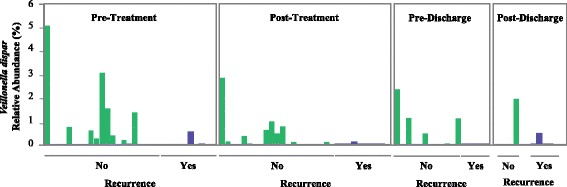
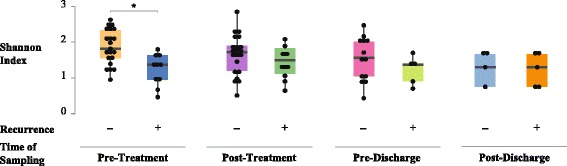
We observed that patients' microbiota "before" antibiotic treatment was predictive of disease relapse, but surprisingly, post-antibiotic microbial community is indistinguishable between patients that recur or not. At the individual OTU level, we identified Veillonella dispar as a candidate organism for preventing CDI recurrence; however, we did not detect a corresponding signal in the conducted meta-analysis.
Although in our patient population, a candidate organism was identified for negatively predicting CDI recurrence, results suggest the need for larger cohort studies that include patients with diverse demographic characteristics to generalize species that robustly confer colonization resistance against C. difficile and accurately predict disease relapse.
病原体艰难梭菌的定植常常发生在微生物群落紊乱的背景下。确定赋予对艰难梭菌侵袭抗性的特定生物体是可取的,因为基于人类微生物组的诊断和治疗策略有可能为艰难梭菌感染(CDI)及其复发的管理和治疗提供更高的精准度。
我们对诊断出首次 CDI 的成年患者进行了纵向研究。我们研究了抗生素治疗期间肠道微生物群的动态,并用诊断时或治疗后的微生物或人口统计学特征来预测 CDI 复发。为了检查预测的有效性,我们进行了一项荟萃分析,使用了以前发表的数据集。
我们观察到,患者抗生素治疗前的微生物群与疾病复发相关,但令人惊讶的是,抗生素治疗后的微生物群落在复发和不复发的患者之间无法区分。在个体 OTU 水平上,我们确定了韦荣氏球菌属(Veillonella dispar)作为预防 CDI 复发的候选生物;然而,我们在进行的荟萃分析中未检测到相应的信号。
尽管在我们的患者群体中,确定了一种候选生物可用于负向预测 CDI 复发,但结果表明需要进行更大规模的队列研究,包括具有不同人口统计学特征的患者,以推广能够对艰难梭菌产生定植抗性并准确预测疾病复发的物种。